Plain Pies and Battered Saveloys

A few weeks ago I was guest of honour at the ArcanaCon RPG convention in Melbourne. The Brown Dirt Cowboy came with me, and we took advantage of this unique chance to travel Down Under to tack a roadtrip on after the con. The whole thing was an amazing experience: we’re both still digesting what we did, and our waking and dreaming hours are beset by flashbacks and daydreams. So, in no particular order…
On the Wednesday we were driving north from Warrnambool and the Tower Hill crater, heading towards Halls Gap in Gariwerd, the Grampian Mountains. Suddenly this wasn’t the Great Ocean Road anymore – the hills gave way to a wide open country, brown grass and eucalyptus, and few cars and even fewer houses. Signs warned of kangaroos, but there was not a one: instead, black cows dotted the landscape, right up to the far horizon.
It was hot. The dashboard said 37 degrees. We were running out of gas. After an hour or two we passed a sign saying we were entering a town, Penshurst. This wasn’t immediately apparent to a European: I guess there was more than one house visible at a time, and all within half a mile of the road. Maybe that’s a town.
But then a crossroads, and a post office, and a petrol stand. That’s more like it. We had a couple of postcards to post, and we were both hungry, so the post office seemed like a good place to find another human. We got out the car – a sudden wave of heat on the street – and I dropped the cards in the post box. At that point the postman drove up to collect.
“Hello!”
“G’day.”
That was an awesome accent. I expect mine was to him, too.
“Can you recommend anywhere to get a spot of lunch around here?”
“Right well there’s the milk bar over there. They’ll sort you out.”
Having no idea what a milk bar was, we thanked the postman and drove to the petrol stand. First things first.
The petrol stand was bare bones and a mystery. No attendants, two pumps, one credit card machine, no instructions. The machine declined all our cards except HSBC – thankfully that worked. It also worked for a hapless German couple who were at a loss in a classic VW camper. “If I give you cash, can you buy for us some petrol?”
Hell yeah. Solidarity amongst roadtrippers – you didn’t want to be running out of petrol in this heat and in what for us was basically the middle of nowhere.
When we parked up at the milk bar the tarmac was melting in the heat. An old-timer in a mobility scooter in the shade said g’day. Inside, there was air conditioning, and a menu straight out of the 1950s. The place was a general store-cum-greasy spoon. Slightly surreally, given the 38 degrees outside, I ordered a big mug of milky tea.
“What’s a ‘plain pie’?” got a nonplussed look from the woman at the counter.
“It’s a pie with nothing else in it.”
“Nothing else but – ?”
“Meat.”
There it was. “I’ll have a plain pie please.”
Best greasy spoon meat pie I’ve had for years. Accompanied with a strawberry milkshake alongside my mug of tea. We were both still feeling a bit crook with the lurgy we’d picked up on the Emirates flight from Dubai, and were craving milk, eggs, cheese. Chris had a battered saveloy and a glass of milk. I wanted to lick my plate. It kind of felt like finding an ice cream van in the Sahara. Something so familiar in an environment that was so, so strange.
We fired up the SUV and rolled stickily from the melted tarmac into the main street. In less than a minute we were in baking empty grasslands again, our thoughts taking flight. And still no kangaroos.
Les Utopiales 2018
Les Utopiales 2018 sont terminées. J’ai passé 3 jours de rêve, me baignant dans la mer accueillante de la SF française. Partager nos passions et nos pensées, c’est sûrement une des meilleures expériences de la vie, et aux Utopiales on s’y abandonne. J’ai été tellement excitée par tous les échanges d’idées, par les expositions, les conférences, les discussions, par les moments de créativité où l’on se rassemble pour chuchoter les incantations, à partir desquelles s’embrasent des concepts nouveaux… J’ai été inspirée par la chance de participer à la conférence sur les nouveaux sens du transhumanisme avec Daniel Tron et Sylvie Denis, modérée par le merveilleux Claude Ecken – quelle rencontre ! Merci aussi à une salle comble pour votre soutien et votre enthouasiasme communicatif ! Et aussi de participer à la conférence sur le corps dans les jeux de rôle transhumanistes, avec Julien Pirou et Romain Mckilleron, modérée par Adrien Toulon, où l’on a célébré la fontaine de créativité et de passions qui est le monde des jeux de rôle.

Merci à Jeanne A Debats et Adelaïde Legrand pour votre invitation chaleureuse, à Roland Lehoucq et toute votre équipe pour votre travail herculéen, à Thierry Godérel et tous les bénévoles pour votre coordination et votre accueil, et à tous les écrivains, les lecteurs, les rolistes, les scientifiques, pour votre participation et votre amitié. C’était génial de revoir Pierre Gevart, Laurent Genefort, Adrian Tchaikovsky, François Froideval, Sybille Marchetto, Jérome, Dounia Charaf Thérond, Hélène Cruciani, Anouk Arnal, Éric Picholle, Ketty Steward, David Meulemans (brièvement !), Adrien Toulon, Manuel Bedouet, Julien Pouard, Thomas Meunier, Marc Sautriot, Samuel Tarapacki, Éric Mainguet, Marie, Ronan, Romain Mckilleron. C’était un grand plaisir de faire la connaissance de Raphaël Granier de Cassagnac, Julien Pirou, Olivier Cotte, Estelle Blanquet, Claude Ecken, Daniel Tron, Sylvie Denis, Jean-Philippe Mocci, Jérémy Guilbon, Eugénie, Erell Ceridwen. Merci à vous et à beaucoup d’autres, et un grand merci spécial à Pixel Somnium pour les photos. 🙂
Découverte littéraire du festival : la version française du roman d’Adrian Tchaikovsky qui a gagné le Prix Arthur C Clarke en 2016, “Dans la Toile du Temps”. Il est sorti en version française en avril 2018 – je le lis pour la première fois et je ne peux pas m’arrêter. Il est génial, je vous le recommande !
Des bises et du chaos,
Sarah
The Controlled Demolition of the Post-War Status Quo

The more I study history, the more I realise that what we see are just the reflections of geopolitical projects and forces of huge importance, planned and engineered behind closed doors and away from prying eyes. Even contemplating of the self-inflicted wounds which our civilisation seems to be gleefully indulging in makes it clear that what we’re seeing here is a controlled demolition of the post-war status quo, that brief blip in human history when it looked like democracy might have had a chance.
- Resource wars in Syria, Libya, the Caspian Basin.
- The use of such wars to create a refugee crisis which will destabilise states.
- The use of such destabilisation to generate and intensify a climate of fear.
- The election of Trump.
- Brexit.
- Brazil.
- But Europe was still a bastion of common sense. So now Merkel.
Was it all just an illusion? It’s almost as though someone is throwing as many black swans as they can find into the fire.
Multinationals and their cartels have had more power and resources and less accountability than nation states since at least the 1970s, and have happily manipulated world affairs to their own advantage – however that advantage might be defined. Their reaction to the democratising power of the internet has been to cynically undermine globalisation and to make it into a corporate asset stripping bonanza, and when peoples have tried to resist and complain, they’ve stoked the fires of international conflict to shut them up. It’s so easy to fire people up to mindless hatred on the rantings of demagogues.
That’s the tragedy of our civilisation. None of this collapse was ever necessary. The super-rich and powerful do not want to reform the international order, as that would require a redistribution of influence and resources to their personal disadvantage, however good it would be for the planet and for the rest of humankind. Their traditional solution is to blow everything up – in marketing-speak, “the creation of demand by destroying inventories and infrastructure”. That way, the starry-eyed dreamers and optimists end up so stunned and impoverished they have to spend two generations rebuilding and simply staying alive instead of agitating for progressive reform. They’re willing to pay for social inertia and hegemony with our blood.
And so the megabust-megaboom cycle churns relentlessly on, and fresh meat is needed for the grinder. We’ve got bullets to sell, lies to parade. As Chairman Mao said, “history is the symptom of our disease”.
We allow ourselves to be governed by psychopaths to our detriment. It used to be that the only way to win was not to play. But now, in the era of automated warfare, we’re not even in the game.
Heaven save us from the nightmares of ambitious men.
Vale, Greg Stafford (1948 – 2018)
It’s hard to overestimate the impact Greg Stafford had on my life. I met him in person for the first time this summer, at GenCon, but I first met his mind and his creations 38 years ago, when I was 12 years old, as a shiny new gamer picking up RuneQuest 2nd edition for the first time. I played RuneQuest for years, at that formative time in life when years really do feel like years. Apple Lane, the Rainbow Mounds, Gringle’s Pawnshop, I know these places almost as well as I know any place on earth. Humakt and Orlanth and the Red Moon went deep into my gamer DNA. RuneQuest and Glorantha changed me as a person, and I’ve been exploring both ever since.
I was thrilled to bits to meet Greg this summer. At the Chaosium writing workshop on the Wednesday before the convention, he came to our table – me, Jeff Richard, Chris Spivey, Jason Durall, Dan McCluskey, David Larkins – and sat down, and told us how over the moon he was to see his creation flourishing and inspiring others. It was an amazing moment for me, to be writing in Greg’s world and being welcomed into the tribe by the shaman himself.
We had two or three more chats during the con – a delightful, fun-filled, friendly man, clearly firing on all cylinders all the time. I watched him talk to awestruck young fans, and told him I was an awestruck old one. I got the chance to thank him and tell him what his work had meant to me.
Now I’m in tears, and thinking how devastated everyone else out there must be, those who knew him well, deeply, for many years. My condolences go out to you all, and especially to Suzanne and all his family.
We are all us.
Sarah, Normandy, 12th October 2018
GenCon 2018
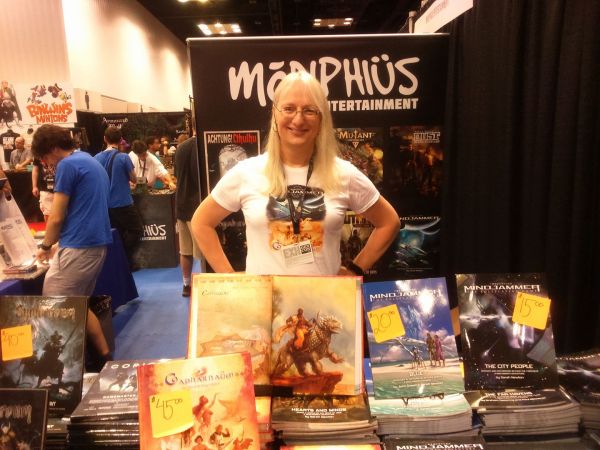
Launching the Capharnaum RPG!
Now the jet-lag has gone, I realise I haven’t yet written about GenCon 2018. It was fab. 🙂 My third time, and the best so far, I had such an awesome week in Indy, meeting up with old friends and making new ones. I returned exhausted yet utterly recharged, fired up with projects for the coming year.
This was my “Studio Deadcrows” GenCon. I was there repping Mindjammer Press, but also this time the French RPG company Studio Deadcrows of Montpellier, originators of our new Capharnaum RPG – which we were launching at GenCon! – and also the publishers of the French version of Mindjammer. They’re a dynamic bunch of gamers from the south of France, from a town where there’s a huge gaming community, and over the past 3 years we’ve been working increasingly closely together and having a blast. This year we made a joint expedition to GenCon, a pilgrimage to the source with a whole bunch of awesome meetings lined up.
I was travelling with three of the Deadcrows – Stephan Barat (Chief Crow), François Cedelle (co-author of Capharnaum), and Morgane Munns (translator of Mindjammer) – and we were staying in a house a stone’s throw from the con with arch-graphic artist and games designer Felix Mertikat and his team members Till and Christophe. This made a huge difference from staying in a GenCon hotel – we had a base to hang out in, play games, chat and decompress, and I think it went a long way to making this GenCon much more relaxed than my previous ones. It was nice to have a “home”.

A full house – Mindjammer Press, Studio Deadcrows, and King Raccoon Games
GenCon itself started full-on on the Wednesday, with wall-to-wall meetings and a fab afternoon planning Chaosium writing projects with Jeff Richards, Jason Durall, Chris Spivey, Dan McCluskey, David Larkins, and Shel Kahn. It was my first time meeting Chris, Dan, David, and Shel, and it was a privilege to be surrounded by such creative force. It was also a special treat when Greg Stafford arrived and I finally got to meet the man who has had such a massive influence on my life – the creator, among so many other things, of the eternally fascinating world of Glorantha. I geeked out in a total fangirl moment as Greg the chief shaman inspired us all further still.

Chaosium Writers’ Meet
I spent a lot of time with Chaosium this convention – a lot of projects to discuss, including the Barbarian Town campaign I’m writing for the new RuneQuest and The Goddess Book project I’m going to be developing, editing, and doing at least some writing on – a scenario book presenting Glorantha as seen through the eyes of my dream-team of women authors. I can’t wait to see what we come up with. We presented both projects during the RuneQuest / Glorantha panel, moderated by Ellie Akers on the Friday morning, alongside a whole host of other projects by Robin Laws, Chris Klug, Jason and Jeff, which have me *so* excited.
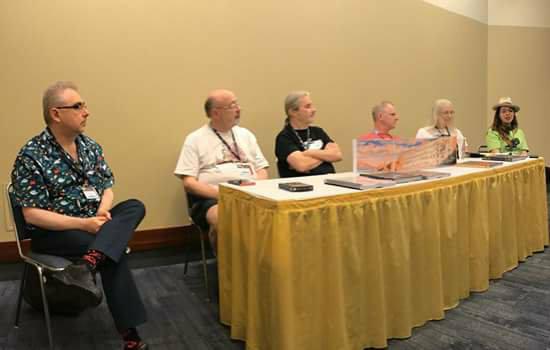
The RuneQuest Glorantha Panel
Hanging out with the Glorantha folks was a great opportunity to catch up with Neil Robinson, Rick Meintz, and MOB, to grab a couple of copies of Khan of Khans, and to get my comp copy of the fantastic new RuneQuest: Roleplaying in Glorantha signed by all the present luminaries, including Greg Stafford and Sandy Petersen. It was also a fab chance to catch up with the august Jim Lowder and talk Chaosium fiction, and with MOB about ArcanaCon in Melbourne next January, where I’m very excited to be guest of honour and looking forward to running a whole bunch of games and diving into the Australian RPG scene. Thanks for the great opportunity, MOB!
Describing GenCon is like trying to describe a whole world. So many encounters, so many moments. I spent several happy bouts at the Pelgrane Press booth, chatting with Simon Rogers and Cat Tobin, meeting the toweringly lovely Will Jobst, and of course basking in the incandescent mind-meld of Robin Laws and Ken Hite. I came away with copies of The Fall of Delta Green, Robin Laws’ The Book of Ants – An Investigator’s Guide to the Dreamlands, the Seven Wonders story games anthology, and #Feminism. I try to make a point of only making impulse purchases at conventions, and these were an instant hit with my brain in RPG ferment. I’ve been especially taken with Ken’s dedication in The Fall of Delta Green: “To Sarah – this is the end, my beautiful friend”. I love Ken to bits; I always feel like I’m in the presence of a fountainous guru, I come away laved and purified, yet also with the feeling of having taken part in an awesome ritual of creativity. I’m a Ken groupie, what can I say?
And while we’re on the subject of gurus, I also had the great pleasure of hunkering down for an hour with one of my fiction mentors, Howard Andrew Jones. Way back in the day of Starblazer Adventures and Mindjammer 1st edition, as editor of Black Gate magazine with John O’Neill, Howard was a supporter of my writing efforts, both in fiction and RPG, giving me perspicacious feedback and shrewd encouragement, including introducing me to literary agent Bob Mecoy. Howard is a scholar of the pulps, a specialist in the works of Harold Lamb, a mighty editor, and a fantastic novelist in his own right, and I’m honoured to call him a friend. He’s also editing the fiction periodical Tales from the Magician’s Skull from Goodman Games, for which he invited me to submit a swords & sorcery tale (an offer which of course I enthusiastically accepted!). In Howard’s gravity well I also dropped by at the Goodman Games booth, where I got the chance to finally meet in person Brad McDevitt, illustrator of Monsters & Magic, and was delighted to see reprints of beloved Judges Guild material and the oh-so-dear-to-me Metamorphosis Alpha (including new material!), and of course the extremely impressive range of supplements and scenarios for Dungeon Crawl Classics and Mutant Crawl Classics. Those guys are where the fire of the OSR burns strong and true.
One of the big delights of GenCon 2018 was to finally introduce myself in person to the Flying Buffalo guys, publishers of course of Tunnels & Trolls, my first ever RPG, the one which got me into the entire hobby, and one which is still very close to my heart, especially now it’s been reborn in its new 8th edition as Deluxe Tunnels & Trolls. It was a thrill to shake the hands of Rick Loomis and Steve Crompton and thank them for their great work, and to talk about my own modest T&T project, “The Lair of the Leopard Empresses”, and how it might see the light of day (more on that in coming months, I hope!). It was a shame not to meet the legendary Ken St Andre and Liz Danforth, who weren’t at GenCon this year, but that gives me something to look forward to at future cons – I’ll remedy that! I came away with fresh new copies of Uncle Ugly’s Underground, the Agent of Death solo, and the English version of the Japanese magazine T&T Adventures. Lovely to see so much material still appearing for one of the oldest (and still highly innovative) RPGs.
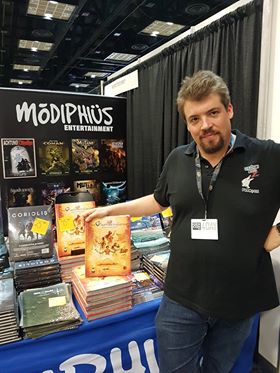
François Cedelle, co-author of Capharnaum
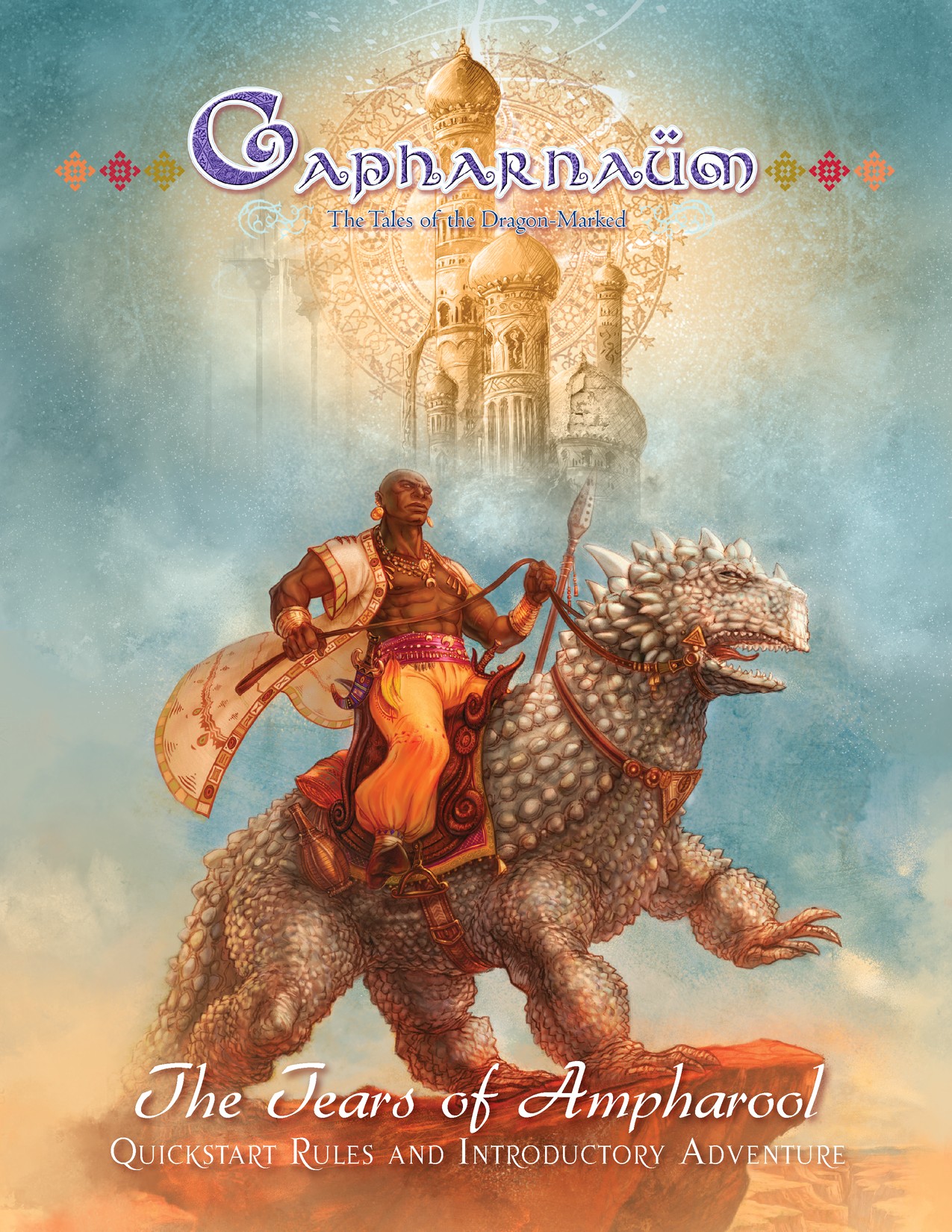
Most of my time at GenCon this year was spent on Chris Birch’s Modiphius Entertainment stand, where we were of course launching our brand new RPG Capharnaum – The Tales of the Dragon-Marked (originally published in French by the Deadcrows guys). This was a moment of great pride for me – I’d first conceived the project in 2009, we signed the deal several years ago, ran a kickstarter for it last November, and here it was at last in English, in gorgeous full-colour hardback. It was a double honour to have François Cedelle, co-author of the game, on hand for the signings, and we did some excellent sales and garnered some jaw-dropped feedback on what is perhaps the most beautiful book Mindjammer Press has published to date. Capharnaum – The Tales of the Dragon-Marked is already available in PDF from DriveThru, and is on pre-order right now at the Modiphius webstore right through to the 31st August, when hard copies start to ship.
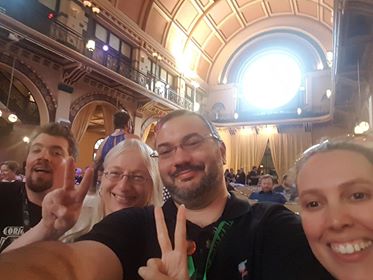
At the ENnies
The Modiphius booth was a whirl, of course – Thursday morning was a heady rush of sales, with the new Vampire 5th edition and a whole range of fine Modiphius products whistling off the shelves and tables. It was great to finally meet T.R. Knight at the Modiphius booth, and his daughters Emily and Rachel, and to hang out with Sam, Lloyd, Adam, and Josh, as we met head-on with a never-ending stream of enthusiastic gamers. We had a special treat Saturday night at the ENnies, when Chris invited the Deadcrows guys onto the Modiphius table, and we congratulated friends from Modiphius, Chaosium, Darker Hue Studios, and so many other publishers as they received their well-deserved honours.

Those ENnies winners
And so many other meetings and encounters. I was so chuffed to meet up with Jerry Grayson of Khepera Publishing again, author of the esteemed Hellas RPG, the new edition of Atlantis (which I’ve loved since the year dot), and now his new up and coming project Orun – Post-apotheosis Space Opera, which looks very exciting. Jerry is a fab guy, with an infectious enthusiasm, an inspiring presence in the RPG world with whom I feel a great Commonality.
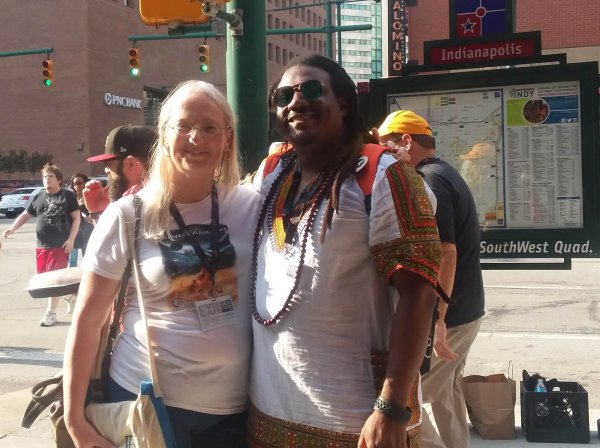
With Jerry Grayson
And I finally got the chance to meet John Snead, writer on Mindjammer, Aeon Trinity, and many other projects, and sit down for a productive hour planning future Mindjammer Press projects, and am delighted we’re going to be work together a whole lot more. Also to meet with Chris Helton, whose critical work at the Dorkland blog, Contessa, and elsewhere I respect enormously, and to see him ably ensconced with Sandy Petersen on the Petersen Games booth. And to meet in person Jason Woodburn – I can’t say face-to-face, as we’ve gamed on Skype together so many times, he from Norway, me from Normandy, linked by a tenuous vikingr spirit, finally clasping hands for a hug in Vineland!
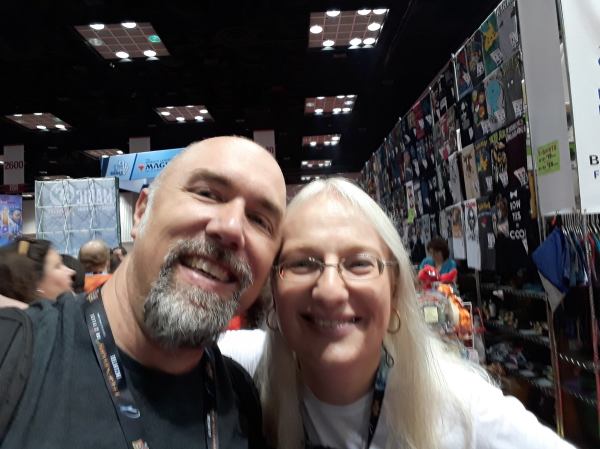
Hail and well met, Jason Woodburn!
I’d left my final Sunday at GenCon largely free for final catchups and impulse purchases, and ended up with at copy of the Bluebeard’s Bride RPG, meeting up with publisher Mark Diaz Truman and author Sarah Richardson of Magpie Games, as well as Monster of the Week from Evil Hat.
And suddenly GenCon was over. This time, I’d tried to pace myself; a good bit of exercise before leaving Normandy, and then an attempt to drink mostly water and eat mostly salad during the convention, meant that I’d survived to the end of Sunday in far better shape than I had done before. Returning to Normandy via JFK and Heathrow over the next few days, however, I crashed hard with the con crud over the mid-Atlantic, with the ever-faithful eastbound jet-lag to follow. None of that dimmed however the spectacular experience of the Best Four Days in Gaming, the return to the source of it all. I came home promising myself I’d be back next year. The past five years building Mindjammer Press had put GenCon temporarily out of reach; hopefully from here on that will change.
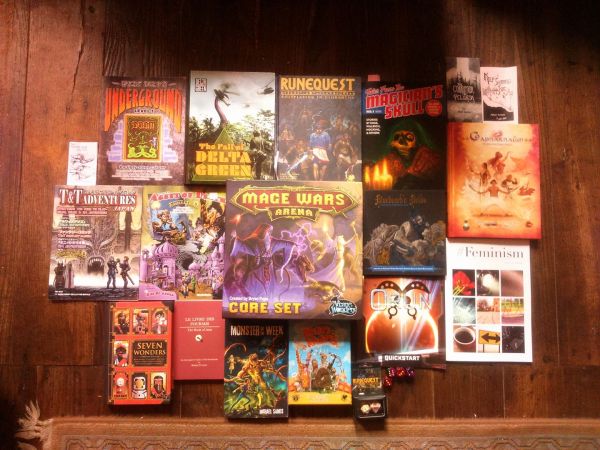
The final GenCon 2018 haul…
Devant les Citoyennetés spéculatives

Je reste encore très inspirée par mes expériences au festival de Nice Fictions. Depuis mon retour, j’écris une nouvelle de Mindjammer en français – la première fois que j’écris la science-fiction directement dans la langue de Barjavel.
Je trouve que, quand j’écris dans un genre, je veux aussi que la plus grande partie de ma lecture soit de même. Comme si mes pensées vivent dans un environnement où il faut respirer, baigner, trouver de quoi se sustenter parmi les ondes et les particules, originaires de la même constellation intellectuelle de ce que j’écris. Écrivant la fiction générale, je préfère lire la fiction générale ; écrivant la fantasy, je lis la fantasy. Et ainsi de suite.
Actuellement, je me gave des oeuvres de science-fiction. Expérience exorbitante – ma tête voyage, vagabonde dans des déserts interstellaires pour arriver aux grèves étrangères. Comme c’est passionnant. J’ai fini La Cité du Soleil d’Ugo Bellagamba, je me suis lancé dans le nouveau numéro de “Galaxies“, dans Les Guerriers du Silence de Pierre Bordage, je me suis trouvée plongée dans La Main Gauche de la Nuit d’Ursula Le Guin. J’orbite autour des mondes fantasques.
Aujourd’hui, j’ai mis sur mon bureau l’ouvrage intitulé “Citoyennetés spéculatives“, édité par les Éditions du Somnium d’Anouk Arnal et d’Éric Picholle. Un précieux cadeau d’Ugo Bellagamba et de Giulio Cesare Giorgini lors de mes aventures à Nice Fictions. Nous nous regardons, ce livre et moi, depuis trois semaines déjà, en essayant de juger le meilleur moment d’approfondir notre connaissance l’un de l’autre, et il se trouve que c’est aujourd’hui que tout commence. Le concept de ce recueil d'”actes” rédigés à partir des présentations et des discussions, les fruits des “rencontres entre littéraires, scientifiques, et écrivains conscients de l’importance de la science-fiction”, me passionne depuis le moment que j’ai reçu le livre.
Je prévois me faire exploser la tête. Voilà. C’est parti.
Trois Jours à Nice – Festival NICE FICTIONS 2018

Nous ne sommes pas seuls. Les membres de notre tribu sont partout. Bien qu’ils fassent un travail solitaire, parfois les écrivains et les artistes se rassemblent, et là où ils se rassemblent brille une rare lumière.
Le week-end dernier, j’ai eu le privilège d’être invitée d’honneur à Nice Fictions, depuis quatre ans festival de science-fiction, de fantasy, et de fantastique, dans cette belle ville du sud de la France. C’est un festival qui incarne la philosophie du transmédia en intégrant dans un seul événement les activités créatives dans la littérature, les jeux de rôle, l’illustration, les jeux vidéo, et beaucoup d’autres. C’est un festival encore jeune, d’une échelle modeste, mais qui vise haut.

Jérôme et Sybille !
Le festival est organisé par une équipe enthousiaste et accueillante, menée par Sybille Marchetto et Jérôme Gayol, dont j’avais fait la connaissance en 2017 aux Utopiales de Nantes. Sybille et Jérôme ont rassemblé des gens passionnés pendant les 4 ans de Nice Fictions. Ils éditent même une anthologie de nouvelles écrites par les invités, aux éditions Les Vagabonds du Rêve, pour célébrer le thème de chaque année. Nice Fictions est amical, détendu, mais il est clair qu’une organisation dynamique se trouve à son coeur.
J’étais invitée au pôle de jeux de rôle de Nice Fictions, sous l’égide de Samy Bend et d’Aldo Pappacoda, auteur de Chiaroscuro, de l’Empire du Soleil Défunt, et d’autres, deux hommes merveilleux qui étaient mes ancres et mes guides pour tout le week-end. Je faisais partie d’une bonne soixantaine de créateurs invités, de tous genres, venant la plupart de Nice et du sud de la France, pour montrer nos créations et en parler. Et aussi, dans le cas du pôle de jdr, pour en animer des parties – samedi soir a eu lieu un grand “nocturne” de plusieurs tables de jeux de rôle, où une trentaine de joueurs ont exploré des mondes fictifs jusque tard dans la nuit.

Mindjammer version française – moi qui mène, Giulio à gauche !
J’ai mené une partie de Mindjammer – version française! -, le premier épisode d’un scénario que je suis en train d’écrire autour d’un grand mystère de la Noosphère, l’« internet interstellaire » de la Nouvelle Communalité. J’ai été frappée par la qualité des joueurs, la façon dont ils ont dirigé leur enquête et nous ont menés vers des révélations que même moi je n’avais pas imaginées ! Et, en plus, par le fait que parmi les 6 joueurs nous avions 3 femmes, donc une table de 4 femmes et de 3 hommes. Ça devient de plus en plus normal de nos jours, mais je me souviens bien de l’époque où les femmes étaient encore rares dans le monde des jeux de rôle. Nous devons nous féliciter pour les évolutions et les révolutions que nous avons réussies !
Tout ça, c’est déjà génial pour un festival, mais il y avait encore un aspect de Nice Fictions qui était très fort – pour moi, peut-être le plus fort. C’était la présence d’une vraie communauté de créateurs au festival, et la façon dont celui-ci était structuré pour encourager les échanges entre les écrivains et les artistes. Souvent les festivals sont organisés uniquement en fonction des besoins du public. C’est naturel – le public est la plus grande raison d’être des festivals. Mais pas la seule : à mon avis, un bon festival doit aussi s’adresser à la créativité, tenter d’établir un endroit où les créateurs puissent interagir, pas seulement avec leurs lecteurs, leurs joueurs, leur public, mais aussi les uns avec les autres. On parle beaucoup d’interdisciplinarité, on estime que c’est dans les échanges que l’on trouve l’inspiration. À Nice Fictions j’ai trouvé un endroit où cette approche est devenue une réalité.
D’abord, il y a eu beaucoup de conférences. Presque chaque heure, quelque chose se déroulait dans l’un ou même dans les deux amphithéâtres du festival. Des vraies conférences : pas du tout de simples présentations publicitaires ou des discussions simplifiées, où trop de préparation peut étouffer l’inspiration. Non, les conférences de Nice Fictions étaient de vrais échanges d’idées, stimulants, excitants. J’ai participé à deux d’entre elles, et j’ai assisté, dans le public, à quatre autres. J’ai pris des pages entières de notes.
À part les conférences, la communauté de créateurs fonctionnait aussi bien dans les salles du festival. C’était peut-être que le nombre d’invités correspondait bien à l’échelle du festival. Nous n’étions ni trop, ni trop peu nombreux. Nous approchions peut-être ce “nombre d’or” où les échanges s’embrasent naturellement, partout, tout le temps. Ça m’a rappelé FantasyCon et EasterCon au Royaume-Uni.

Donc pour moi c’était un festival de belles rencontres. J’ai été invitée grâce à Giulio Cesare Giorgini et à Ugo Bellagamba, qui me connaissaient en tant que backers du Kickstarter de Mindjammer. Tous les deux travaillent comme professeurs (de droit et d’histoire du droit) à l’université de Nice et sont passionnés par le concept de transhumanisme. Ugo Bellagamba est aussi bien sûr écrivain de science-fiction, auteur d’œuvres telles que La Cité du Soleil et Tancrède, qui a reçu le Prix européen des Pays de la Loire aux Utopiales 2010 et le Prix Rosny Aîné 2010. Imaginez le clone hybride de Borges et d’Umberto Eco avec une casquette de science-fiction – c’est Ugo. Je suis très reconnaissante à tous les deux pour m’avoir fait découvrir le monde de Nice Fictions.
Et quel monde ! Je suis devenue active dans le cercle des festivals et des conventions de France il y a deux ans, à l’époque du cataclysme du Brexit, et j’ai rapidement retrouvé ma tribu dans les conventions de jeux de rôle aux Utopiales, à Au-delà du Dragon, aux Chimériades, à la Comédie du Livre. Mais ce n’était vraiment que le week-end dernier, à Nice Fictions, que j’ai pu aussi me connecter à ma tribu dans le monde de la fiction en France. Et c’était une joie absolue.
Le moment où tout s’est illuminé a été samedi soir. Giulio (Giorgini) animait « Une rencontre avec Sarah Newton », moment très flatteur avec présentation Powerpoint de mon parcours d’écrivain – et, tout d’un coup, dans la discussion qui s’en est suivie, je suis devenue consciente d’avoir trouvé ma tribu, d’être parmi les miens, d’être soutenue et bercée par des âmes sœurs.
Ce week-end j’ai pu faire la connaissance de Nathalie Dau, invitée d’honneur du pôle de la fiction et auteure des deux tomes du “Livre de l’Énigme” que j’ai lus en janvier-février et beaucoup aimés. Elle est adorable – esprit profond, sensible, véritable artiste – et j’attends le troisième tome de ce cycle bouleversant avec impatience. J’ai pu revoir Olivier Sanfilippo, le féliciter sur le succès de sa campagne de financement participatif de L’Empire des Cerisiers, et d’admirer encore une fois sa cartographie glorieuse pour la nouvelle édition de RuneQuest – Roleplaying in Glorantha. J’ai rencontré l’écrivain Léo Lallot, avec lequel j’ai immédiatement ressenti un lien spirituel – nous avons tous les deux passé des années en Orient, et je vois dans ses yeux que nous avons été forgés dans des feux similaires… J’ai pu faire la connaissance de l’écrivain Éric Picholle, qui m’a redonné l’envie de lire Anne McCaffrey, et d’Anouk Arnal des Éditions du Somnium, éditrice du fascinant livre Citoyennetés spéculatives, dont Ugo et Giulio m’ont fait cadeau.
Après l’entretien, j’ai rencontré Pierre Gévart, grand homme de la SF française et chef du magazine Galaxies, qui m’a invitée au festival Eurocon à Amiens en juillet, où je rêve déjà d’avoir des expériences aussi passionnantes. Merci infiniment, Pierre, vous m’ouvrez la porte et j’entre, les yeux scintillants.
Tant de beaux souvenirs, de bons moments. Même les annulations de vols ont agi en notre faveur ; dimanche après-midi, au lieu de traîner dans des aéroports, j’ai pu apporter ma modeste contribution à la conférence sur “le Droit et le Transhumanisme”, et parler davantage avec un dynamo créatif, Hélène Marchetto, éditrice et une des âmes dirigeantes du festival.
Je suis rentrée en Normandie lundi, l’esprit changé par ces trois jours à Nice. Je flotte encore. J’ai hâte de répéter cette expérience. Je remercie tous les organisateurs pour leur invitation si gentille, tous les bénévoles pour leur travail essentiel, souvent tard dans la nuit, et tous les membres de notre tribu pour leur soutien et leur accueil si chaleureux. Vous êtes merveilleux.

Au-delà du Dragon, Montpellier, 2018
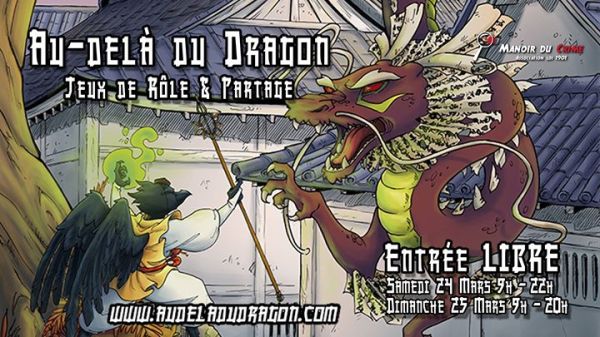
Ô dieux ! Quel magnifique festival Au-delà du Dragon ce fut ! Je me suis arrimée à la Flotte de Félicitation de Mindjammer, ici dans le secteur normand, à minuit lundi soir, épuisée mais encore excitée, passionnée, les yeux brillants à la suite d’un weekend plein d’aventures. J’ai pu rencontrer d’autres fans, des MJs, des joueurs de Mindjammer et de Capharnaüm et échanger avec eux nos expériences de la Communalité et du Jazirat. J’ai eu le très grand plaisir de dédicacer les livres de Mindjammer, version française, exceptionnellement beaux – le Livre du Joueur, le Livre du Meneur – créés par Studio Deadcrows.

La version française de Mindjammer !
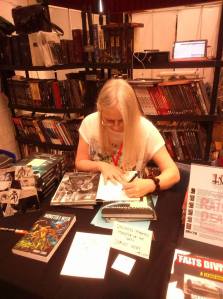
On dédicace !
Merci au Manoir du Crime et à tous les bénévoles pour avoir organisé ce weekend fantastique. Merci à Florian, François, Morgane et Stephan pour votre accueil chaleureux, merci à Antoine et Joffrey pour avoir organisé les parties de jdr, à vous tous pour avoir fait une version française de Mindjammer si belle et si passionnante, aux gens splendides de la Caravane d’Asteria pour m’avoir permis de mener une partie de Capharnaüm sous une tente entourée de gens et d’accessoires du Jazirat (et de verres de délicieux thé à la menthe !). Et à tant de gens pour votre amitié et pour de bons moments passés ensemble – Kristoff, Mathieu, Rémi, Vincent, Harmony, Sam, Thomas, Pierre, Leo, Momo, Ehlâm, Erwan, Yann, Yan, Yannick, Damien, Laura, Felix, Til, Grégoire, Alex, Mehdi, Gabriel, Sibylle, Sam, Denis, et tant d’autres – merci.
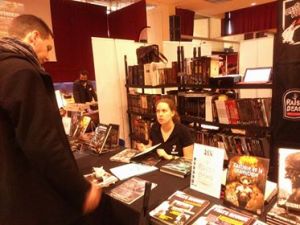
Morgane Munns, traductrice de Mindjammer en français, fait les dédicaces!
Cette semaine, je m’occupe de charger tous ces expériences inoubliables dans la Noosphère. Et peut-être d’essayer de récupérer cette heure de sommeil qu’on a perdue samedi soir… Vivement “Au-delà du Dragon 2019” ! À la gloire des héritiers des dragons ! La Communalité vous salue !

Capharnaüm et la merveilleuse Caravane d’Asteria

Appartenir à la francophonie

Depuis deux ans j’écris en français. Ou, du moins, j’essaie. Des romans, des nouvelles, des essais, des articles. En tant qu’Anglaise, malgré mes longues années d’étude à l’école, mes douze ans de vie passés ici en Normandie, mon amour profond pour la littérature et la culture française, écrire dans la langue d’un autre n’est jamais chose facile. Tout ceci nonobstant, je viens de me rendre compte d’un fait surprenant, quelque chose qui, maintenant, me paraît une évidence, mais, peut-être comme toutes les évidences, n’en était pas une avant.
Lorsque je construis mes textes en français, je travaille et retravaille les mots. “Que dirait un Français, me demandé-je, comment formulerait-il un tel concept ?” J’essaie de mettre en marche dans mon imaginaire un Français ou une Française idéalisée qui parlerait un français parfait et élégant, représentant de la langue de Molière (ou de Rimbaud, ou de Virginie Despentes) qui devrait, je raisonne, exister dans sa totalité dans mon inconscient, si seulement je pouvais le sommer d’apparaître. Je considère mes mots, encombrés de mon passé, de ma lecture, de mes études d’autres langues – pas uniquement de l’anglais, mais du russe, de l’allemand, du japonais – et je m’efforce de chercher des tournures qui ne résonnent pas d’une telle étrangeté, mais d’une appartenance essentielle à la tradition écrite française.
Cher lecteur, vous avez peut-être perçu là où je me suis fait piéger. Mais moi, il fallait qu’un autre – en fait plusieurs autres – me l’explique.
Un bon ami qui me soutient profondément dans mes efforts littéraires m’a fait remarquer un jour : ” Tu sais, j’aime ta façon de t’exprimer. Tu utilises les mots d’une manière différente à laquelle on se serait attendu. Quand on te corrige, il ne faut pas que ça soit perdu. C’est intéressant, rafraîchissant. Ça apporte quelque chose à la langue.”
“Oui, ai-je répondu, mais j’ai du mal à comprendre le moment où mon français personnel devient un mauvais français. Que ça sonne exotique, intéressant, rafraîchissant, tout ça, c’est bien, mais si ça sonne faux, poussif, maladroit…”
Tout de même, son commentaire m’a troublé. Et, aussi, a excité ma curiosité…
J’ai commencé à me renseigner sur le concept de la francophonie. Bien entendu, de telles étiquettes existent partout sur les étagères des libraires en France, désignant les écrivains qui écrivent en français mais qui ne sont pas considérés comme des “écrivains français”. Mais le terme implique beaucoup plus que ça. Il ne s’agit pas simplement des écrivains qui essaient d’écrire un français monolithique et idéalisé sans y arriver, mais plutôt de ceux qui écrivent une langue française complètement réelle, vivante, valable, mais qui diffère de la langue française “officielle”, telle qu’on l’imagine en se prétendant membre de l’Académie française. Il existe une pluralité de langues françaises, dont chacune charrie son propre fond culturel, sa vue du monde, sa façon à elle de concevoir les choses et de les exprimer.
Comme j’ai dit, tout cela devait m’être déjà évident mais ne l’était pas. Dès ce moment, une nouvelle perspective commençait à se pointer par devers moi, moins définitive, plus déroutante. En quoi consistait-elle, cette perspective ?

En ceci : que, quelque part, il existe une langue française bien à moi. Une langue qui s’exprime avec élégance, avec profondeur, qui ravit ses lecteurs, qu’ils soient français ou non, mais qui n’est pas forcément identique à la langue française telle qu’elle est parlée et écrite par les lecteurs et écrivains qui ont grandi dans l’Hexagone. Une langue qui se montre foisonnante de mes propres antécédents littéraires — de mon amour pour le paysage sauvage du nord de l’Angleterre, de mon instinct pour la poésie et les rythmes anglo-saxons qui se font entendre dans mon choix de mots et de concepts, de mon acquisition des images, des métaphores, des philosophies — bref, des cultures littéraires — de l’Allemagne, de la Russie, du Japon, ainsi que de mon Angleterre natale et bien sûr de ma belle et chère France, mon pays d’adoption.
Et la facette déroutante ? Comment juger le moment où je m’approche de cette langue française personnelle, de cette francophonie à laquelle j’appartiens et que je vise à incarner. Chaque fois que l’on écrit en français à l’école, ou pour un professeur, ou tout simplement d’une manière correcte du point de vue grammatical, il est facile d’identifier ses erreurs et de les corriger. Mais si on ne veut pas endommager sa propre voix, détruire sa facilité à employer des images, des constructions qui englobent sa façon de voir le monde, bref, qui manifestent sa propre francophonie — comment juger cela ?
La francophonie se présente comme un paradoxe délicieux. Elle est à la fois autre et sienne ; individuelle et cousine. Et, peut-être, elle incarne en soi le potentiel d’enrichir la langue française d’une diversité époustouflante de points de vue, de goûts, d’expériences. Et, éventuellement, il devient une évidence aussi qu’il n’existe pas une pluralité de langues françaises, mais une seule, globale, riche et internationale, qui se renouvelle constamment, qui bourdonne de créativité, et qui est notre patrimoine à nous tous.
C’est ça la francophonie à laquelle je veux appartenir.
Children of Orion: the Venu Sourcebook – OUT NOW!
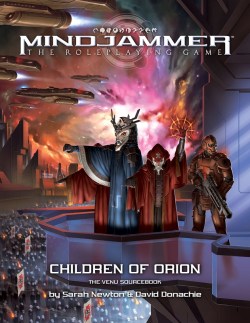
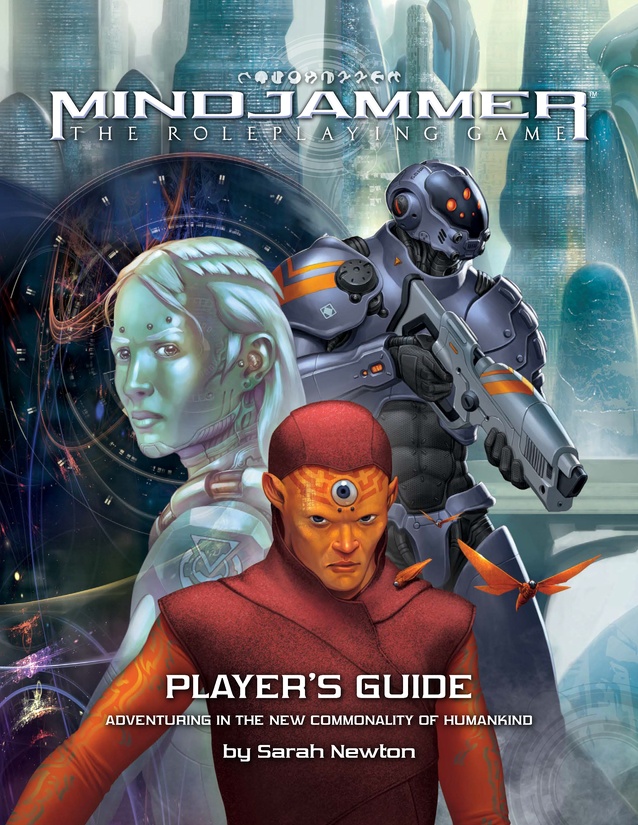
Today marks the release of the Mindjammer supplement CHILDREN OF ORION – THE VENU SOURCEBOOK. It’s a book I’m very proud to finally see hit the shelves. It had its genesis over eight years ago, back in 2009, and both the Venu and Mindjammer have come a long way since then!
The Mindjammer setting has always been one of a miraculous hyperadvanced far future – an amazing civilisation which has overcome many of our own civilisation’s limitations to reach for the stars, and to expand outwards into the galaxy, facing and overcoming countless incredible challenges. It’s my own vision of a science-fiction future – one shared by many – where the technology and future might be often beyond our ability understand, but which feels realistic and which adheres to a logical scientific underpinning. For all its sense of wonder, the New Commonality of Humankind is, for me, a place that could exist.
And it’s always been a golden age, optimistic civilisation. Yes, there are incredible dangers, existential threats; no, a future victory is by no means certain, and there is everything to play for. But it’s a civilisation which – for all its flaws (and they are many) – I think I’d probably want to belong to.
From day one, it was always clear the New Commonality needed an enemy…
Back in the days of Mindjammer 1st edition, we weren’t using original artwork. As a supplement for the awesome Starblazer Adventures RPG, we followed its concept of using the fantastic black-and-white line art from the D.C. Thomson “Starblazer” comics of the 1980s. You can see that art all the way through Starblazer and Mindjammer 1st edition. In some of those illustrations, the heroes were shown up against sinister foes clearly from some evil galactic empire – the eternal trope of space opera. But I wondered: who were those guys? Their natty black cloaks, their blocky power armour, those foul-looking beam weapons. And why were they fighting a civilisation which – by all accounts – wanted to offer them a shot at utopia?
From those questions the Venu were born. In the earliest days, they were little more than Space Nazis: bad guys for the heroic PCs to mow through. But even as I was writing the “Black Zone” campaign that formed the second half of the Mindjammer 1st edition rule book, I was asking myself: what makes these people tick? Why do they hate the Commonality so much?
Slowly, they took shape. In keeping with the “evil galactic empire” trope, the Venu Space Nazis of 1st edition were human supremacists, with a low level of technology which could only just compete with the Commonality’s dazzling innovations. But why? And why were they all wearing those sinister masks? What were they hiding?
Now, in Mindjammer , as a game which tries to adhere to scientific underpinnings, there is no such thing as psionics. In the New Commonality, thanks to the ubiquitous “interstellar internet” of the Mindscape, there is technopsi – technological psionics – which plays a similar role. But the Venu didn’t have a Mindscape. They were wearing masks. They worshipped the pure human form. They were screwed up.
Of course: they were mutated. By a power they didn’t understand, a power they needed to combat the Commonality, but which twisted their form and drove them to a terrible cognitive dissonance, forcing them to become the very mutants they professed to despise.
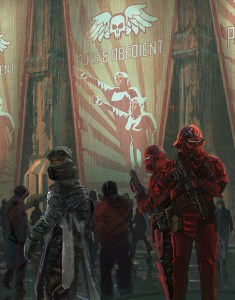
That force is behind the Venu Empire. It’s still mysterious, but it does have that solid scientific underpinning (which, for now, shall remain mysterious…). Even in 1st edition Mindjammer, the Venu called it the Radiant Darkness, and it permeates the CHILDREN OF ORION Venu Sourcebook which we’re publishing today. In some as yet unknown way, it provides the Venu with abilities which give them a fighting chance to withstand the Commonality. And perhaps to do much more…
Two years ago, as the Mindjammer Kickstarter completed, I spoke with David Donachie, who I’d worked with on Legends of Anglerre, about working together on the Venu sourcebook. I sent him my notes, and waited to see what he came back with. I wanted ideas that bounced off mine, took us in unexpected directions, winkled out things I hadn’t seen from being too close to the Bright Empire of Venu. David came back with a radioactive smorgasbord of ideas, and CHILDREN OF ORION was born!
For most of this year, I’ve been working on producing the sourcebook which is published today, incorporating David’s ideas with my own, knitting it all together into a whole, providing an insight into the Commonality’s greatest foe. Today, the Venu are no longer the Space Nazis of 1st edition: they’re a complete, detailed, and all too believable interstellar civilisation, driven by fear and xenophobia to sign away their souls in a devil’s bargain to resist a foe which opposes everything they believe in. The Commonality is everything the Venu are not: it’s inclusive, diverse, outward-looking, capable of incorporating other cultures into itself and slowly changing to adapt (although not without consequence – that’s a whole other story!). CHILDREN OF ORION provides you with histories and details of the Venu civilisation, but also much more: starmaps and planet descriptions, technological paradigms and descriptions of gear, ships, the “walkers” and “motes” which are the pinnacle of their robotics tech, opposed as the Venu are to AI. In short, CHILDREN OF ORION gives you everything you need to play Mindjammer games set inside the Venu Empire.
And what does that mean? Well, it opens up a whole new arena of play for Mindjammer gaming. There’s now a vast and oppressive star empire open for adventure. You can play Venu troopers, or sinister servitors of the Dark Radiance Executive (also called the Cult of Radiant Darkness…); you can wield Venu mutations and the mysterious abilities the Commonality – for want of a better word – calls “Venu psi”. But you can also play Commonality agents working against the Venu – either fighting them directly, or conducting clandestine operations, or even trying to manipulate their culture and defuse its most destructive memes.
 And there’s more. There’s a resistance inside Venu Space, and perhaps not only on the worlds the Venu have conquered since the recent war. You can join that resistance, and fight against the oppressive forces of the God-Emperor! Or maybe you just want to survive and thrive in the galaxy as it is: maybe you’re a roguish trader, perhaps the owner (one day…) of a Caravan-class trading ship from one of the huge and ancient trading combines of the Empire, whose castle-like orbital strongholds dot Venu Space. What will you do when the Resistance – or the sinister Executors of the Dark Radiance – come calling?
The Venu have come a long way. Today’s the day you can find out how. There’s a war brewing between the Commonality and their oldest and greatest foe – everyone says it’s just a matter of time.
Whose side will you be on?
*****
CHILDREN OF ORION – THE VENU SOURCEBOOK releases today in PDF format from DriveThruRPG and the Modiphius webstore, and in 112-page softback physical book on Monday 23rd November.