Mindjammer RPG – Pre-orders Imminent
Welcome to the New Commonality of Humankind!
With pre-orders of our new transhuman science-fiction RPG Mindjammer due to open in the next week or so, here’s a never-before-seen sneak peak at Commonality Space, Mindjammer‘s default setting.
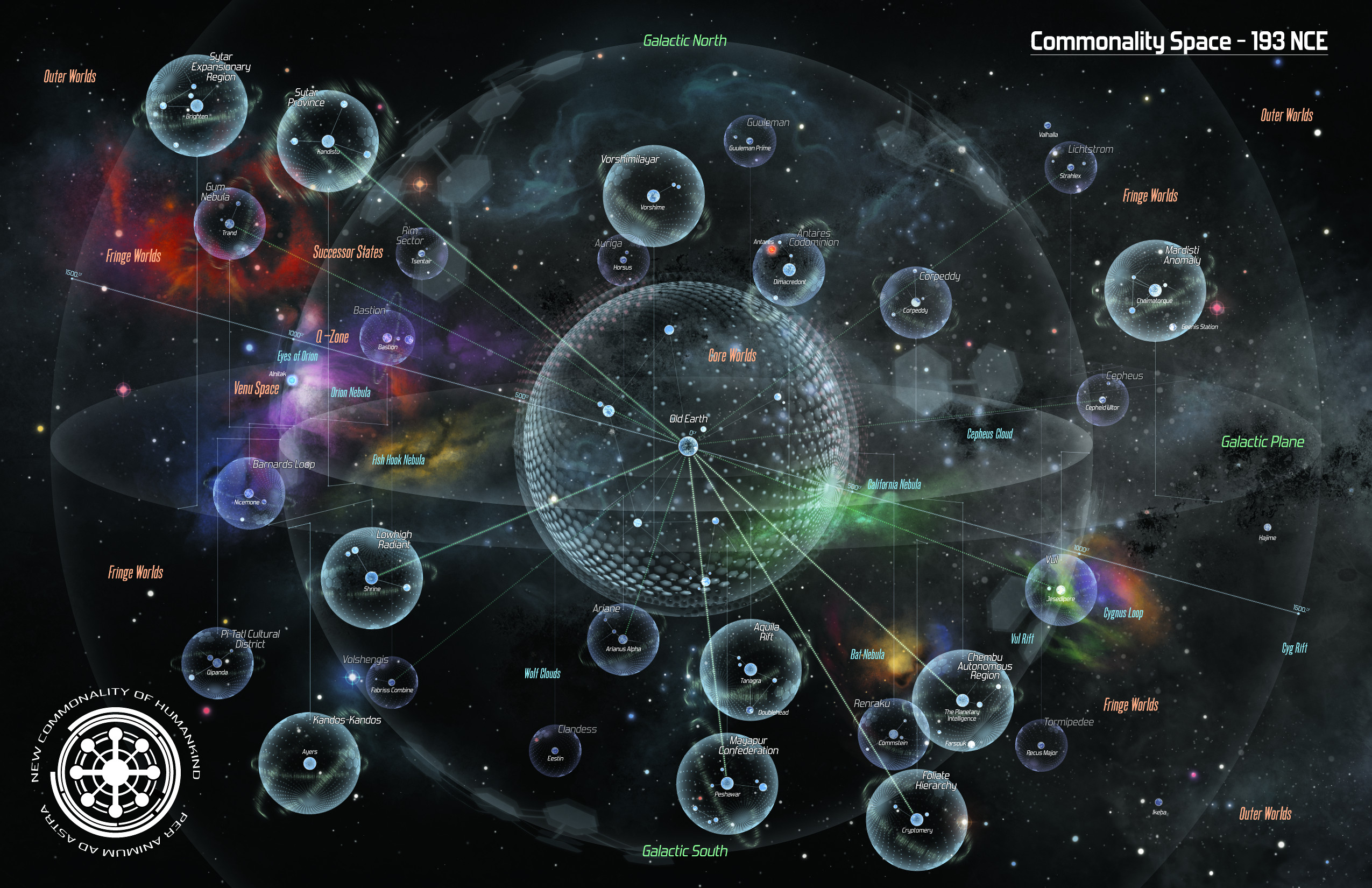
Mindjammer is a far future transhuman science-fiction roleplaying game. As such, it has a default setting – the New Commonality of Humankind, a vast and expanding interstellar civilisation of the 17th millennium. For 10,000 years the old Commonality spread to the stars in slower-than-light generation and stasis ships; the stars closest to Earth formed the “Core Worlds” civilisation, but the rest, too far for practical STL communication, took their own paths, often falling silent and diverging from the Commonality and even human norm. These “lost colonies” may well extend as much as 10,000 light years from Old Earth.
200 years ago, the Commonality “discovered” planing – faster-than-light travel – and immediately set about recontacting its lost colonies, a process known as Rediscovery. The result has been chaos and mass cultural conflict, and a vast interstellar civilisation the like of which has never been seen before – the New Commonality. The schematic above depicts the current extent of Rediscovery – a volume of space some 3000 light years in diameter known as Commonality Space. The schematic shows the hearts of the various sectors of Commonality Space, dispersed in a 3d volume, with the Core Worlds at the centre. Every year, the Frontier is pushed back further and lost colonies found.
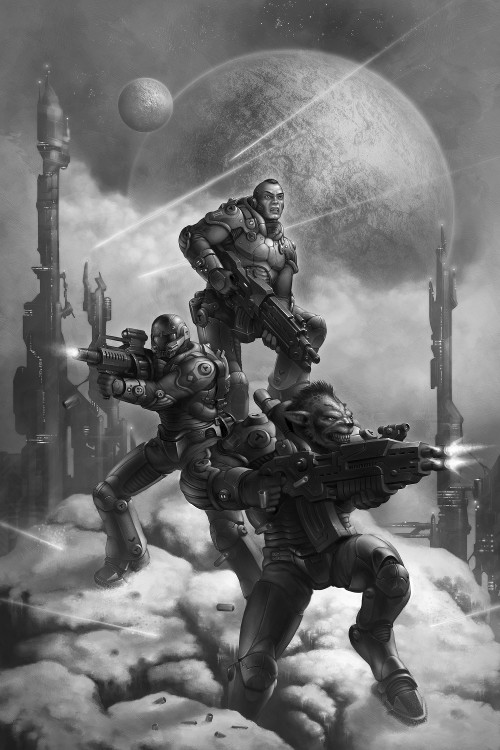 The New Commonality of Humankind is the default setting presented in the Mindjammer core book. As you’ll have noticed, it’s very large in scope and capable of incorporating all manner of gaming tropes, styles, and settings. You can easily create your own campaign area, either as part of Commonality Space, or out beyond the Frontier; it’s a big galaxy.
But that’s not all. You can also use Mindjammer as a rules set for your own favourite science-fiction setting. The game as been designed to be modular, so you can use whichever parts you need for your own game. Want to play in a different imperium, federation, or empire? No problem – Mindjammer is a complete set of rules for any science-fiction setting.
Right now we’re in the final throes of layout, finalising the proofing and building the indices. Next week we hope to open for pre-orders of the massive 488-page hardback of Mindjammer – The Roleplaying Game; and at the same time, you’ll be able to immediately download a PDF of the “Thoughtcast Edition” pre-release PDF. The Thoughtcast Edition is essentially a 99.9% complete final version – we may be adding a few sidebars of additional background content before going to print, but otherwise it’s all there.
So what do you get in the Mindjammer core book? Here’s a run-down:
- a complete standalone roleplaying game, using the Fate Core rules system. Everything you need to play, in one volume.
- detailed backgrounds for character genotypes, cultures, and occupations. Play a sentient starship character!
- full rules for starships, organisations, and culture operations.
- new and innovative rules for describing planets, star systems, and alien life.
- deep background material on the New Commonality of Humankind.
- rules for the Mindscape and virtual worlds.
- starmaps and planet descriptions, histories and background.
- hyper-advanced equipment, weaponry, enhancements, starships, and more.
It’s been a long time coming, but we’re finally there. In my next blog post I hope to be inviting you all to the new Mindjammer pages and the chance to preorder Mindjammer – The Roleplaying Game.
Cheers,
Sarah
The Commonality Space Schematic above is the work of the awesome Jason Juta, whose work features extensively in Mindjammer – The Roleplaying Game. Jason’s done a great job of visually depicting the three-dimensional nature of Commonality Space in a two-dimensional image.
Check back here regularly for information about Mindjammer, as well as our Google+ Mindjammer community and the just-opened Mindjammer Press Forums. See you there!
Mindjammer RPG – Starships
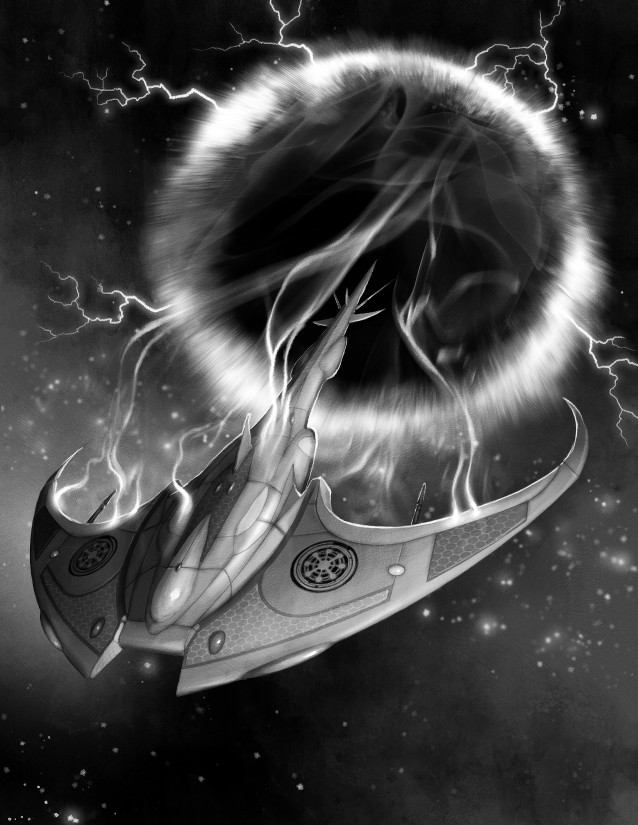 One of the big things about the Mindjammer setting is its starships. Not only are they hyper-advanced, fitted with faster-than-light planing engines, in the New Commonality they’re also intelligent beings in their own right – and in the Mindjammer RPG you can play them as characters.
This week’s preview showcases several pages from Chapter 13: Starships and Space Travel. What you see here are statistics blocks for a selection of Commonality starships, statted in Fate Core terms as minor, supporting, and major NPCs. This means that GMs can use these ship stats as-is in their games, but also modify them to be more or less detailed or powerful; and that players can use them as guidelines or templates for creating their own sentient starship characters. Your Mindjammer starship may vary!

(click to download)
Chapter 13: Starships and Space Travel presents stats for 36 Commonality, Venu, and other polity starships, and includes illustrations of many of them, and deck plans for the Mindjammer, Profit-class New Trader, Herald-class Fast Courier, and Venu Warhawk. Chapter 14: Vehicles and Installations does the same for ATVs, grav tanks, triphibs, sky cities, floating fortresses, walkers (including Venu Walkers), and more. Chapter 12: Constructs includes rules for creating your own starships, vehicles, and so on, and for playing them, including construct stunts, extras, and equipment. Do you want to know what the Variform enhancement can actually do for your ship? Or what happens during a precipitate 2-space emergence? Or how to track and chase jump wakes out at the heliopause? Here it all is.
This week we’ve also had to realise that we’re not quite going to make our target of this coming weekend for the Thoughtcast Edition Pre-release PDF, unfortunately, and now as we’re hitting the Christmas holidays that means we’ll now be releasing early in the New Year. Layout is proceeding extremely well – we hope you’ll agree Mindjammer – The Roleplaying Game is looking good – and we’re now just up against the natural timescales of layout and proofing. We’re still expecting to open for preorders very early in the New Year – I’ll post an update in the first couple of days after the 1st with with more information. Thanks again for your patience – we hope you’ll enjoy Mindjammer – The Roleplaying Game very shortly!
Cheers,
Sarah
This week’s artwork comes from the pen of the very talented Ian Stead, who provided the deckplans and much of the starship, vehicle, and equipment artwork in Mindjammer; and the awesome Jason Juta.
As ever, please post comments and questions here, or come and join us at the Mindjammer Google+ community.


Hot on the heels of last week’s announcement of the Collectanea Creaturea monster book Kickstarter from Ebon Gryphon Games (still running – check it out!), today we announced over at the Mindjammer Press website that Vagrant Workshop / Pro-Indie will be publishing a German version of our Monsters & Magic RPG. I’m very chuffed about this – not only is it a great opportunity to work with another RPG partner to spread the word about Monsters & Magic RPG and the Effect Engine to a wider non-English speaking audience, but I was a linguist (and actually a translator) in a former life, and it’s a total thrill to see one of my games appearing in another tongue. Einfach toll!
Carsten Damm and Kathy Schad at Vagrant Workshop / Pro-Indie are good people, and the publishers of many RPGs and other games, including the German language version of Jason Morningstar’s Fiasco. They’re passionate about games, and bring a keen eye and a great attention to detail to their work; I can’t wait to see how Monsters & Magic in German looks. Carsten informs me that translation work is proceeding apace, and that they’re anticipating releasing the German edition during the course of 2014. Together with the Collectanea Creaturea, and our own Horror of Haugling Hall and Oriental Monsters & Magic, 2014 looks to be a great year for the Effect Engine.
In other news, layout work on the Mindjammer RPG is now proceeding at a breakneck pace, and we’re hoping to open for pre-orders with a special pre-release Thoughtcast Edition PDF just before Christmas. It’s going to be touch and go, but we wanted to give something to all the Mindjammer fans who’ve been waiting for the RPG release. The Thoughtcast Edition will be as near as possible the fully laid-out PDF, short only of final proofing, indices, page references, and maybe a couple pieces of artwork, and will be provided as a special “thank-you” bonus to everyone signing up for the preorder over the Christmas period. The finalised PDF will come in early January, at which point we’ll also go to print, so expect the hard copy just as soon as we can thereafter.
Next week we’ll also hopefully have some previews of the Mindjammer starships chapter for you, featuring artwork and deckplans by the awesome Ian Stead. Watch this space!
Cheers,
Sarah
You can find out more about the German language edition of the Monsters & Magic RPG here.
Monsters & Magic RPG: The Collectanea Creaturea Kickstarter
 It’s now been six months since Mindjammer Press launched my “old school fantasy, new school play” OSR RPG Monsters & Magic, and I’ve not been the only one since then working on new material for the game. Travis Casey and Julian Stanley of Ebon Gryphon Games have this week announced their Kickstarter for the Collectanea Creaturea monster supplement for Monsters & Magic, featuring a wealth of monsters for your Monsters & Magic games.
This looks like it’s going to be awesome. Travis has been a regular over at our Monsters & Magic Google+ community, championing the game and the Effect Engine system which powers it, and it’s great to see him working on this excellent-looking expansion. Monsters & Magic is a game designed to be used with your favourite old school resources – your monster manuals, spellbooks, scenarios, what have you – with little or no conversion, and as such it comes with a selection of monsters and spells in its slim 140 pages, enough to get you started and play through the first 4 levels or so of experience. Beyond that – well, that’s where you can use those online or physical books you know and love.
But, ever since we launched Monsters & Magic back in June this year, people have been asking about new material. In particular, people have wanted new monsters and spells, plus information on higher levels, as well as scenarios and campaign material. Over here at Mindjammer Press we’ve been working on The Horror of Haugling Hall, a scenario for beginning to heroic characters, and the Heroic Adventures Handbook, a book of additional material for characters from 5th to 9th level. But Ebon Gryphon Games have stepped brilliantly up to the plate this week with their Collectanea Creaturea monster book – and the greatest thing is, it’s already written, and ready to go!
The Collectanea Creaturea contains monsters specifically designed for use with Monsters & Magic. That means they come with everything predefined – motivations, actions, special defences, monstrous effects, mental defence and mental hit points precalculated – so you don’t even have to think about that “little or no conversion” when you open your favourite critter book. With the Collectanea Creaturea, it’s already done for you. At the outset, the book has 91 ready-made monsters, plus 6 new player character races, and cool new rules for using familiars in the game. And, as you might expect, there are stretch goals, including a Fate version of the book (and, as you know, I love me some Fate…), plus a ton of additional monsters and other content. As of writing, the Kickstarter has already reached its initial goal, and has already unlocked the Fate version and 15 new monsters, so it’s looking set to be a great supplement, probably approaching or even exceeding the core Monsters & Magic book in size.
So if you’re a Monsters & Magic fan, or just love OSR products or even just monster books, check out the Ebon Gryphon Kickstarter for the Collectanea Creaturea. Just $5 gets you the final PDF; $10 gets you the prerelease PDF and subsequent PDFs; and a mere $25 gets you the physical copy – and there are higher reward tiers too.
I’m very much looking forwards to seeing this – Travis and Julian have been doing great work, and it’s an absolute buzz to see the Monsters & Magic community continuing to thrive and grow.
Happy gaming!
Sarah
*****
You can buy the Monsters & Magic RPG in PDF version from DriveThruRPG, and in physical version from Chronicle City.
You can find the Collectanea Creaturea Kickstarter here.
Mindjammer RPG: The Mindscape
 One of the great pleasures of writing the 2nd edition Mindjammer RPG has been being able to sort out all my thoughts about the Mindscape, the interstellar communications and data storage medium of the New Commonality of Humankind. It’s like a far future successor to the internet – a vast virtual space which almost every citizen of the Commonality is connected to by the “Mindscape implant”, a biotech neural interface. It allows for all kinds of abilities – not the least of which is technopsi, or technological psionics.
The Mindscape has been part of Mindjammer from its very beginning – indeed, it’s the reason for the existence of the Mindjammer starships themselves – sentient starships which travel throughout the Commonality, updating the Mindscape and keeping it current. Writing the Mindjammer novel let me refine my thoughts about the Mindscape further, including pinning down some of the parameters of technopsi, exomemory, thoughtcasting, and the boundaries of “thanograms”, the memory engrams of the dead stored in the Mindscape which are used to assemble new personalities for synthetic beings. In Mindjammer 2nd edition, I’ve been able to dedicate an entire chapter to the Mindscape, and I hope you’ll enjoy what you see!

(Click to open)
The final chapter contains lots more – notes on imposalities, sentinels, technurgy, fictionals, chronodisplacement, and Mindscape instances, and many other applications of this exotic aspect of the Mindjammer setting. If you want to push the boundaries of what your Mindjammer character can do, if you want to explore the transhuman aspects of this massmind technology, or if you just want to burn someone’s brain with the power of your mind, then check the Mindscape out.
Let us know what you think – here or at our Google+ Mindjammer community. Hope to see you there!
Cheers,
Sarah
This week’s art preview is by the wonderfully talented Jason Juta, whose artwork features throughout the Mindjammer roleplaying game.
Mindjammer RPG: Enhancements
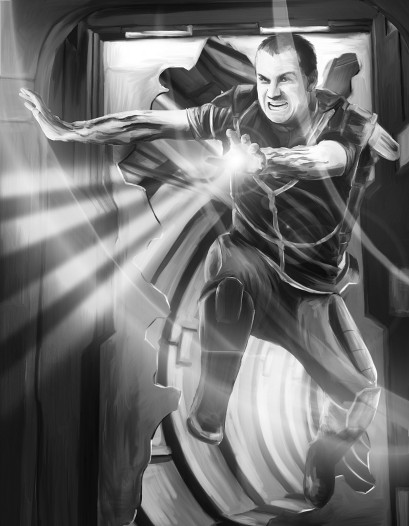 This week’s preview of Mindjammer – The Roleplaying Game is a special two-parter, showcasing how we’re using extras to power equipment, and especially the cool genurgic, virtual, and cybernetic / mechanical modifications called enhancements, potentially a key part of your Mindjammer character.
In Fate 3rd edition, the concept of stunts or stunt packages which didn’t directly derive from a single skill was always a little problematic, sitting in an uncomfortable “unofficial space”, usually together with occupations or in an out-of-the-way part of chapters dealing with alien powers. Fate Core, with its immensely flexible Extras rules, brings them back centre stage, removing the overload which previously stunts had to bear. As we’ve touched on in previous previews, Mindjammer uses extras extensively; in fact, there’s an entire chapter dedicated to them.
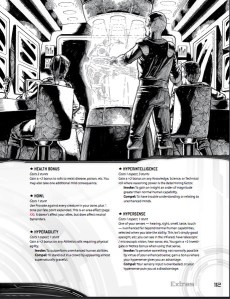
(Click to open)
So how does that work in practice? That’s where this week’s second preview comes in, showcasing four pages from Chapter 8: Technology. There you can see a small selection of the essays on Mindjammer‘s technological paradigms, followed by the first part of the section on genurgic mods, which are Mindjammer‘s biotechnological augmentations. Take a look at those. On page 120, you can see a couple of mods described – these are the ones which don’t form a direct one-to-one match with the special abilities in Chapter 7. On the following two pages, you can see the full list of genurgic mods available to your organic (flesh and bone) characters; in many cases, they are instances of the Chapter 7 special abilities – examples of the possible forms those abilities can take when implemented via biotech.
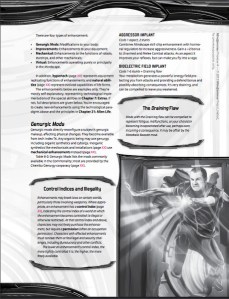
(Click to open)
That’s it for this week’s preview. We’re approaching the final throes of layout here at Mindjammer Central, and we’re tentatively eyeing early next month to open for pre-orders of the Mindjammer physical version and providing you with the bumper PDF – I’ll keep you posted here and at the Mindjammer Facebook and Google+ pages, as well as at MindjammerPress.com, as those dates become clearer. In the meantime, if you have any questions, please let me know!
Next time, I’ll take a look at the virtual world of Mindjammer – the ubiquitous and powerful Mindscape, and what it means for your character and your Mindjammer game.
Happy gaming!
Sarah
*****
This week’s artwork is by the talented Eric Lofgren and Marco Morte.
Tunnels & Trolls RPG – Looking Forwards to Deluxe
 So I was reading Tunnels & Trolls 5th edition again, and comparing it to 7.5. I’m still a huge fan of 5th – I think the GMing advice is crucial, and Liz Danforth’s editing style makes the book at once intimate, friendly, and very clear. However, I do like the Talents rule from 7.5 – it’s very neat, and interfaces with the T&T paradigm very smoothly. I also love the Spite Damage mechanic, especially when you start breaking it out into a “power die” approach for special abilities, as 7.5 implies you can with its monstrous powers. Very cool.
There seems one huge difference, though – and bear in mind I’ve never played 7.5, only 5th ed. Namely, the way in which damage is shared out amongst the members of a losing side in a combat (what The Kids today would call a “group extended contest”). 5th ed states the damage is shared out as equally as poss among participants, with any low damage going to the wizard; 7th ed states you can share it however the losing side wants.
This is a massive difference. If you have a warrior in your party – even one with a measly leather armour and buckler shield – they can easily have 18 or more armour points. In a melee, that’s a massive soak; in 5th ed, it protects the warrior, but in 7.5, it effectively protects the whole party from harm.
One thing I’m hoping for from the upcoming Deluxe T&T is a discussion, either in the rules or in the community, about the “player tricks” you can do with Saving Rolls, etc, which spruce up T&T conflicts, making them more tactical, etc. A typical example in 5th ed might be the warrior making a Dexterity or even Charisma SR to try and attract multiple attacks to him, taking a greater share of the Hit Point Total than the “equal share” method would give him, effectively making him more effective and more protective in combat. In 7.5, that option is removed by the “share as you like” approach to the HPT.
Anyhow, just musings about Tunnels & Trolls, which I’m re-appraising these days as such a cool little system. It was the first RPG I ever owned, way back in 1980, and I played the hell out of it. I’m looking forwards to reading the new incarnation, especially in the light of the various indie and narrative games about these days that I think owe a hidden debt to its innovative mechanics.
Oh, yes, and I played Buffalo Castle last night, too. First time in *harrumph* *cough* -ty years. 🙂
Rich delvings and mighty thews to all!
Myrella the Much-Dinted, Who Will One Day Wield a Great Shamsheer…
ps: remind me to post about “opposed rolls” in T&T too. Some cool nuggets there…
Mindjammer RPG: Character Skills and Stunts
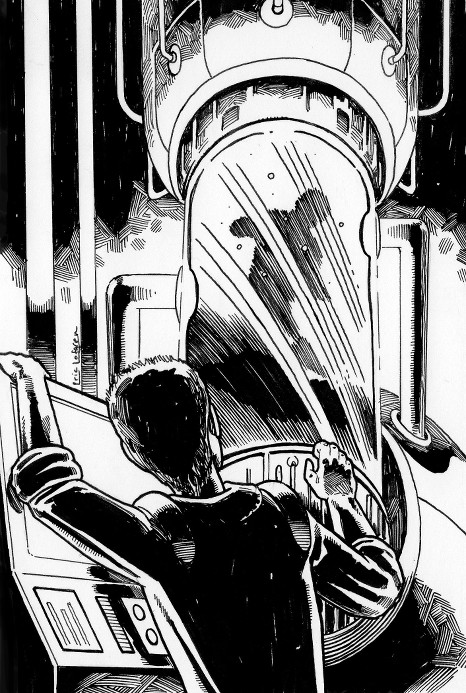 Last week I took a look at occupations in our upcoming Mindjammer 2nd edition roleplaying game. This week I’d like to focus on character skills and stunts.
As you might expect, Mindjammer customises the Fate Core skills list, though to a fairly limited extent. We have a Drive and a Pilot skill; and Unarmed Combat, Ranged Combat, and Melee Combat skills. Burglary is renamed “Intrusion”, and Craft is renamed “Technical”; as well as Knowledge, we have a Science skill. We’ve added a Bureaucracy skill.
And that’s about it. Noticeable by their absence are Leadership and Technopsi from Mindjammer 1st edition; for Leadership, we’ve gone with the Fate Core thinking that Leadership was a bit “meta”, and we’re focussing on the use of skills like Rapport, Empathy, Provoke, and Deceive for leadership activities. What we’ve done with technopsi represents an overall design philosophy for Mindjammer 2nd edition; rather than isolating technopsi activities as a separate skill, technopsi is now one of the various contexts in which you can take actions – so if you have a Mindscape implant, and in some cases certain stunts, then you can use any appropriate skill for technopsi actions. You can use Investigate with your Personal Sensor Array for technopsi sensorview; you can use Will for mindburn; and Pilot or Drive to remote control a vehicle, etc, using the Mindscape. It’s a much more organic approach to Mindscape activities, building them into the game from the ground up, and in play it allows you a lot more flexibility.
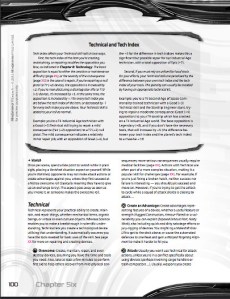
For stunts, we’ve aimed as much as possible to follow Fate Core in taking some of the overload off stunts which they had in Fate 3. Starblazer Adventures and Legends of Anglerre in particular put a huge emphasis on stunts – including some very elaborate stunt trees – as part of character advancement, so that as characters advanced, the number and nature of their stunts became overwhelmingly important, and the rulesbooks gave disproportionate space to an ever-increasing list of stunts. We’ve reined that in; with Fate Core‘s extras, we now have a very flexible tool for use in character advancement, far more multidimensional and less onerous. As a result, we’ve flattened the stunt hierarchy, and as much as possible restricted ourselves to the number of pregenerated stunts we’ve provided. In today’s preview, you can see the Technical skill, which has the longest set of stunts out of all the game’s skills (most of which have just a handful). Given that Mindjammer is a science-fiction game, and given the depth of the setting and the variety of actions scientific and technical characters can take, we hope you’ll forgive us – in a sense, Technical stunts are to scientists and technicians what weapons and armour are to military characters – the arsenal they’ll use for cool and game-significant actions.
(Click to open)
As a final point, take a look at the “Technical and Tech Index” text box on page 100. There’s a bit of design philosophy there; that text box explains a pretty thorough way of using relative tech indices in play to deepen your use of the Technical skill. If you want to. That last bit is key: all through Mindjammer we’ve tried to present rules and background incrementally, so you can use as much or as little complexity as you want. Mindjammer is a big game; it’s a complete, full-featured science-fiction RPG, with rules for characters, starships, constructs, robots, aliens, cultures, organisations, planets, civilisations, star systems, stellar bodies, alien life, biospheres, ecosystems, astrography, transhumanism, mutations, gear, enhancements, technopsi, trading, salvage, mining, espionage, cultural ops… you get the picture. We’ve tried to include all the rules and a big chunk of background in a single volume, to clear the way for the campaign supplements and setting sourcebooks to come; it’s everything you’ll need in a single volume. But at the same time we’ve tried to structure the book in a way that’s easy to dip into and quick to play – in each chapter, any complexity is always optional, and you can play pretty much with the basic rules in Chapter 2, and maybe some of the extras in the Technology chapter. Then you can add in the extra bits you want for your game, as and when you want them. That Technical text box on page 100 is typical; it’s there if your game is going to rock with that degree of attention paid to Technical skill actions, but completely optional if, say, your game is more about military sci-fi or personal interaction.
That’s it for this week – I hope you’re enjoying what you’re seeing! Next week, we’ll have a look at some of the cool things that are coming up for Mindjammer equipment. Time to fire up that sentient starship character and take his humanoid avatar extra out of stasis!
Cheers,
Sarah
Let us know if you have any questions, or would like me to talk about something specific in these posts. Drop me a message here, or come and join us at the Mindjammer Google+ Community. See you there!
This week’s artwork is “Eidolon Engineer”, by the awesome Eric Lofgren. Eric’s work features extensively in Mindjammer – The Roleplaying Game, and I’m chuffed to bits to have him on board!
Mindjammer RPG: Occupations
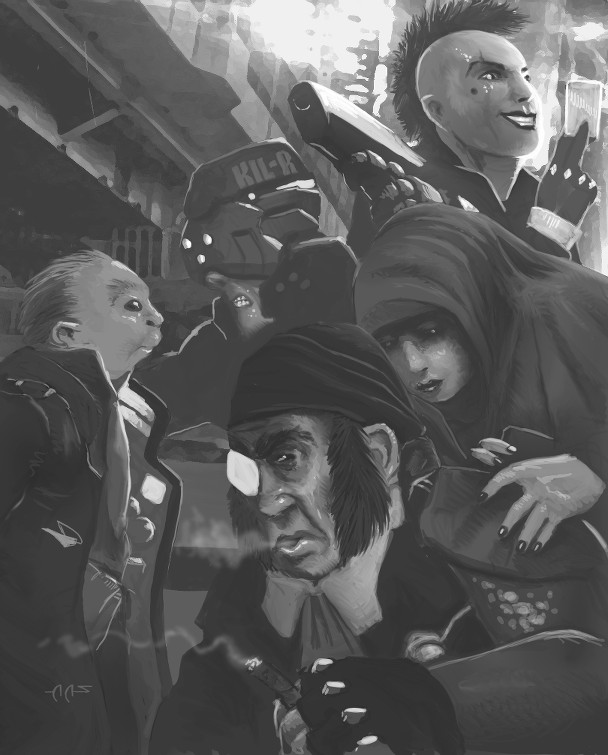 This week I’d like to talk a little more about occupations in Mindjammer – The Roleplaying Game. As you’ll see from the preview PDF, occupations work similarly to the cultures I talked about a couple of weeks ago – aggregations of high concepts, troubles, suggested skills, stunts, enhancements, and equipment, to help to create a Mindjammer character quickly and easily.
Occupations are never set in stone – you don’t have to take one, and the ones that are given in the core book can be tweaked and changed to fit whatever your character concept is. But they’re a very handy shorthand, as well as a way of describing some of the character archetypes in the Mindjammer setting. An occupation is a top-level broad type of character – there’s a military occupation, a merchant occupation, a spacer occupation, and so on, pretty much self-explanatory and covering what you’d expect. Each occupation contains a number of builds, which is where it gets fun. Each build specifically proposes the high concepts, troubles, and skills, stunts, and other abilities which are its tools of the trade, as well as a description of how that build fits into Commonality society (or not…). Builds are really where the archetypes shine, and where the Mindjammer setting hooks right into your character. Sure, you might have a Security occupation – but are you a CORESEC enforcer, a culture agent, or a gestalt controller?
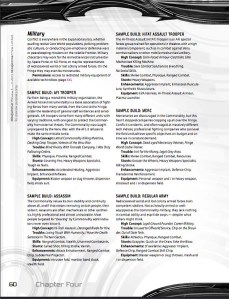 This chapter is where you can see those archetypes, and create characters based on them. If you need a character in a hurry, you can copy out the suggested abilities straight onto your character sheet, and get playing right away. We expect in general though you’ll modify the builds as you go, customising them based on your character’s backstory. Occupations generally contain more abilities than a beginning character can take, so there’s also a ready-made advancement path if you want it. You can also change occupations, and of course invent your own; and, if you’re the type to push the envelope, later in the book we present a number of post-human occupations and builds, where you can get seriously transhuman. More on that in a future post.
One thing I wanted to draw your attention to in this week’s preview; take a look at the Memetic Engineer build in the Sci-Tech occupation on page 63. You’ll see that build suggests stunts like Cultural Intrusion, Cultural Redaction, and Memetic Engineer; these allow you to use your skills in hugely differing contexts. In this case, they let you use your Intrusion (the Mindjammer name for the Burglary skill), Empathy, and Technical skills in actions against whole cultures. That’s right; with the Cultural Redaction skill, you can restore damage done to entire cultures; with Memetic Engineer, you can even change them. Cultures are a big deal in Mindjammer (certainly not the only deal, but a big one); but the same principle works for actions against starships, space stations, organisations such as governments and instrumentalities, and so on. The ability to take a stunt to act in a radically different context is central to the game.
Lastly, check out that “Culture as Extra” entry at the end of the Memetic Engineer build. This is just like Max Proffitt having the Rosemary Princess starship as an extra, except you can use a whole culture as if it was part of your character. If you want to make cultural ops part of your game, you can begin to see how; but the same goes for all kinds of other entities – including clandestine organisations for special ops, espionage, and conspiracy / political games. And when you take the same principle into the Mindscape… You get the picture.
Take a look! If you have any questions, fire away, either here or at our Google+ Community. Work on layout is proceeding apace here at Mindjammer Central – join me here next week for another update as we approach launch.
Cheers,
Sarah
OS X Mavericks – File Tagging
 Two years ago, after twenty years of PCs, I became a Mac user. One of the big reasons, in addition to the stability and reliability of OS X and its software and the Mac hardware, was the integrated way Apple products simply work with one another. I’d already had a 1st gen iPad from launch, so upgrading to a Macbook and soon after an Apple TV was a no-brainer – and they all worked together, seamlessly. Awesome.
The iCloud, however, not so much. Sure, it was a cool idea – all my Apple devices sharing a common online storage area – but the implementation didn’t meet my needs. It was basically flat – no nested file system which I, and indeed the whole world, had got used to over decades. It felt like a completely separate storage space, a massive undifferentiated digital bin-liner, sharing no paradigm with the file system I used on the Macbook, and indeed which other cloud services like Dropbox used so well. The iPad’s flat (and siloed) file system was a pain in the neck to use, so the idea of porting that to my main work machine was… ugh. Just, no.
So the iCloud languished. The one thing it was good for was seamlessly sharing a file between the iPad and the Macbook – say, working on a Pages document on the Macbook, saving it to iCloud, then opening it up when travelling to work on it on the iPad. Ideal. But, even there, there were problems: Pages on the iPad, for some bizarre reason, only had a subset of fonts, so you couldn’t trust the iPad not to screw up formatting if you didn’t use its limited font set for your document, even on the Macbook. And, second, the flat file system again; that massive bin-liner of documents in the iCloud meant sorting through documents was a pain, the moment you had, say, more than a couple of dozen.
All this is why, having updated to OS X Mavericks today, I’m very interested to see “file tagging” introduced to the Mac file system. What’s file tagging? Well, exactly what it says on the tin: you can save a document from any application with one or more textual “tags”, irrespective of where it lives. You can even go into the Finder and change and add tags to a document without opening it. Then, in Finder, you can click on a tag as though it was a folder, and see all documents tagged with it. So it’s basically like iMap folders or Gmail labels, only for documents on your file system.
This is interesting for one big reason. When Apple introduced the iCloud, I remember the announcement that they were “trying to move away” from the traditional file system paradigm of multiple nested folders. Obviously the old folder paradigm begins to crumble pretty quickly when you start sharing documents between machines, and particularly when you share them between people. If you’re working on a document on your iPhone, iPad, and laptop, you want it to just “be there” – you don’t want to have to be remembering where you put it. Likewise if you share that document with someone else – version control means things get snafu’d pretty quickly.
File tags seem to be a huge step towards that new paradigm. They offer an alternative to the traditional file system which is device agnostic, and which allows devices to easily address / use the same file. Very importantly, they allow for “virtual folders” to be shared between the file system and the iCloud (I think – I haven’t tested this yet), which if true will overcome a big limitation of iCloud so far. I’m looking forwards to playing around with it.
Will the replacement paradigm actually work? Well, there are a lot of questions, even with file tagging right now. What’s the theory when you share a document with someone? Do the tags get saved with the document and passed on to someone else? I’m not sure. iCloud seems more structured towards a single user’s shared file system across multiple devices, rather than the single file system, multiple users approach of, say, Dropbox. But there’s a redundancy there. Surely iCloud’s going to have to be multi-user too?
So, for the time being, I’ll be playing with file tagging, but not using it in anger. There are still a lot of unknowns – we’ve all got wedded to the nested folder file system over the past 30 years or so and Dropbox seems to be a good compromise between shareability and intuitive multi-device access. But I appreciate what Apple are trying to do, here – to take away the administrative overhead of managing a multi-level nested file system of zillions of files, in favour of a looser, more work-based approach. It’s a scary thought, letting go of the rigid structure of nested folders, but the ease-of-use of a set of devices which intelligently remember what you’re doing is surely the way ahead.
Maybe.
*****















 Sarah Newton