Mindjammer RPG: Genotypes and Extras
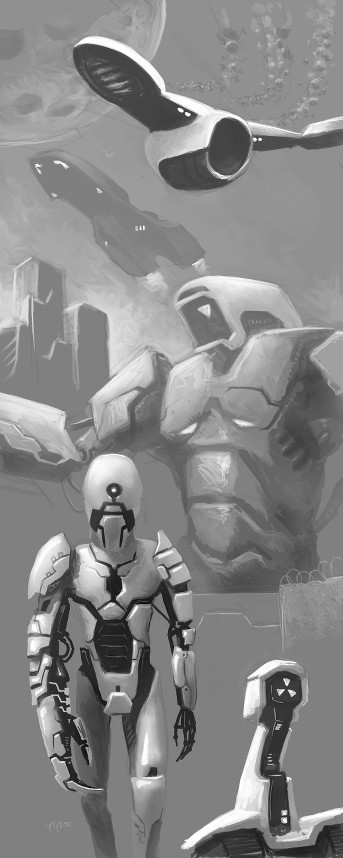 Last week we looked at the upcoming Mindjammer – The Roleplaying Game very broadly, talking about the kinds of transhuman science-fiction games you can play. This week I’d like to drill down a bit into the details, and take a look at one of the ways in which Mindjammer uses the new Fate Core “Extras” rules.
When you create a Mindjammer character, you generally choose a culture, a genotype, and an occupation, which in turn help you define things like your high concept, trouble, skills, stunts, and contribute to your phase trio. In many ways you can view cultures, genotypes, and occupations as extras, although to be precise they’re aggregations of these.
This week’s preview contains four pages from Chapter 4: Cultures, Genotypes, and Occupations, showing some of the pregenerated genotypes you can select for your characters (guidelines are also provided, like most things, for creating your own). In the preview you’ll see sections from two genotype groups – synthetics, representing created life forms; and hominids, also known as homo variens, representing the many divergent spin-offs from homo sapiens found through Commonality Space and beyond. Mindjammer provides many more genotypes, but these are a good start to get a handle on how they use extras.
In Mindjammer, a genotype is basically your “race” or “species” – there are genotypes for humans, xenomorphs, hominids, installations, aliens, and so on. Your genotype describes the parameters of what your character is capable of, physically and mentally, and offers examples of the typical occupations he might choose, as well as typical aspects, skills, and stunts. They’re templates to help you create your character, as well as blueprints for the GM to quickly generate a representative NPC from that genotype.
Check out the “Installations” genotype on page 47. That’s the genotype you select if you want to play, for example, a sentient starship character, though you can play other installations, too – you could have a character who’s a space station, or a node mind operating a global Mindscape, or even a massive sky or star city, a grav tank, grav base, or more. In the Installations genotype you’ll see suggestions for occupations – you don’t have to choose one of these, but they’re a good place to start. Then you’ll see two entries for “Typical Enhancements” and “Mandatory Extras”. These are both extras in Fate Core terms – special stunts, skills, or aspects, or aggregations of two or more of these, which your character can take using his or her extras budget, and which represent abilities, equipment, etc, which are somehow fully or partly external to your character.
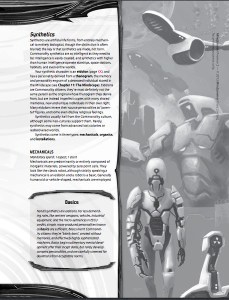
Click to enlarge
Next, look at “Mandatory Extras”. This is as it sounds – the “Human” genotype is the norm in Mindjammer, and the further your character goes from this, the more likely it is that some of his abilities, and specially his extras, are going to be pre-decided. For extras, your starship character actually gets off pretty lightly; he must spend his extras budget’s aspect point on the Mindscape Instance extra, which is basically the mechanical / installation version of the Mindscape implant – it connects your starship character to the Mindscape, but also gives him a small portable version of the Mindscape he can transport in his hull, which can be useful in missions beyond the Commonality Frontier.
Below that, you’ll see one more “mandatory spend” for an installation character – this time an aspect. If you’re an installation, you must take the “Exotic Transhuman Intelligence” aspect, or something derived from it, as one of your aspects. You might be able to roll it up in your high concept (in fact, this particular aspect is easy to do that with), but either way you must incorporate it into your character sheet.
Some genotypes have more onerous mandatory spends: the Chembu, also on page 47, must spend 3 aspects and 1 stunt on abilities determined by their genotype, and they also get a flaw, a negative aspect, in addition to their usual aspects.
Extras are a very versatile tool in Fate Core; using them for “external” abilities such as genurgic modifications, mechanical enhancements, and equipment is an easy and obvious way of using them, and Mindjammer‘s “Extras” and “Technology” chapters provide lots of examples of these. But there are other cool things you can do with extras, too – a couple of weeks ago we looked at Max Proffitt’s “starship extra” for the Rosemary Princess as an example.
In our next preview, we’ll take a look at occupations, and how they incorporate extras more broadly into your character.
Cheers,
Sarah
*****
This week’s preview’s art is by the awesome Andreas Schroth, whose work graces many of the pages of Mindjammer – The Roleplaying Game.
Mindjammer RPG – Transhuman Science-Fiction Roleplaying
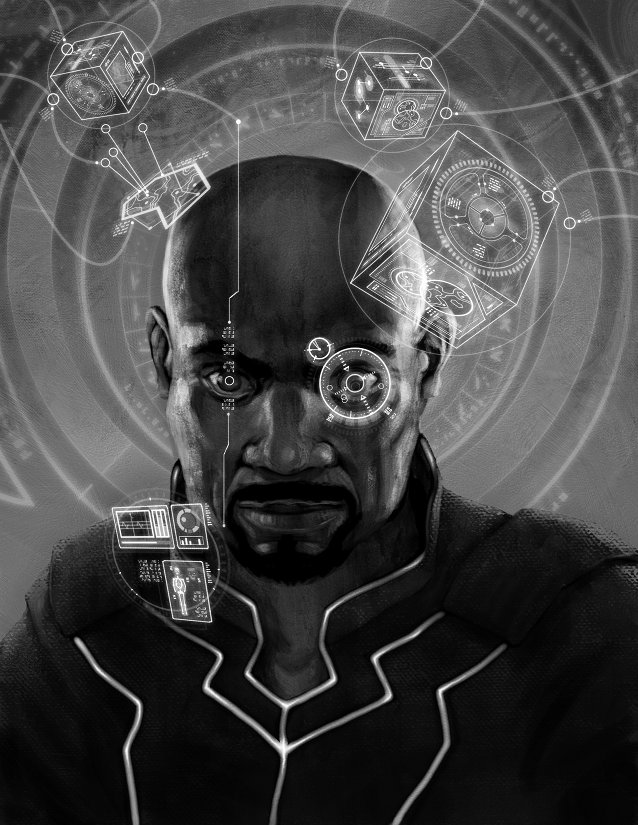 That picture on the right-hand side – by the awesome Jason Juta – is Thaddeus Clay, a culture agent controller from the Security and Cultural Integrity Instrumentality, better known as SCI Force. The ghost images around his head represent his virtual vision – his view into the Mindscape, the vast interstellar shared information storage and communications medium, provided by his Mindscape implant. As a SCI Force controller, Clay isn’t just able to communicate his thoughts to others, to upload and download memories and sensory impressions – known as thoughtcasts – to the Mindscape, but he’s also able to interact directly with other people’s implants, sometimes even reading surface thoughts, making suggestions, and investigating their contacts, actions, and even what enhancements and abilities they have – a phenomenon known as technopsi. He’s wearing a p-suit – a suit of intelligent adaptive weave armour, with a built-in bio-med array and personal sensor suite – with a collar in the shape of the SCI Force insignia.
Clay’s job is simple: to lead a team of culture agents in missions on worlds deep in cultural conflict, whether resisting integration into the Commonality, or threatening the Commonality with dangerous memes and other ideologies. Cultural ops can be as big as changing the mindset of an entire culture, or as small-scale as removing a dangerous despot from power.
Clay is an example of just one sort of character you can play in Mindjammer – The Roleplaying Game. The game provides rules for cultural operations, Mindscape activities, interacting with worlds, cultures, and organisations, and changing the way they think and do business, as violently or as peacefully as you need.
But there’s so much more. Last week I posted the character sheet for Max Proffitt, one of the “New Traders”, the rag-tag bunch of ne’er-do-wells, freelancers, and rogues who ply the spacelanes at the Commonality’s edges, running cultural embargoes and taking advantage of the many commercial opportunities thrown up by the great cultural chaos known as the Rediscovery. Mindjammer provides unique rules for trading campaigns, tailored for the post-scarcity economy of the New Commonality of Humankind and the often violent clash of cultures on its frontier.
The Commonality is a vast place. Commonality Space is some 3000 light years across, with tens of thousands of worlds, whether fledgling settlements, synth-colonies, or Lost Colony worlds settled during the ancient First Age of Space. Conflict is everywhere – sometimes political, filled with intrigue and high-stakes gambits; sometimes military, as worlds violently resist the Commonality’s overtures; sometimes personal, as individuals go beyond what it means to be human, interacting with the Planetary Intelligence, embarking upon post-human evolutionary paths.
 The document to your left is a 3-page preview from our upcoming Mindjammer – The Roleplaying Game, available November 2013. It’s from the introduction chapter, and gives you a breakdown of what you can find in this bumper hardback’s 24 chapters. We’ve tried to cater for all your favourite science-fiction campaign styles in the game: you can play explorers beyond the Fringe, searching for new worlds and lost civilisations, identifying and even contacting bizarre alien life forms; cyborgs and transhumans in the byzantine underworlds of the Core Worlds; hardened mercs on the Frontier, fighting for all sides; uplifted animals resisting Venu incursions in the nascent Sentient Alliance; Space Force pilots patrolling the Q-Zone; contact teams, traders, scientists, and more. You can play divergent hominids, augmented humans, synthetics, xenomorph uplifts, even aliens. You can even play sentient starships as characters, and join your away teams in remote avatars. Mindjammer runs the gamut of science-fiction genres, tropes, and styles, from gritty to heroic, space opera to hard SF, light to dark.
Next week, we’ll take a look at some of the things we’ve done in the game with the Fate Core extras rules, beginning with the cultures, genotypes, and character occupations. Let us know what you think – and if you have any questions, fire away!
Cheers,
Sarah
Mindjammer RPG – At last it’s coming!
After almost a year on the biggest roleplaying game project I’ve ever worked on, it’s coming at last. The Mindjammer 2nd edition roleplaying game, built from the ground up using the brand-new Fate Core engine, is almost here!
It’s amazing to think that it’s now just over 3 years since the first edition Mindjammer (“Starblazer Adventures in the Second Age of Space”) won the Judges Spotlight Award at the 2010 ENnies. The time between then and now has flown – and seen a complete re-think to the Mindjammer game as first we’ve launched Mindjammer Press, and second we’ve re-tooled the whole game to work with the awesome 4th edition Fate Core RPG, published by Evil Hat Productions this year. We’ve gone from an 80,000-word softback supplement for Starblazer Adventures, with artwork from the old Starblazer comics, to a brand new hardback game over twice the size, completely standalone, and the beginning of a brand new line of Mindjammer products.
But now we’re approaching the end of that process. The new roleplaying game, Mindjammer – Transhuman Adventure in the Second Age of Space, is in layout, and we’re gradually approaching launch. We’re expecting the PDF to go on sale in late November, with the hardback to follow. Watch this space…
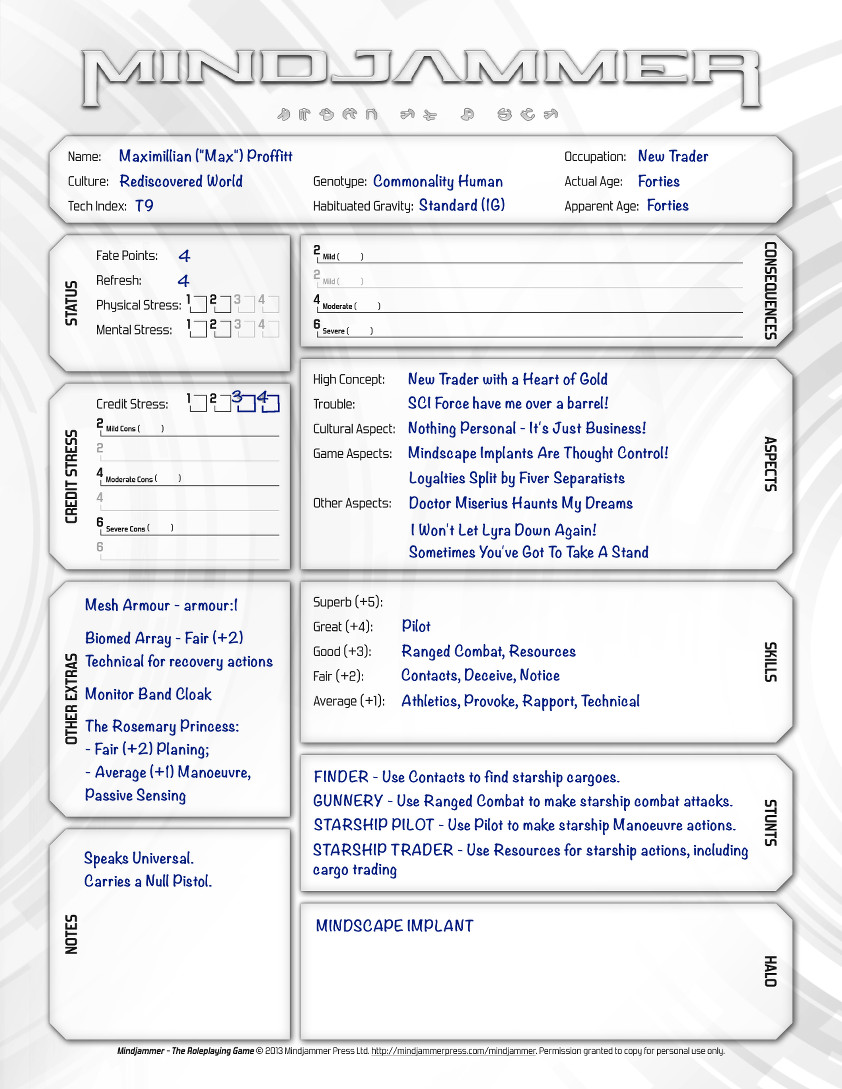
Over the coming weeks in the build-up to launch I’m going to be blogging about the new game – showcasing artwork, presenting concepts and snippets from the core book, and trying my best to answer questions. Today we’re making a modest start, with the introduction of the new character writeup for Max Proffitt, roguish new trader and hero of 1st edition Mindjammer and the Mindjammer novel.
Click to enlarge
Next, check out the Halo section on Max’s character sheet. Max only has his Mindscape Implant in there, but other characters (think Thaddeus Clay or Jackson Stark) have other abilities, too. Your halo is all those abilities you have because of your access to the Mindscape. That includes things like skill chips, exomemories, technopsi abilities, even remote and virtual enhancements and some genurgic abilities (like Mindscape-fuelled hyperintelligence). Your halo abilities, while being private to you, are to some extent exposed via the Mindscape to unscrupulous hackers, and can be interfered with, damaged, and even stolen by those with special ops implants or black chips. There are lots of other cool things you can do with your halo – it’s where your individual personality begins to touch with the great virtual medium of the Mindscape, and gradually coalesce with the minds and personalities of others. In the new Mindjammer, we’ve made your character’s halo something directly accessible by the rules.
 There are other things on this character sheet too – you’ll see some renamed skills, and the presence of a credit stress track for those games where you just have to get into corporacies, organisations, and even interstellar trading. There’s a whole section on what interstellar trading even means in the Commonality of the 17th millennium. Economically speaking, interstellar trading is always difficult to justify in science-fiction – it’s usually vastly more efficient to manufacture something in a star system than transport it between the stars – but we’ve tied the whole concept in with the Mindscape, Rediscovery, the Expansionary Era, embargoes, and an up-to-date take on resources and the nature and make-up of star systems and planets, to provide what we hope will be a compelling new way to run science-fiction trading campaigns if that’s what you want.
Of course, Mindjammer is a complete transhuman science-fiction game, and there are many ways to play. Next week, I’ll take a look at the themes, tropes, and styles of play Mindjammer addresses, and sort of the many different kinds of game it supports. In the meantime, drop me a line below if you have any questions, or come and join us at the Mindjammer Google+ community as we approach the launch of Mindjammer – The Roleplaying Game!
All the best,
Sarah
*****
A Rejoinder to James Burke’s “In the Year 2100”
 Yesterday the BBC posted a video article by James Burke on his predictions for the year 2100AD – 87 years from now. You can view the video here.
It’s an interesting report, not the least for James Burke’s wonderful naivity. In the three-minute video, he happily proclaims the end of hunger, deprivation, poverty, and disease, all thanks to the promise of nanotechnology and the biotech revolution which the 21st century is already promising us.
He isn’t the first pundit – or even scientist – to have fallen into the trap of equating technological progress with social development. When I was growing up, the television was full of promises that the early 21st century would see a time of great prosperity, increased leisure time, the reduction of the working week to 4, 3, or even 2 days, perhaps even part time, as the robotic and computer revolution worked to produce an efficient system of production which saved us all a great deal of labour to spend our lives on more worthwhile endeavours.
Go back further, you’ll find the same promise coming from: the washing machine, the fridge, and the hoover; the mangle; the steam engine; the factory system; the printing press. I bet the guys and girls who thought up the wheel and that rubbing two sticks together thing thought they were on the cusp of paradise too.
The thing is, there’s already more than enough stuff to go around in the world we live in today. We could fix world hunger overnight right now if we wanted to. We have the money; it’s just it’s concentrated in the hands of the rich, and our governments seem keen to keep it that way, and to bombing the crap out of anyone who disagrees strongly enough. Having the technological capability to usher in utopia isn’t enough; there has to be the social will to do so, and the legal, social, and even military framework to stand up to those who would prevent it.
Capitalism by its definition requires scarcity to operate. If scarcity doesn’t exist, then capitalism creates it – by whatever means is to hand. Often that’s war – the traditional way of removing the problem of overproduction. That’s simply how it works. In the same way industry creates things to wear out, you can bet your life that James Burke’s dreamy future nanoreplicators will come with built-in obsolescence, user credits, subscriptions, etc, etc, to actively work against the unlimited post-scarcity model they would seem to offer.
Think about it: in the digital space, we have a post-scarcity situation already: we can “nano-replicate” music, movies, PDFs, books, all kinds of data, for free, without limit. “You wouldn’t steal a car” drones the tedious DVD “piracy warning” which we’re forced to watch whenever we’ve already paid for a movie; well, you bloody well might if you could make an exact copy of that car and leave an identical untouched original in its place. Would it even be stealing? Words, words. However you look at it, capitalism right now is hysterically trying to introduce obstacles to that digital post-scarcity system we already have – to prevent the ubiquitous free availability of “nano-created” digital materials from getting a hold in our societies and wreaking profound changes to our economic status quo. Why is that, do you think?
They’ll fail, ultimately, for sure: but not without a huge fight. I think James Burke is naively overlooking the fact that we’ll require major social change to enable his post-scarcity utopia.
So how about it, James? How about trying to come up with a road-map to the year 2100AD that you’ve shown us? It’s a wonderful idea, and I (like most sane people) would support it 100%. But how on earth are we going to get there?
It’s not a technological hurdle we face; it’s a social one.
Sarah
Normandy, October 2013
GenCon 2013

This year I’m not at GenCon, for the second year running, as we work to build up Mindjammer Press from its foundation roughly a year ago. All being well we’ll be there in 2014. However, even though we’re not there in person, Mindjammer Press is represented by the print version of our new “old school fantasy, new school play” OSR roleplaying game, Monsters & Magic, which launched at GenCon just yesterday! It’s available on the Chronicle City booth (booth 1751) for just $24.99, a 140-page softback complete roleplaying game using our new RPG engine, the “Effect Engine”, and featuring artwork by industry stalwarts such as Jennell Jaquays, Eric Lofgren, Brad McDevitt, Linda Jones, and Gillian Pearce, and of course that gorgeous cover by the inimitable Jason Juta. Check out a copy today if you’re at GenCon – and if not you can order print copies directly from the Chronicle City webstore, or purchase the PDF at DriveThru RPG. It’s been getting great reviews, and we have a growing site of material at Mindjammer Press, and a thriving Google+ community. See you there!
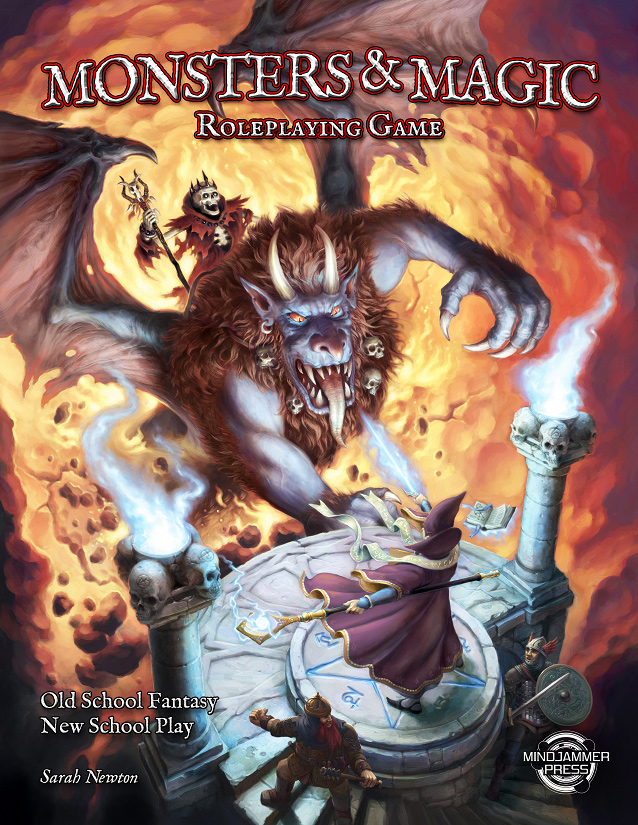
Monsters & Magic RPG
Also at GenCon this year I’m absolutely delighted to have been nominated for an ENnie Award in the Best Adventure category for my scenario Achtung! Cthulhu: Three Kings, published by Chris Birch’s Modiphius Entertainment and Angus Abranson’s Chronicle City. It’s the first in a series of World War 2 Cthulhu scenarios for Call of Cthulhu, Realms of Cthulhu, and Trail of Cthulhu, forming an overarching campaign called “Zero Point” which will take you right through the Second World War and beyond. The second part, Heroes of the Sea, is already available, and part three, Code of Honour, appears early in the new year. The ENnie Awards voting finished a couple of weeks ago, and the awards ceremony is tonight (!); the competition is very stiff, and there are some awesome fellow nominees with whom I feel very honoured to share the roster, so we’re all keeping our fingers-crossed here at Mindjammer Central!
You can buy “Achtung! Cthulhu: Three Kings” in PDF at DriveThru RPG, and in print version from the Chronicle City webstore.
Farewell to the World Speculative Fiction Blog
So there it is. The World SF Blog is closing its doors.
For the past year and a half I’ve had the great good fortune to be fiction editor of the World SF Blog, the online magazine of stories and articles on the subject of speculative fiction from all across the world. I’ve had the privilege of working with Lavie Tidhar, the blog’s creator and editor-in-chief, and Charles Tan, its assistant editor, as well as with so many talented writers, reviewers, bloggers and creators. Together we’ve been part of a dialogue about the changing nature of speculative fiction, almost a microcosm of our nascent creative global culture, which has been a fascinating, stimulating, and occasionally giddying and even humbling journey. My perspectives have been shattered and overturned repeatedly, and like all SF junkies I’ve returned for more, wide-eyed and heady with changing airs. I’ve been afforded glimpses into the processes of writers, working with them to edit and proof their works, and in many cases help those works achieve their first flight into the wider world. What a ride!
This spring in Bradford, at Eastercon 2013 / 8 Squared, I had the most unexpected of experiences, receiving the BSFA Award for the blog on behalf of Lavie and Charles. A truly special moment – a culmination. It’s always sad to see something end, but – what a wonderful position to end from!
Thanks to everyone who’s supported us, visited the site, submitted stories, articles, and content, and made the World SF Blog such an unforgettable experience. There’s so much more to say, of course, but it’s time to pass the torch on to other fora. Speculative fiction, like our world in these revolutionary times, is in constant flux, reinventing itself at every turn. Nothing stays still, and I look forwards to seeing what will take its place. Something unexpected! Something exciting!
And for us, now that the World SF Blog is flickering in shrinking shells into yesterday? Onward – to other horizons!
Sarah
Normandy, June 2013
Monsters & Magic RPG: Higher-Level Play
 We’re now exactly a week away from our target release date of 12th June 2013 for Monsters & Magic, the new OSR fantasy roleplaying game from Mindjammer Press! That makes today the final preview before release. I’ll keep posting and talking about the game after launch, of course, but today I wanted to post a short teaser from the “Advancement” chapter of the book, giving you a peek into how you can use the rules for higher-level play.
As I mentioned on the Monsters & Magic Google+ community, Monsters & Magic actually allows for play at any level, although the monster statistics and spell lists provided are focussed on the first four levels of play. That’s because we envisage you using your favourite classic fantasy bestiaries and spellbooks with the game; we wanted Monsters & Magic to be a complete and playable game in its own right, so included a core of spells and monsters for you to use right away, but at the same time we didn’t want to reinvent the wheel and include several hundred pages of material you can get easily elsewhere. Not so the rules, however; out of the box, we wanted to make sure you could play your favourite classic fantasy characters, so the rules accommodate play right through 1st to 4th level, then beyond to 10th, 15th, even 20th level.
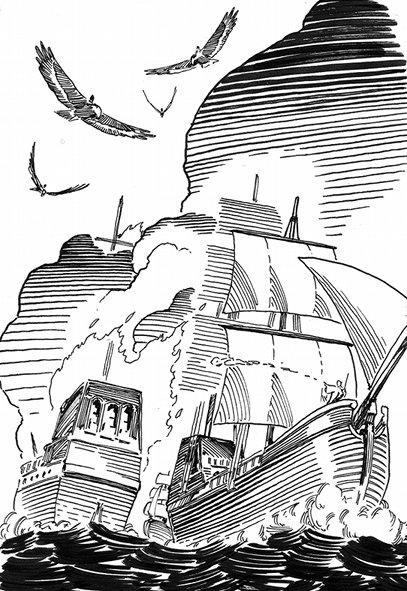 The way we’ve done that is to structure character levels into scales – groupings within which we imagine characters will have different concerns gradually escalating in power, influence, and magnitude. Today’s preview illustrates some of that concept in the epic, legendary, and mythic constructs which characters can buy as advancements, and use in conflicts and actions at higher levels and scales. You’ll also notice an example of play of a relatively simple epic-level conflict – our magic user, Xiola Zenwaith, now 11th level, aboard her sailing ship Princess of Tarnaband, attacking the Demon Tower of Zann!
I hope you find the preview interesting! Today here at Mindjammer Central we’ve just gone into proofreading of the laid out game and, barring any last-minute gotchas, we expect to be launching Monsters & Magic at RPGNow and elsewhere next Wednesday 12th June. I’ll be posting an announcement here and also over at the Mindjammer Press website, and elsewhere. Hope to see you there!
Sarah
Normandy, June 2013
This week’s art preview is by the very talented Eric Lofgren, whose work features extensively in Monsters & Magic. Check out his website here! Feel free to ask any questions or just say hi here, or join us too at the Monsters & Magic Google+ Community.
Monsters & Magic RPG: Example of Play
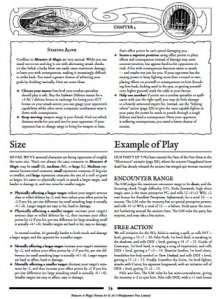
Click to download
You’ll see one of the key aspects of the Effect Engine at work in this preview – the concept of spending the effect points you generate on your action check (usually a dice roll) to create effects and consequences, which allow you to do cool things and drastically affect the tactical balance of play. This is where Monsters & Magic really takes off in play, and its premise is simple: when you describe what your character is trying to do, whatever it is, and you succeed or even fail in your attempt, the consequences of your action have both a descriptive impact and a direct game mechanical impact on play. You’ve got a massive amount of leeway in how you describe your actions – as long as the GM and your fellow players agree what you’re describing is feasible, you can do it. During one of our early playtest sessions, Mormyga the Witch, our resident magic user, cast a Magic Missile at a werewolf and made an incredibly good roll, generating effect points way in excess of the missile’s damage and in fact causing a “major consequence”. “Can I say that the missile struck the werewolf in the head, burning its eyes and half-blinding it?” Sure, I said – that description makes sense. And so the werewolf then had a burned and half-blinded major consequence for the rest of the combat which got in its way when it tried to do most anything – and set it on a spiral which lead to its grisly demise.
 It’s a simple example, and combat-focussed, but hopefully you get the picture. You can create effects and consequences with any action check at all – not just combat and magic, but when intimidating or charming somebody, building a siege engine, commanding an army to attack a castle, or casing a heavily trapped temple before stealing a golden idol. Effects and consequences can provide bonuses and penalties to your checks, and even to other people’s; but they can do lots of other things, too – and you can even create “special effects” which go beyond the framework of what your regular consequences can do. Want to somehow absorb that medusa’s “turn to stone” ability and make it into one of your own special effects? Now’s your chance… your imagination is the only limit.
We hope you like the preview – if you’ve any questions, please stop by our Google+ community and say hi! We’re now probably about 2 weeks or so from launch – possibly even less, as long as there are no gotchas on the way – so next week’s blog post may be the last before we go live. I’ve a few ideas what I might talk about – but how about you? What would you like to know? Let me know here, or over at the Google+ community.
Happy gaming – and may your effects be ever spectacular!
Sarah
Normandy, May 2013
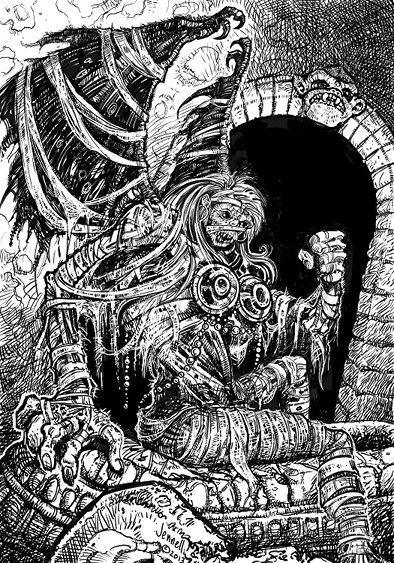
ps: today’s featured artwork – depicting an episode from the Silvermoon scenario in Monsters & Magic, and which stars in the Example of Play in today’s preview, is by the awesome Jennell Jaquays, whose artwork has inspired us all from the very earliest old school days right up until now. We’re proud to have her work in Monsters & Magic – we hope you’ll like it too!
Monsters & Magic RPG: Introducing the Effect Engine

Click to download
Last week, we looked at character creation in our upcoming Monsters & Magic RPG, available June from Mindjammer Press. As the launch date approaches, I’d like to talk a little about the core mechanic of the game – what we’ve called the Effect Engine. We’ll be releasing the Effect Engine under an open license, with its own SRD, so you can use it to power your own games, as well as to tweak and customise how you use Monsters & Magic.
Our design goal with Monsters & Magic has been to create a game which would suit old school games, but also incorporate the latest thinking in RPG mechanics. Most importantly, it would allow you to use your old school and classic fantasy RPG material with little or no conversion, on the fly. The Effect Engine is the result: a flexible core mechanic which takes the traditional classic fantasy attributes and statistics as its “inputs”, ties them into a system of “action checks” (either static or rolled on 3d6 + modifiers), and outputs “effect points” which you can use to cause a wide variety of freely-narratable in-game effects and consequences. Today’s preview showcases two double-page spreads from the game system chapter of Monsters & Magic, introducing the Effect Engine.
So what is the Effect Engine? Simply put, it’s a rules mechanic which generates effect points, which you then spend to create effects. Effects can be almost anything you could “do” with an action – physical or mental damage, knockback, wounds, throwing sand in someone’s eyes, distracting someone, even turning them to stone, on the negative side; but also positive things like getting yourself into superior tactical position, “powering up” before casting a spell, successfully hiding in shadows before your ambush, and so on. Pretty much anything which can result from your action can be an effect, as long as you can describe it.
 The number of effect points you generate on an action check is equal to the amount by which your action check result exceeds the resistance. If you get a check result of, say, 20, against a resistance of 15, you get 5 effect points. If you outclass your opponent, you can generate very high effect point totals, and even create multiple effects. On the flipside, if you fail your action check, you generate consequence points (basically negative effect points), which can result in you coming a cropper – the Effect Engine equivalent of fumbles and botches. But, again, consequences can be descriptive and very varied – and are usually described by your opponent. That’s right; if you screw up your sword strike against that ogre, the ogre gets to say what happens. Or, more likely, the GM…
Effects change how the game plays; they can give bonuses or penalties to your abilities, as well as restrict how you describe what you’re doing and what you can do. There are restrictions on how many and which effects or consequences you can inflict on an opponent, or incur on yourself, and choosing your effects is a freeform yet tactical process, which gives genuine in-game weight to how you describe your character’s actions. There are many cool tweaks and extensions to this broad-brush system, which you’ll be able to read about in detail in the Monsters & Magic core book.
That’s a quick summary of the Effect Engine; check out the Preview for more details, and feel free to stop by at the Monsters & Magic community if you have questions. Next week, I’ll post an Example of Play, so you can see how the Monsters & Magic game works at the table.
Good gaming, and may your dice ever roll true!
Sarah
Normandy, May 2013
Monsters & Magic RPG: Creating Characters
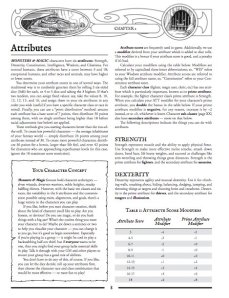
 Last week, I posted a first look at the character sheet for our upcoming OSR RPG Monsters & Magic (out early June), as well as a sample character from the game, Gramfive the Grim. This week I wanted to post a preview of the game’s layout, including some sample pages from Chapter 2: Creating Characters.
As you may have seen last week (check out the post here if not), Monsters & Magic characters look very much like the classic fantasy characters you know and love – they share the same attributes and many of the same statistics. There are some differences, but by and large there’s a lot of crossover. That means, of course, that your classic fantasy characters are very playable using the Monsters & Magic rules. Depending on your tolerances, there’s little or no conversion required, especially at low levels, and even at high levels any conversion you’re doing can probably be handled on the fly, during play.
There are a couple of reasons why. The first is the Effect Engine, the core mechanic of Monsters & Magic. I’m going to go into this a lot more next week, but suffice it to say the Effect Engine takes pretty much all the same “inputs” as your favourite OSR or classic fantasy game – character level, weapon damage, attribute modifiers, other bonuses, etc – but uses them in a unique way to allow you to achieve all manner of cool in-game effects, from damaging your foe, to affecting the local environment, getting yourself into advantageous positions, putting your foe into disadvantageous positions, helping others, and lots more. You can pretty much take your favourite classic fantasy character, look at his character sheet, and roll your action checks using the Effect Engine with what you see written down there.
Preview PDF
In Monsters & Magic, you get traits from three places: your race, your character class, and your individual character (what are called personal traits). So, for example, Infravision is a trait; so is Hide & Sneak. And, of course, you can roll your own, within certain boundaries. The mechanical effect of traits is something I’ll discuss next week, but you get the gist.
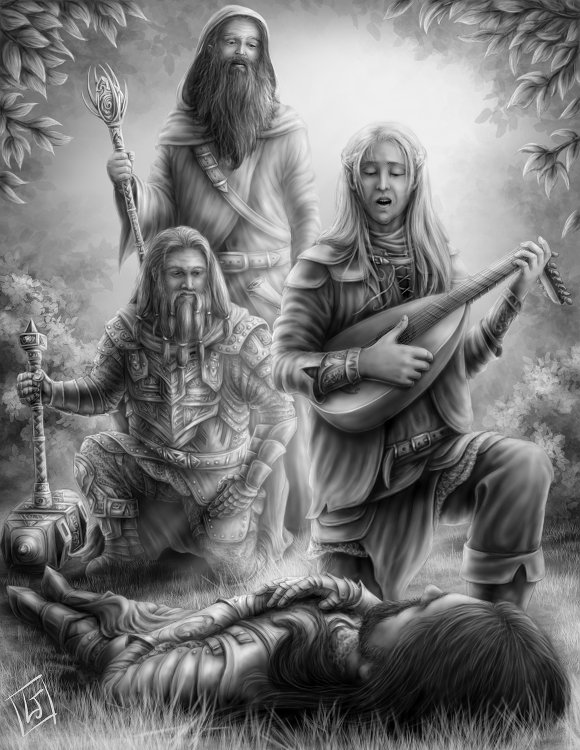
Anyway – we hope you like the preview! The layout design is by the awesome Michal Cross, and the featured artwork by the very talented Eric Lofgren, Linda Jones and Gill Pearce. See you at the next post!
Sarah
Normandy, May 2013
The Monsters & Magic RPG and the 4-page preview presented here are copyright (c) 2013 Mindjammer Press Limited, and will be published under the Open Game License and the Effect Engine Open License. For details please contact info@mindjammer.com.















 Sarah Newton