This Ocean Night
A Mindjammer Story
by Sarah Newton
 The man from Northern Yoosa looked completely lost. He stood on the shining concourse at Chengchi Intercontinental Arrivals in his homespun suit and carrying a battered suitcase, studiously ignoring the open stares from passers-by. If he had stood there in a loincloth and carrying a slaughtered beast over one shoulder he could scarcely have looked more conspicuous. Laoya doubled her pace as she strode up to him, and grasped his free hand and shook it like they’d shown her in prep, smiling all the time and ignoring the look of surprise on his face.
“Mr Chatton, I presume?” she said.
The man stared at her with huge eyes, then nodded. “You speak Yoosan?”
“Yes”, she said, not quite following. “I took a shot as soon as I knew we’d be meeting. How was your flight?”
The man shuddered, casting a glance out of the glassteel walls to the blast berms. “A terrifying way to travel. If God had meant us to hurl ourselves out of the atmosphere he’d never have given us lungs…” He forced a smile back to his face. “Sorry. Force of habit. I’m delighted to be here.”
Laoya smiled, secretly delighted at the mention of God. It blew her mind to think that this was a genuine Primitive – one of the Yoosan tribesfolk still being incorporated into the Commonality. His quaint clothing — something a child could have made with the simplest of helpers — were probably the best his people could provide, painstakingly assembled by elders and craftspeople from their primitive systems of barter and husbandry. Her flesh prickled with goosebumps as she thought of the wastelands – verdant again after centuries of desolation — which had once been the empire of Ancient America. It was like meeting a ghost, a time traveller. What did this all look like to him?
* * *
She’d been thrilled when the mission had come through. Of course it was what she had trained for, at least for the past twenty years — but that was barely enough to scratch the surface of the data the Commonality had gathered since Foundation, with its project to reunite the shattered nations of Earth. She’d pushed the shots to the maximum, enlisting helpers to mitigate the side effects, and had gradually mastered her field. Now she was one of the hallowed clique of a thousand here in Chengchi who knew enough about Earth’s scattered cultures to be entrusted with their revitalisation.
Twenty years! But this man — she dared a sidelong glance at him as he hopped gingerly onto the pedway — was only a few years older than that. Forty, his file had said — and yet he looked old. She wondered if he knew how young he really was.
He was looking out of the pedway, his first glance at Chengchi’s startown. Beyond the blast berms loomed the cyclopean walls of the interplanetary compound, shrouded in the low cloud which had swept in from the Yellow Sea that morning. She felt the low rumble through her feet as an interplanetary transport — probably a fuel tanker on the Titan run, this time of the morning — hurled itself skywards, a slight reddish glow staining the cloud. She heard Chatton gasp.
He was looking at the streets below, his face pale. “So many people… Good God… I had no idea.” There were tears in his eyes. Elevated heart-rate, one of her helpers told her. Shall we apply a sedative?
Scratch that, she told the helpers irritatedly. This was too interesting to bludgeon with drugs. She knew about this from the anthropology shots. “Are you all right, Mr Chatton?” She took his elbow; the shots indicated light physical contact was appropriate in the Yoosan tribes.
He gave an uncertain smile. “Yes… I think so. I hadn’t expected so many people. I’d been told… read about them in the papers” — Laoya’s helper provided definitions — “but… seeing it, it’s… overwhelming.” He glanced at her. “Does that make sense? I’m sorry, I must sound like a lunatic…”
Laoya missed the attempt at levity. “Not at all, Mr Chatton. Not a lunatic. We’re very happy to have you with us. I’m here to facilitate your integration into Commonality society. If there’s anything you need, please tell me. Maybe a mild sedative…?”
He laughed out loud. “Drugs? Good God, woman — now you’re the lunatic!” He swept his arm before him, encompassing the startown cityscape, the blast berms, the ruddy glow and muted roar of the interplanetaries… “This –” he said, jabbing the air — “is a lot to take in! Even though I’ve wanted it all my life! Just give me a day or two. I’ll be fine!“
He seemed terribly animated, his nostrils flaring, inhaling great lungfuls of air. For the first time Laoya thought she saw how young he really was. She’d get him on anagathics as quickly as she could. He looked much better when his face shone like this.
“Mr Chatton –”
“Please — call me Jon. Mr Chatton is so formal. And I don’t even know your name.”
“Jon,” she mouthed. “Very good. My name is Laoya.”
“First or second name?”
“Ah — it’s my group designation. Maybe second. My personal designation is CC-259.”
He raised his eyebrows. “I see. Well, Laoya is fine. A pleasure to meet you.” He took her hand and shook it till it tingled. “Where I come from we do it like this,” he said, in perfect Shinese.
* * *
The Commonality began in Shine. Not the classic China of history and prehistory, nor the Chinesian Empire which broke away in the Tenth Millenium; no, the Shine of the early Commonality was a strange, maritime creation, an archipelago of islands and once-peninsulas in the Yellow Sea, and a five thousand kilometre strip of duralon spires and glassteel temples dating from just after the glaciation. Shinese culture had been shattered by the Fall of Man — all the cultures of Earth had been — but the Venusian colony been self-sufficient enough to survive the dark age when most of the offworld colonies had died. As soon as it could it had sent dropships with supplies — machines, returnees, and most of all knowledge — to rebuild the Middle Kingdom to face a greatly changed world. The first weather control satellites had launched from Cape Pailong within earshot of ruined Hanoi and, slowly, Earth’s people began to reclaim their birthrght from the clutches of the ice.
But everything began in Shine — the Reborn Kingdom of Light.
Jon Chatton stood by his window on the 195th storey of the Ministry of Evolutionary Planning and watched the pillared lights of Chengchi which glowed through the clouds which sailed like tallships from the Yellow Sea to the east. Even after six months, the view never ceased to enthrall him.
He was looking younger. His hair was thicker, and his skin had taken on a blush it hadn’t known since… well, he didn’t care to think. Things didn’t ache as much, and a vague sense of optimism and well-being swathed him like nostalgia. He had forgotten how youth felt.
He’d had misgivings when Laoya had first proposed the anagathic regimen. Everyone in the Commonality did it, she assured him — it was as normal as dentistry or genetic modification. But it still felt like tampering with God’s creation — something which always drew a look of blank incomprehension from the Shinese anthropologist’s face. More than that, he didn’t like the idea of tampering with who he was. He’d lived through his forty years, and expected to carry scars — physical and psychological. Dammit, he’d earned them. He wasn’t ashamed of surviving to an age most of his tribesfolk never saw. But in the end the temptation was too much. That, and — though he only admitted it to himself after several glasses of plum wine — the unspoken message in Laoya’s eyes, the electric tingle which passed between them when they brushed past one another. That had made him want to tidy himself up a bit, too. Who wouldn’t? She was a fine woman, even if she was ninety years old.
He shook his head again, looking out over the city. Everything was so turned on its head here he’d almost stopped trying to make sense of it.
He frowned as the door opened and Administrator Wu came in.
“I’m not disturbing you, Mr. Chatton?” Wu’s smile was half supercilious sneer and half badly-disguised pretence.
“Not at all, Administrator. Always a pleasure.” As if you give a damn. “Cigar?”
It was petty, he knew, but always worth it for the horror on the Administrator’s face whenever he was confronted with signs of Chatton’s barbarism. Wu had never been cut out for diplomatic or contact work, and the Commonality — with brutal efficiency — had placed him where his talents could shine. He was a Monitor. An internal spy. A snoop. Rumours abounded that he had shopped his paternal grandparents for re-education. Looking at him you could believe it. A worm of a man.
“No cigar? Sure? You don’t mind if I do?” He didn’t want one, but it was all part of the game.
I’m getting as bad as they are, thought Chatton. He held the cigar in one hand and the clippers in the other, and watched the Administrator as his eyes swept around the office, as though searching for something out of place, some petty infringement he could use in the endless games of influence and intrigue the Ministry seemed prey to. He didn’t want a damn cigar. He tossed it back in the humidor and the clippers after it. His frown deepened, and he rubbed his forehead.
The Administrator was watching him keenly, a private smile playing around the corners of his mouth. His eyes were unfathomable, like a shark. “How are you, Mr Chatton? You look tired.”
“I am a little. The field project has been taking up a lot of time. Though we’re still on target, don’t worry.”
“I know you’re not delayed. I scan the files. It’s part of my job.” He smiled with his teeth, his eyes still dead. “In fact you’re ahead of schedule. The containment fields have held up through all our benchmarks. You are to be congratulated, Mr Chatton. You’re a very talented man.”
For a barbarian, Chatton wanted to add. But he said nothing.
* * *
The Stasis Field Project had been Chatton’s ticket to glory. At least it had seemed like that at the time. He’d been recruited from the Californian hill tribes for his mechanical and mathematical aptitude — the evaluators came through twice a year and kept lists of all promising candidates — and from the college at St. Francis he’d quickly come to the attention of the Evolutionary Ministry. Before he knew it, Chatton had been propelled from obscure tribal mechanic to lead scientist on one of the biggest engineering projects the Earth had attempted since the establishment of the Climate Bureau.
Stasis. Not biostasis, hibernation, or any of those myriad biogenetic technologies which flared up and died out every now and then. No: true stasis. The ability to stop the flow of time in a limited area, and then restart it at a point in the future. It was the key to Earth’s extrasolar ambitions, the key to the future. And he held it.
Two hundred years ago, humankind had returned to space. In some ways, thanks to the Venus colony, it had never really left; but those contacts had been limited, emergency only, a beacon of light during the dark age and a lifeline when it looked like the species might have gone extinct. The Venus missions could never be construed as an interplanetary civilisation: they were grim, heroic affairs, miraculous in that they’d succeeded at all. But, two hundred years ago, the Commonality had earmarked budgets to begin the long slow climb back to the stars. For a century it contented itself with relearning the ropes; tinkering about close to home, first in the inner solar system, then further afield, out to the Jovians and beyond. And then — the first interstellar missions. Using the plentiful ores of the Asteroid Belt — and even sometimes the asteroids themselves — the Commonality forged huge worldships, tens of kilometres long, to carry generations of colonists to the nearby stars. With no viable stasis technology the ships carried living crews, on journeys which could last hundreds of years. To avoid the psychosis of closed-in spaces and the perils of inbreeding, the ships had to be huge, with internal habitats of wide-open spaces, and populations large enough to ensure genetic viability.
They were monstrous affairs. The first, dubbed Prometheus, set sail from the Ceres Shipyards on August 24th, 6404 AD (Ancient Dating), in a grand ceremony marking Year One of the Interstellar Era, and the world cheered.
By dint of good luck Prometheus succeeded, and only thirty years later arrived at Barnard’s Star, the location of a known garden world. Subsequent ships were faster, and little by little mankind reached out to its interstellar backyard.
Twenty years ago that changed. In a rash display of optimism the Commonality had commissioned the Abraham Lincoln, a joint venture between the Commonality’s finest from Chengchi and a handpicked crew from the just-founded Yoosan Academy of Sciences in Angel City. It was to herald a new era of intercontinental cooperation, a new stage in the Commonality as more of Earth’s peoples were welcomed back into the fold.
It didn’t herald a new era, but an incident of such horror that word of it had never been made public. There were rumours, of factionalisation, cultural differences, urban legends about reversions to tribal behaviour among the Yoosan crew. But nothing certain. There had even been talk of cannibalism.
Chatton had thought that the truth was probably much worse.
Since then, generation ships had been anathema to the Colonisation Directorate, and the push to find a viable stasis technology had begun.
* * *
Five weeks after their meeting Administrator Wu rescinded Chatton’s immigration status, but by then Chatton no longer cared. The situation was almost comical.
“You can’t do this!” Laoya had cried, with uncharacteristic passion. “This man has done nothing wrong!” She pointed at Chatton like she was defending him in a court of law. “We pluck him out of his home tribe and bring him halfway round the world, pump him of knowledge and technical know-how, and how do we repay him? By dropping him when he’s no use to us any more. It’s… it’s inhuman! You can’t do it.”
Administrator Wu remained glacially calm, blinking softly. The half smile never left his lips as he waited. Finally Laoya clenched her fists and gasped with frustration. She kicked the side of the desk.
“Calm yourself, Functionary. It’s been noticed that your behaviour has become more unstable since you’ve been associating with this Primitive. Do I need to recommend you to a re-education centre?”
The Administrator turned to Chatton. “Mr Chatton doesn’t have any problem controlling his anger at all, do you, Mr Chatton? But it’s there all the same. Do you see it, Functionary? This man would kill me, if he thought he could get away with it. Wouldn’t you, Mr Chatton? Mark it well — a thousand years of savagery separates our Commonality from these primitives, and you will not talk it out of them. They’re throwbacks, a disease. Any contact between them and our Commonality risks contagion. Do you understand your behaviour better, now, Functionary?”
Wu kept his eyes on Chatton all the time he spoke. Chatton remained motionless behind his desk, his face cold. “You’ll of course be given time to arrange your affairs,” the Administrator said, slowly. “The Commonality owes you a great debt of gratitude, and you’ll be well reimbursed once you return to your… tribe.” Wu’s lips re-covered his bared teeth, and the contemptuous smile returned. “I think our relationship has gone as far as it naturally can.”
Laoya bit her lip and blinked back tears of frustration. The past months Chatton had spent with her had been delightful, and they had worked together in the tender expectation of many more days to come. Now the Administrator had ended that. What had he called it? Unlicensed cultural adulteration?
Did these people have no souls? No passion? Chatton curled his lip.
He reached out and took Laoya’s hand, smiling gently. Her tears flowed freely, but her eyes betrayed her uncertainty. Why was he so calm? He nodded, and squeezed her hand.
“Enjoy yourself, Wu. Enjoy this moment, because it’s all you’ll have. Happily not everyone here is as obvious as you. There are some people with integrity, even in your glorious Commonality.”
Wu’s smile froze. “What do you mean? Don’t be pathetic, Chatton… You’re bluffing…”
“I’m going with them, Wu. I’m getting the hell out of this Commonality you’re all so self-righteous about. You think this is progress? You think this is civilisation? It’s just some crazy ant-hill, full of poisonous little insects like you milking people for survival. You people wouldn’t know passion if it exploded in front of you. You’re dead inside. You have the greatest opportunity humankind has ever had, the chance to reinvent our entire civilisation, and you’re frittering it away on rules and bureaucracy. You’re a bunch of control freaks. I’ve had enough of it.“
Laoya was staring at him. Wu, too. “You’re going with them?” he said, weakly.
“Too damn right. I got that straight pretty early in this project. Back in my ‘tribe’, as you’d say, we’ve a sharp eye for thieves and backstabbers. I knew you’d pull something like this. I’ve had a place on the Hunter’s Star since we made the stasis field breakthroughs. I’m leaving this golden cage you’ve built yourselves. I just hope there’s something better out there.” He nodded to the wheeling night sky outside.
“Jon…” Laoya’s lip trembled, and tears streaked her honey-coloured skin. Chatton brushed her cheek with his thumb, pulled her close and kissed her.
“Mr Chatton! This is unacceptable!”
Chatton ignored him. He felt Laoya tremble. All her Commonality upbringing, her decorum, even shame, was in his hands.
“There’s a ticket for you, too. If you want it.”
* * *
The ship was breathtaking. Smaller than previous colony ships, now that there was no longer need for habitats for generations of colonists, she was still vast, half a mile of crazily dispersed structures designed for maximum survivability, the best mankind could design. The best Chatton could design.
Chatton stood on the shuttle’s observation deck and his heart swelled with pride. The pit in his stomach from missing Laoya still gaped; they had said farewell last night, before the stasis unit in her capsule had been activated. They would meet again, in fifteen hundred years’ time. Or in no time at all. It depended where you were.
Fifteen hundred years. One thousand five hundred light years: the furthest any of Earth’s colony ships had ever attempted to go. The Orion nebula was rich in stars where life had taken hold, an ideal place to begin a new outpost of Commonality civilisation, a cluster of worlds each just a handful of light years apart. Or even to establish a new civilisation. But that thought was just for himself.
Wu had done what he could, of course, to block Chatton’s plans. Once he had realised that Chatton himself was untouchable, he had put all his spite into preventing Laoya from going with him. It had been tawdry, like a child having a tantrum, but the more Wu dragged them through the mud, the more shabby he and his glorious Commonality looked, and the more Chatton shone.
In the end the Shinese had given way, and permitted the ‘cross-cultural adulteration’. A victory for Chatton had been agony and shame for Laoya’s family, who could not understand why their daughter had thrown away a life of honour and piety for an uncertain existence with a barbarian on a savage and distant world.
Some gaps could not be bridged. Language itself failed, and the two sides were left staring dumb and uncomprehending across a cultural chasm. The lump returned to Chatton’s throat as he remembered Laoya’s shell-shocked look as her family turned their backs on her. He knew he wasn’t at fault — but why didn’t it feel that way?
The last night they had spent together had not been one of joy, but of sorrow, guilt, and loss. But they had been together; and it had been a night of tenderness, too.
“It’s strange. I know I won’t feel time pass at all, that one moment I’ll blink, then we’ll be there, still together, like nothing has changed. But I still can’t help feeling we won’t see one another for fifteen hundred years.”
Laoya sat in his lap, her arms round his neck, her head on his shoulder, looking down at the floor. He could smell her hair, feel the curve of her hips beneath his hand, hear her breathing. Here, she would do this, when they were alone in Chatton’s stateroom, she would allow herself intimacy, contact, confession. Chatton knew it wasn’t in her cultural makeup, that she’d had to fight her upbringing even not to flinch when he stroked her cheek, and he knew she’d done it for him. Here, in the stillness of his stateroom aboard the Hunter’s Star, the prudish Commonality felt like it was already half a galaxy away. Tomorrow, when they launched and engaged the stasis fields, it would be.
“I wonder what we’ll find,” she said, biting her lip.
They’d had this conversation so many times. Chatton smiled, turning her head to his and looking into her eyes. “It’ll be fine. We’ll find a new world. A great, empty, new world, with no Commonality telling us what to do and when to do it, no radioactive ruins, no reminders of ancient mistakes. No tragedies, no unhappiness. And no Administrator Wu!” He finished on an explosive laugh.
She laughed too, nervously. “A new start…” She wiped her cheek.
The dream seized him. “Think of it, Laoya. New friends, new places which don’t even have names yet. Everywhere we go will be for the first time.”
Whatever doubts she had, she forced them away, and nodded, smiling. “There’ll be children…”
The breath stuck in Chatton’s throat. His smile broke, and he pulled her towards him.
“Yes. There’ll be children.”
* * *
It is night. Darker than any night before. There are stars — countless, strewn like silver dust across a black canopy. But there is no sun, no moon. Nothing: only night.
A tiny speck moves in the darkness. A tiny knot of metals and minerals and organic compounds, infinitesimally small against the infinite night. Blink and you will miss it; and yet it moves.
Aboard the Hunter’s Moon Chatton lay in the darkness, listening to the sound of his own breathing, suddenly overcome with the terror of being buried alive. He resisted the urge to cry out. Somewhere, in the distance, an alarm sounded. Repetitive, yet dwarfed into insignificance by the immense weight of nothingness which pressed in all around.
A few minutes later found him sitting upright. Fully alert; there was no sense of awakening. There had been — what, discontinuity? He had been in his bunk by the bridge listening to the countdown for stasis — and then here.
Where was here? Had they arrived? After all — this was how it would feel. There was no sense of time, of distance — just one moment, in Earth’s solar system, the next, fifteen hundred years in the future. And fifteen hundred light years away.
No, they hadn’t arrived. The lights would have come on. There would have been activity. This was darkness. This was quiet. There was something wrong.
He could hear someone breathing! He almost shouted — then checked himself, clenched his teeth, commanded his thumping heart to be calm, to swallow the fear which threatened to rise in his throat and send him screaming into mindless panic. He swallowed. There. He was calm.
He cleared his throat. “Is there anyone there?” His voice sounded small.
“Doctor Chatton?”
Only one person called him Doctor: “Sergei?”
A thick accent drawled back. “I think so. What’s happening?”
“I have no idea. There’s an alarm. Why isn’t there any light?”
Suddenly, there was light. All at once; there had been darkness, now there was blazing light. It wasn’t even as if someone had switched them on. There was just light.
Sergei looked alarmed. “Another discontinuity?”
“I don’t know. I don’t know how I’d tell…”
Their eyes met. Their thoughts were best not expressed, at least not yet. Sergei looked pale, frightened. If a man is a soldier and afraid, he needs a gun. If a poor man, he needs money. Sergei and Chatton were scientists. They needed information.
* * *
On the darkened bridge Sergei strode to the readout.
“How much time has passed?”
Sergei paused, his finger touching the screen. “Six hundred years,” he said, softly.
The green glow from the low-power screen bathed their faces.
“Everyone we know is dead,” Chatton said.
Sergei said nothing. It was a strange feeling. No grief, but a great emptiness.
“Can you tell what happened? Why we’re awake?”
Sergei studied the readout. He shook his head. “Nothing. Systems are nominal. Everything’s working fine. Here — our module’s stasis field was deactivated. It didn’t fail.”
“Deactivated? Who by?”
Sergei looked up. “Unknown.”
The hairs on Chatton’s neck prickled. “Run a full diagnostic. We need to see exactly what happened.”
“Doing it now.” Sergei’s face fell. “Good God…”
“What?”
“It’s not just our module. Two of the pods were… deactivated, too. Oh, great maker, no… Doctor — I don’t think they ever woke up. Look at these readings — we’ve lost containment on two whole capsules… sulphur dioxide… methane…” He stopped, looking up ashen-faced at Chatton. “Doctor — something’s rotting in there…”
Chatton hurried to the console. “Which capsules?”
Sergei shook his head. “It’s not Laoya. But we’ve lost over four hundred people.”
“My God… Recently?”
“It’s hard to say. Judging by the readings I’d say full-blown decomposition. Maybe a month.”
“But why waken now? The alarms are programmed to wake us immediately if there’s any –”
“I don’t know. None of this makes any sense.”
Chatton’s mind raced. The Commonality! “Could it be sabotage?”
“Who would do such a thing? They would be dead long before we ever reached our destination. Who would hate us so much?”
“I can think of one person.“
“Really?”
“No, not really. I doubt even he would do anything like this. So, probably not sabotage. Then what?”
Sergei frowned. “You’re sure the scanners show nothing out there?”
“Take a look yourself. We’re so far from anything it’s unbelievable. There’s a brown dwarf four parsecs away; that’s it. Nothing. We’re deep in interstellar space.”
“What kind of nothing?”
“What?”
“Indulge me, Doctor. You said there’s nothing. What kind of nothing? I want a good look at it.”
Chatton stared at him. Then, slowly, he nodded. “I’m with you. I think.”
* * *
The holo display showed nothing. Or, rather, it showed the starfield all around them, light years away, and a vast empty space surrounding the ship. Nothing. But…
“There! Do you see it?”
“What the hell is that? Some kind of gravitational lens?”
“Densitometer shows no gravity wells. It does look like a lens, though. There — again! It seems to be going around us. Orbiting…”
Chatton grimaced. “Or stalking.”
It had taken them hours to find it. They’d used every instrument the ship’s scanners could bring to bear, and every one of them had turned up negative. Electromagnetic spectrum, gravity — nothing out there. Until Sergei had spotted it on a visual trace, of all things. A couple of stars in the vast starfield surrounding them had briefly winked. Then, a little further along, a couple more. Like something had passed between them and the ship. Something vast. And invisible.
“Some kind of astronomical anomaly?”
“Clearly…”
“No, Doctor. I mean… well, it’s not a black hole… so something we’ve not encountered before.”
Chatton said nothing. Hand to his head, he stared at the screen, racking his brain.
“How far away is it?”
“I have no idea.”
“Can’t we triangulate?”
“Against what?”
“I don’t know. How about that brown dwarf?”
“Doctor, that won’t work. It’s too far away, too dim. Even if we do set up scopes at either end of the ship, that’s a half-mile baseline, tops. All we’ll get is what we already know: it’s a long way away.”
“Whoa! Did you see that?!”
“Where’s it gone?”
“That’s just it — it just vanished.”
“What? A cloak? Wait — there it is, now!”
“That’s too far. It must be another one. Look — that one’s gone, now!”
“Over there! Doctor, this has got to be the same one. There can’t be three of them!”
“Look, it’s too far. These appearances are microseconds apart. It’d have to be breaking the light barrier to be covering that sort of distance.”
They looked at one another.
They scrambled into action. “Give me readings on all frequencies, every instrument we’ve got, right down to local gravometric disturbances!” Chatton shouted. “And record everything! This could be our only chance!”
Sergei clicked his fingers with impatience as the holo-controls fired up, then punched in the commands. “OK — we’re recording it all, everything it does. Look! Another — what, another ‘jump’? Doctor — do you think this could be it?”
Chatton’s breath tore shreds through his lungs, his heart pounding with excitement. “My God… my God…” he whispered, “I just hope we can get this analysed… How is it doing that?”
Sergei shook his head. “Wormholes? I don’t know. None of these readings –“
“Never mind. None of our scanners are looking for the right thing. Our science isn’t even close to this!” His face shone, his eyes wide with awe.
“Doctor… I think it may have noticed our scans…”
On the readout the anomaly had stopped moving. It shifted from side to side for an instant, for all the world like a predator gauging the distance to its prey before pouncing — then it vanished.
“Where’s it gone?”
Suddenly the lights flashed red on the bridge, and a klaxon sounded. “Proximity alert! Proximity alert!” a strident voice blared.
The viewscreen outside went black, as a huge object blotted out the stars and swept towards them. Tendrils of pain wrenched through Chatton and Sergei’s bodies, as though their heads were being pulled from their torsos.
“Tidal effect!” Sergei shouted through clenched teeth, his face beading with sweat.
They staggered backwards as whatever it was played havoc with the ship’s gravity fields, and outside the stars came back on.
Chatton scrambled to the readout. “It’s behind us,” he gasped.
Clutching his head, Sergei leaned heavily against Chatton. The pain was subsiding — unless, of course, the anomaly returned.
“What’s it doing now?”
“Oh, good God. It’s approaching one of the stasis capsules. There are over two hundred people in there!”
“Doctor… that’s Laoya’s capsule.”
“Oh, no… Please, no…”
The anomaly — still barely visible — was huge now that it was close. Sweeping through local space, it appeared on a collision course for the thin cylindrical stasis capsule at the end of its boom. Chatton watched, tears welling in his eyes, a terrible, aching sense of helplessness in his chest. His hands gripped the control panel.
At the last minute, the anomaly veered away, missing the stasis capsule by a hundred metres at most, and slowly began to circle the ship.
Chatton blinked. “What just happened?”
Sergei frowned. “I don’t know about you, Doctor, but I’d say we just had a couple of shots across our bows. Instructions to get moving.” He looked over at Chatton. “Unmistakable signs of intelligence, I’d say.”
Chatton stared out the viewport, at the thin, fragile capsule still hanging in space, carrying its precious cargo.
“Doctor? What are we going to do?”
Chatton turned. “I need to get into one of those capsules.”
“I’m glad you said ‘I’, not ‘we’.”
“Thanks. It’s good to have your support.”
“The Commonality wouldn’t like it. They’d say you were too valuable to risk your life for two hundred colonists.”
Chatton wrinkled his lips sourly. “That’s one of the reasons I’m here. Screw the Commonality.”
Sergei’s guttural laugh echoed funereally around the bridge. For the first time Chatton felt slightly less scared. It was good to have a plan.
* * *
Chatton tried not to think about what he was doing as the airlock door opened onto the whistling emptiness of space. He’d taken the shots — the subliminal sleep treatments — for spacewalks during his orientation back on Earth, but that was just procedure, like emergency evacs and resuscitation drill. He never imagined he’d ever have to do it.
But here he was. Gingerly, he squeezed the controls on the EVA harness, and the floor fell away. His breath caught, his head swam, the helper medkit blew an anti-vomiting agent into his lungs. Focus on the module, he told himself. Don’t look down.
Somewhere out there the anomaly was watching him, circling the ship in long, slow sweeps. He had no doubt of its intelligence; the swerve around Laoya’s module had been no accident. The nagging suspicion that the anomaly — whatever it was — somehow knew the module was important to him, had never left him. He gritted his teeth, focussing on the module. Stick to the facts, the job at hand. This thing is so big that’s all you can do. One step at a time.
The module was in semi-darkness. Through the porthole by the emergency airlock he could see the gently flashing alarm, winking red. It was mostly out of gut feeling that he and Sergei had settled on one of the damaged modules as their first port of call. With four hundred people already dead, Chatton didn’t want to risk any more. But they had to know what had happened. To aft he could see the boom to Laoya’s module, and the sight gave him strength. Whatever it took, he would do this. He wouldn’t let them all die, helpless and in ignorance.
Despite what he knew was ahead it was still a relief when Chatton gently contacted the stasis module and operated the airlock control. His heartrate was elevated, but he turned down the drugs, wanting clarity. The airlock cycled, showing breathable air beyond. He thought for a moment, then depressurised his suit and took his helmet off.
He saw the corpses as soon as the inner door opened. The air smelled of rotting meat, but less than he had feared; mostly it was cold, dry, the smell of old leaves or closed-in spaces. The bodies lay where they had been when the stasis field was activated; on their bunks, in neat rows, a grid of ten by ten, two bunks high. Two hundred people, families, friends, lovers, loners, all seeking a new life in the stars. All dead.
Chatton wondered how they had died. If the stasis field had simply failed, the colonists would have woken up, and there were failsafes and emergencies in the module to keep them alive while they woke the sleeping crew. That hadn’t happened; this was something else. They had never woken. The stasis field had failed, and they had died, as simple as that. Except it should never have happened.
He needed the autodoc. Some kind of autopsy would give them more information. He didn’t relish trying to transport one of the desiccated corpses back to the ship, but right now he couldn’t see what else to do.
The comlink chirped into life. Sergei’s voice. “Doctor –“ it said. A warning voice.
Then — nothing.
The lights went out. The comlink died. All power in the module failed, and with a dying whine the heating module in his pressure suit did, too. Utter darkness. It grew very cold.
His breath shaking, Chatton reached round and cracked a glow-stick, bathing the module in a morbid green light. He suddenly had the feeling he was not alone. He looked around, heart pounding. Nothing.
There was a crackling sound, and something moved. In the pallid green light Chatton watched in horror as one of the corpses raised itself stiffly into a sitting position, jerking like a clumsily-handled puppet, casting wild shadows off the walls and ceiling. The other corpses remained still.
Chatton’s head swam; he found it difficult to breathe.
Impossibly, the corpse’s chest inflated, and then exhaled, filling the air with a noxious stench, making Chatton gag. A low, croaking rattle issued from its throat.
“Staaayyy…”
Chatton’s skin crawled.
“Staaayyy — sisssss…”
His throat was dry, his tongue clinging to the roof of his mouth. He tried to talk, but the corpse spoke again.
“Re… calibrate… stayyy-sisss…”
Chatton’s breath shuddered through his lungs. “What…?” he whispered.
“Recalibrate… stasis… or everyone will diiie…”
His hand rose to his mouth. “What are you?”
“We are lightness. We are speed. Remodulate frequency… to next harmonic…”
“What? How do you know –?”
“No time… No more warnings… Do this. Do this now!”
There was a jolt, and the whole ship shook as though something had hit it. The rictus grin leered towards Chatton one last time: “recalibrate… now…” Then it collapsed, like a puppet with its strings cut, and Chatton knew he was alone. The lights started to flicker; his suit heating began to purr.
Pain! A howling, screeching cacophony tore through the stasis module, metal grinding against metal, as though the ship was tearing itself apart. Even against the inertial dampers the pod swung violently, and Chatton staggered towards the comlink and shouted through.
“Sergei! Sergei! Do you read me? Fire up the stasis field configuration helpers immediately! Sergei!”
The voice that came back was garbled with static. “…all hell breaking loose here… helpers coming on-line… but interface… don’t know… my God! Doctor! Doctor! Can you see it!”
The static vanished, and Chatton felt a bow-shock pass through his body. His heart thumped, and his face was bathed in a fiery red light, blazing through the porthole, incandescent like a sudden sun here in the depths of space. He staggered to the viewport.
It was no sun. Chatton’s face fell with awe, struck dumb with the scale of what he was seeing. It was a… a tear, that was the only word he could think of, a hole torn… in space, like a tear in a piece of cloth, and the great lambent glow was shining through from… from somewhere beyond. His mind reeled as he tried to figure the size of the thing — it must have been thousands of kilometres across. Tens of thousands. The Hunter’s Star hung like a mote of dust in a sunbeam before it, ready to be swept away.
Something moved. Inside the ruddy glow he made out a vast structure, like an enormous mountain, bigger than any range on earth. It hove into view, as though the tear in space were some window into another world, and Chatton gasped as he made out fiery, coruscating clouds tumbling down its slick, ebon slopes. The sky beyond was carnelian, with suggestions of further mountainous shapes beyond, a terrifying and unfathomable geometry. As he watched, the great mountainous structure shuddered, a tremor passing over its surface, and a great aperture opened in its side, hundreds of kilometres wide. An aperture which shone with an undeniable, burning malevolence as if it looked through into this universe… Like an eye…
And behind, a great, lumbering limb, reaching through the impossible tear in space.
Chatton screamed. Temporarily, his mind went white, and fight or flight possessed him. He staggered blindly around the module, heedless of the corpses strewn around, looking for anything, anywhere to hide. There was a sudden dimming of the volcanic glow — like a cloud passing over a dying sun — and Chatton spun round to see the anomaly: not a gravitational lens this time, but a solid mass of featureless serpentine blackness which snaked across the hellish hole and collided with the entity struggling through.
A huge, silent explosion, so vast it seemed slow-motion, as if two enormous titans fought for supremacy, and shockwave after shockwave hurtled towards the Hunter’s Star. Chatton clung to the wall for dear life, yelling through the comlink.
“Sergei! Recalibrate the stasis field now! I’m giving you the frequency. Do you read!?”
The voice came back, shaking and near-hysterical. “I’m ready! Give me the numbers! Now!”
The first shockwave tore through the ship, sending sparks showering and screeching through the agonised superstructure, and Chatton’s knuckles went white as he clung to the wall and shouted numbers through the com. On the other side, in the bridge, Sergei keyed in the settings to the configuration holo, while outside, coruscating fields of unimaginable energies exploded in shell after shell off the raging interdimensional storm, lighting up the darkness with flash after flash as vast, spherical nebulosities expanded from its core. His voice rising to a crescendo, Chatton shouted the last of the configurations, and the holo before Sergei turned a soft, lambent green. Execute?
Sergei punched the key. Execution confirmed.
A static pulse rippled through the ship as the stasis fields in each of the modules blinked, a microsecond of discontinuity before establishing themselves again. Would the sleepers remember a brief second of light and panic in the depths of their dreamless sleep? Chatton hoped not.
Suddenly, outside, there was darkness. Chatton felt the energy drain from his limbs, the air from his lungs, and he almost slumped to the ground. The tear in space was gone; the entity — was gone. An afterglow of hellish light still burned in his eyes, the screech of the tortured ship still rang in his ears, but out there, now, through the viewport, there was darkness, and the distant stars. No… that wasn’t quite right. As his eyes adjusted, he could make out the ejection shells which the rift had thrown off still glowing dimly, sphere after sphere of nebulous matter already receding into space and time. It was an unearthly, beautiful, chilling sight.
“Sergei,” he whispered. “Can you see that?”
Sergei’s voice came back tired, shaky. “I can, Doctor, yes. Is it over?”
As he spoke, Chatton saw a couple of stars wink out and back again, as though a gravitational lens had passed over them. There was nothing else.
“I think so, yes.”
* * *
That ‘evening’ Sergei made coffee, and in the soft light of the stateroom they tried to cheer one another before reactivating the stasis field.
“They’ll never believe it, you know. Even with the recordings.”
“Who says they have to know?”
“You’d keep this from them?”
“Face it, Sergei, we can’t even begin to grasp what we saw, and we saw it with our own eyes. Try telling a bunch of colonists that there is… what? Some kind of intelligence? Vast and utterly beyond us, in interstellar space, protecting our universe from… I don’t know what. Something outside. We’d have mass panic.”
“So you still think it was protecting us?”
“What else could it have been doing? It could have killed us all, but didn’t. It could be some kind of artefact, some kind of machine, but — well, I think it gave us a chance, Sergei. It knew it was the stasis field, I’m sure of it. It told us exactly how to fix it.”
Sergei grinned, shaking his head, bewildered. “You Yoosans find your God everywhere. So why not out here? But why didn’t we discover this back in the solar system? We did tests…”
“I don’t know. There’s so little we know about –“ he looked around him “– all this. Interstellar space. Out here beyond the gravity wells of solar systems. We don’t even know if the laws of physics work the same out here. Not any more.”
They fell silent, remembering the titanic scene. Pensively, Sergei bit the energy bar he had opened, took a sip of the hot steaming coffee.
“There’s one thing for sure; the anomaly travelled faster than light. We have the recordings. I don’t know what it means, yet, but that’s what I want to look at when we arrive. That could be the key to everything; the end to all these slowboats, these stasis fields. We’ll come back out here one day. There’s so much more we need to know.”
Sergei frowned. “I’m not sure that’s such a good idea.”
* * *
Later, the two of them lay in their bunks, waiting for the stasis field. In the darkness, Sergei spoke.
“Doctor?”
“Mmm?”
“Do you think it’ll happen again?”
“If it does, we’ll never know. No more warnings, it said. But somehow, I don’t think it will.”
“Tell me something.”
“What?”
“Was it worth it? Coming all this way?”
“Leaving Earth, you mean?” In the darkness, he thought of his tribe, Chengchi Intercontinental. The starship. Laoya. “Yes, it was worth it.”
“Back to sleep?”
“I think so. I don’t think I can face another nine hundred years of this. Can you?”
Sergei thought for a moment. “Well…”
“Sergei?”
Gravelly laugh. “Just kidding.”
“Good night, Sergei.”
“See you in a minute, Doctor.”
“Nine hundred years.”
“It makes you think, doesn’t it?”
“It makes you thi–“
THE END
*****
If you enjoyed THIS OCEAN NIGHT, why not try more Mindjammer fiction and games?
- Mindjammer — the novel (Kindle and paperback versions).
- Mindjammer — the roleplaying game.
- Mindjammer: Hearts and Minds — culture conflict adventure for the Mindjammer RPG.
This Ocean Night is (c)2015 Sarah Newton. All rights reserved.
Mindjammer – the Novel: sales numbers
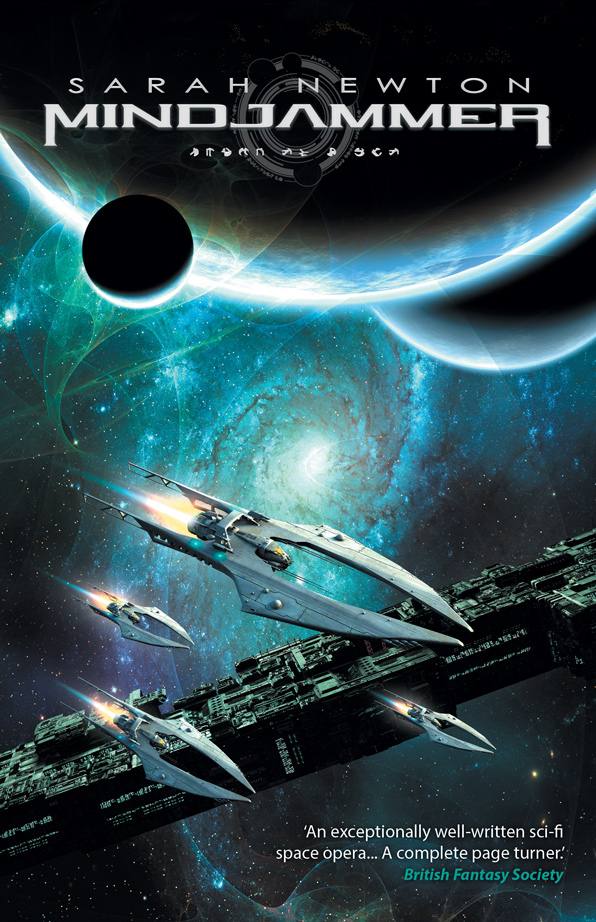 So, with the tax man never far away, I’ve been doing some sales reports this week to get a handle on how things have been going here at Mindjammer Central. One of the very pleasant surprises has been the sales figures for my far future transhuman science-fiction novel, Mindjammer, which I wrote back in 2011 and was published via Cubicle 7 Fiction and then via Mindjammer Press in 2012. In the two and a half years since publication, I found out today that we’ve actually sold a little over 3600 copies.
That actually blows me away. All but 230 of those were ebook sales. Of those 230 paperbacks, 160 of them were sold via Amazon Createspace – the other 70 were sold direct at conventions. The Createspace figure surprised me somewhat – although Amazon seem to be selling paperbacks at a more reasonable $12 or so these days.
Now, out of the 3370-odd ebooks we sold, I only have location and date data for 1757 of them. But analysing those may be enough for some representative percentages. Here’s how that looks. Over 30% of sales (extrapolating from 539 out of the 1757 for which I have data) went to the UK, which I found surprising. Over 5% went to the Eurozone and “rest of world” countries, and the remainder – so, 65% – went to the US.
The timings are interesting, too. So, again with date info for only 1757 of the 3370 ebook sales, 938 were sold in 2012 – the first six months of sales. Yup, 53%. Basically half of all sales to date happened in the first 6 months. The 2013 sales amount to 560 (again, of that 1757 for which I have dates), so 32%. Then the remaining 15% of total lifetime sales so far (259 ebooks out of 1757) happened in 2014. Again, the percentages are estimates — I don’t have absolute dates for 1900 or so of the 3600 sales to hand right now — but I’m guessing the numbers are pretty representative, and it’ll be interesting to see how sales continue in 2015.
A huge amount of the Mindjammer novel sales is of course thanks to all the Mindjammer fans, and the good people at all the gaming and SF websites who kindly reviewed the novel, let me do interviews with them, and all those peeps who came up at conventions and bought hard copies, or went home and bought soft ones. I’m minded now to think how many more copies we could have placed if we’d been able to put full print run hard copies into distribution at a standard distro price of, say, 8-10 bucks, and get them on the shelves in bookstores…
…but – 3600 copies. For what’s basically a self-published novel, I’m well chuffed. Thanks to everyone who bought a copy of Mindjammer, in whatever format, and – if you haven’t yet, you can get one here!
The Commonality salutes you! 🙂
Sarah
Normandy, February 2015
On Writing: The Filthy Japanese Novel 2

The City of Neon Ghosts
Recently I’ve been posting and tweeting about fiction writing on my current WIPs, the “Filthy Japanese Novel” and its follow-on, the “Filthy Japanese Novel 2”. The FJN-1 is now doing the rounds after a hefty rewrite and edit, and I’m well into the rough draft of the FJN-2. I thought I’d blog about it this week as there’s more to say than would fit into a tweet or post.
The Filthy Japanese Novel 2 is a “follow-on” sequel rather than a “part two” of an ongoing story. FJN-1 is most definitely a self-contained and standalone tale, but on finishing I found there was more I wanted to say about at least a couple of the main characters – and the second novel is what comes out of that. It should more accurately be called the “Filthy London Novel” as that’s (mostly) where it’s set, but, hey – if I ever get to write FJN-3 (which is set back in Tokyo), they’ll form a kind of unity, so why not?
I thought I’d blog some thoughts about the process of writing. Or, rather, my process – doubtless your mileage will vary. On the pantser/plotter spectrum, I sit somewhere in the middle (like most writers, I suspect). I like to have a good idea of what happens before I start – where the story opens, where it ends, and most of what happens in the middle – as well as a good idea of the characters and the paths of development and change they’re going to follow. Theme and stuff – well, that comes out of the writing, and you probably don’t twig actually what you’ve been writing about thematically until some time later.
As far as the “plot” goes, mine develops like this: I know I want to write about some characters, what happens to them. I know the characters well, and I know what’s happened to them immediately beforehand, and I know in detail the situation I’m putting them in at the beginning of the story. Then, I press “play”, and write down what happens. In the very early stages, that “writing down what happens” bit can take a number of forms; it can be rough notes, bullet points, crazy mind maps, or even pages of spontaneously written scenes, with interjections and “[???]” type question marks all over the place. I’m throwing paint (or mud…) at the canvas (or wall…) and seeing what sticks, and what the picture starts to look like.
Sometime during this chaotic process I start to see a thread – the elements of a storyline. And, at some point, I glimpse what looks like an ending. I jot it all down; in particular, I pencil in that ending – it’s a provisional conclusion to the story, where the whole thing might end up, if my chaos-born storyline actually turns out to make sense.
This process can take time. Perhaps months; sometimes less. A very skeletal structure can be much quicker – maybe even a day or three – but the stress-testing and crossing-out and finally coming up with a writing plan you feel confident enough to start working with can easily take 2-3 months, especially if there’s research involved. A lot of that time involves just letting everything brew – doing something else, reading round the subject, waiting for your unconscious and conscious selves to negotiate a mutually acceptable way forward.
With the Filthy Japanese Novel 2, I reached the end of those 2-3 months about 2-3 weeks ago. In fact, it took longer; the embyro of the novel took hold several years ago, but its gestation was slow – I realised from the start it was going to be quite ambitious in scope, something I didn’t want to start upon if I didn’t think I had a chance at finishing. Also, some jejune approaches I was taking needed to work themselves to exhaustion in my head so I could move on, before putting pencil to paper. But the actual plotting and planning – probably 3 months. By the end of that period, I had almost 50,000 words, a plan for 35-40 chapters, and an eyeball on somewhere around 100,000 words as my target. By comparison, Mindjammer is 125K, the FJN-1 is half that. So, middle length for me.
At that point, I told myself I was starting on the rough draft. A lot was already down on paper, but I knew most of it was going to get thrown away as I “wrote through”, starting at the beginning of the tale and filling out each chapter in sequence. Some chapters were almost fully formed, but needed rewriting with point-of-view corrections, massive editing, repurposing, and wholesale plot changes; some chapters were little more than one-line notes of “This needs to happen here!” type exhortation. Thanks, me, that’s a great help…
I’m currently 12 chapters into that process. At the moment, it’s looking like the FJN-2 is going to fall into 4 parts, each of 10 chapters: “thesis”, “antithesis”, “synthesis”, “paradigm shift”. We’ll see. I’m currently writing through one chapter a day, sometimes a bit less, never more. At that rate it should take about another month; it’ll probably take longer. At the end of that process I should have my first rough draft. That’s not anything any other human is going to see – not even the BDC, my alpha reader. My first rough draft is me vomiting my story onto the paper – just getting it down there, bludgeoning the story into submission, splurging it out messily and horribly. At the end I have something I can at least work with – there’ll be some good stuff in there, some poetry, but basically it’ll all need rewriting, probably some hefty restructuring, and probably at least 2-3 months work.
During that first rewrite of the first rough draft, I’ll start to glimpse themes – what my story is actually about (rather than what I think it’s about). That’ll necessitate a “recursive rewrite” – ie my first rewrite will actually be a “two steps forward, one step back” affair where I’m constantly going back and re-rewriting sections I thought I was done with. The closer you get to the end, the further it seems to be away.
By the end of that process, I’ll have my alpha draft. I may do a quick editing pass to chop out some of the excess verbiage (there’ll be loads – I usually overwrite by 10-15%). But, then, I think I’ll have something to show to the BDC, my alpha reader. He (May the Universe Bless and Smile Upon Him) will read diligently through this early malformed draft and tell me if it’s crap – which bits he can’t understand, which bits are cheesy or suck big time, and which bits make him cry. By the end, I’ll have enough feedback to start my second rewrite – again, a few months – which will take me to the beta draft.
And, at that point, it goes to beta readers. And that’s a whole other story…
Next up I think I’ll be talking about that whole “writing what you know” thing. Having written SF, fantasy, and now something gritty and modern day, “writing what you know” has taken on whole new levels of meaning.
Cheers,
Sarah 🙂 x

“Anyone else think passive constructions are cool?”
“Brevity is the soul of wit,” says Polonius. Unfortunately he says it in a whacking great monologue which practically puts everyone else to sleep. As a piece of editing advice it’s pretty apt; you’ll find it honoured in the breach just as much as in the observance. Recently I’ve been doing a lot of editing and rewriting, both on subs for the British Fantasy Society Journal, and also on the multiple rewrites of my current work-in-progress (provisionally titled “The Filthy Japanese Novel”). It’s made me think about my earliest experiences self-editing, and I thought I’d blog about it today.
Years ago I was a literature student, au fait with analysing themes, character, plot, structure, the whole caboodle of literary dissection. But I was ignorant of the technical side of writing – the tools you need to construct a good story. Being a good reader doesn’t necessarily make you a good writer…
I’m still learning that – whacking great shifts in insight and ability drop on me regularly. Dialogue attribution, narrative point of view, and a rigorous loathing of irrelevance still obsess my waking hours every day. But there’s one technique I learned early in my writing life – six years ago, under the tutelage of William Jones, who edited both my first published short story and RPG book, “The Apprentice” and “The Chronicles of Future Earth”. It blew my mind so thoroughly that I’ve always called it The Jedi Editing Technique. It deals with brevity.
In On Writing, Stephen King says the formula for writing success is “second draft = first draft minus 10%”. That in your first rough draft you usually overwrite, and one of your first tasks is to prune that excess verbiage to something more elegant. I’d say that’s a fair assessment, particularly for fiction; but I’d also say that for roleplaying games, the Jedi Editing Technique can be even harsher; “second draft = first draft minus 20%“. That’s right; in fiction, you can kill one word in ten and tighten up your manuscript; but in roleplaying games, you can kill one word in five.
That’s word massacre on a Game of Thrones scale.
There’s a reason for this. Both RPG and fiction publishing are commercial endeavours, and wordcount costs money. Bluntly, it costs twice as much if you take 10,000 words to say something instead of 5,000. It’s not just time that’s money – it’s wordcount, paper, and ink, too. Get a print quote and see.
Many RPG writers get wedded to their verbal darlings as if they were literary works. Here’s an ugly reality: they’re not. RPG books are technical manuals – they’ve more in common with instruction books than poetry. Sure, there are massive imaginative elements involved – but they’re usually more conceptual than literary. You may have flash fiction in your RPG book, but generally where an RPG soars is in its ideas, which are often completely divorced from the words which express them. Conciseness is a greater virtue in RPGs than fiction.
What does that mean? In fiction, you reach a point where removing words harms textual integrity far earlier than in RPGs. Fiction is a verbal art, the beauty of words integral; with RPGs, clarity and explanation are the virtues, not beauty. The best RPGs do both, but an RPG publisher wants you to convey your point in as few words as possible.
Here’s a worked example. It’s a piece of my own writing from six years ago, the moment I grokked the Jedi Editing Technique. It’s a before-and-after from an RPG book – but the same truth applies to fiction. Take a read of the rough draft before editing:
“When creating human characters, it is worth bearing in mind that although the human race of Future Earth is physically little different to that of today, culturally it is an entirely different matter. Not only are the people of Urth separated from us by unimaginable gulfs of time, but also by the fact that their world is one in which great and mighty Gods are an absolute and incontrovertible fact. By and large the people of Future Earth are conservative in the extreme; with countless millennia of forgotten history behind them, a human life seems insignificant, little more than a brief flickering against the great backdrop of the Springtide Civilisations, where nothing changes, from year to year, century to century, millennium to millennium, and where the world is ruled by a God-Emperor who has protected the world from his Omniscient Throne for over 15000 years.”
Okay, it’s serviceable, descriptive, grammatically correct – but isn’t it as florid as all hell? Doesn’t it take forever to read through? It’s like literary syrup – grammatical structures snag at your sleeve and trip you up at every turn. It’s 145 words long – and hugely overwritten. Now let’s trim it a little, see if we can’t make it flow more smoothly.
“When creating human characters, remember that while the human race of Future Earth is physically little different to that of today, culturally they vary greatly. The people of Urth are separated from us by unimaginable gulfs of time, and by the fact that their world is one where great and mighty Gods are an absolute and incontrovertible fact. The people of Future Earth are conservative in the extreme; with countless millennia of forgotten history behind them, a human life seems insignificant, little more than a brief flickering against the great backdrop of the Springtide Civilizations, where nothing changes, from year to year, century to century, millennium to millennium, and where the world has been ruled by a God-Emperor from his Omniscient Throne for over 15000 years.”
Now that’s 127 words. That’s a reduction of just over 10% – the “Stephen King” recommendation for fiction. So what’s been done? Well, for starters the “essay bollocks” has been removed: phrases like “it is worth bearing in mind that” add nothing to your meaning, and simply eat up wordcount. You don’t need them. Likewise the “not only… but also” type constructions: wordy. “Not only is it cold, it is also wet” is 9 words; “It is cold and wet” is 5 words. The “-10%” preliminary edit says exactly the same thing – but in a tenth fewer words.
Let’s go further. Try this:
“When creating human characters, remember the human race of Future Earth is physically little different from humans today. Culturally they vary greatly. The people of Urth are separated from us by vast gulfs of time. Their world is one where great and mighty Gods are an absolute and incontrovertible fact. They are conservative in the extreme, with countless millennia of forgotten history behind them. Human life seems insignificant to them, little more than a brief flickering against the great backdrop of the Springtide Civilisations, where nothing changes from century to century, and where the a God-Emperor has ruled the world from his Omniscient Throne for over 15000 years.”
This is 109 words. From 145. That’s a reduction of 36 words, ie more than 20%. This time we’ve destroyed a lot of the texture of the prose; sentences are reduced to simple statements, there’s no room for flourishes. And yet the meaning is intact. This type of stripping down probably wouldn’t work for fiction, but almost always works for RPGs; and when you’re paying by the page to print a book, a 20% reduction in page count or a corresponding increase in content is gold!
When I write RPGs these days, I manage to cut 15% of my initial wordcount during the first editing pass. That probably means I’m not overwriting as much as I used to. One day I hope to see that reduced to 10%, then 5%, until finally I’m writing lean, mean text for RPGs straight off the block. For fiction, I still fall pretty comfortably in the “10% too long” space, but I think that’s okay; when you’re writing your rough draft, overwriting may ensure you get everything down on paper — as long as you don’t forget to strip it down and keep it lean in your first editing pass.
I guess we’re always learning as writers and editors, but I felt the “Jedi Editing Technique” was something I could modestly share. I hope it’s useful!
Cheers,
Sarah
*****
Idle Speculation on Tolkien in Brittany and Normandy

As many of you know, I live in Normandy, France. I often fly back to the UK from the airport at Dinard, some seventy-five kilometres away over the border in Brittany. The route I drive to and from the airport takes me along the N176 road, giving me beautiful views of the amazing Mont St Michel – and my thoughts often drift towards Tolkien.
Apparently Mont St Michel was the inspiration behind Peter Jackson’s visualisation of Minas Tirith in the Lord of the Rings trilogy of movies. Standing on the great terrace at the abbey of Mont St Michel and looking out over the bay and surrounding countryside, I’m always struck by the similarities with the citadel from which Denethor took his deadly plunge. So much so, in fact, that I’ve wondered if Tolkien himself might have been inspired by the place. I’d often thought that maybe Tolkien could have passed this way during his time in Northern France during the First World War – but whenever I’ve tried to research the issue, or read his letters, I’ve never found any connection – he was based much further east, around the Somme.
Recently, however, I read of an earlier trip to France by Tolkien, in the summer of 1913, acting as tutor to two Mexican boys. Tolkien spent a total of six weeks in northern France; first two weeks in Paris, but then travelling to the fashionable (and apparently somewhat vacuous at the time) seaside resort of… Dinard, in Brittany. The location of the airport I drive to on a regular basis. Tolkien was involved in a tragedy there – the mother of the Mexican boys was killed in a car accident, apparently curtailing the various “sightseeing activities” in the region and forcing a return to England. But the fact remains; in the summer of 1913, Tolkien was sightseeing in and around Dinard, in Brittany.
The road to Dinard from Paris is pretty much the same today, although obviously larger and busier – the N176 I drive regularly. As you approach Dinard, Mont St Michel is beautifully visible in the north, a huge edifice, the only outstanding feature in this very flat terrain. Tolkien would have seen this in passing; and, an ardent mediaevalist in charge of sightseeing activities and tutoring two young boys, how could he not have taken the detour to see this most amazing of sights?
Here’s a curious note: along the road to Dinard, just where the road to Mont St Michel branches off, between the communes of Macey and Servon, there’s a little crossroads, just a small village of a handful of houses and an old inn. The name of the village? Well, it’s called Bree (“Brée” in French). And the old inn? It’s called “Le Sillon de Bretagne”, the “Saddle of Brittany”. I wonder if it ever had a sign of a prancing pony over the door?
Can anyone confirm my idle speculation? It occurs to me Tolkien may well have done some stomping in these green and hobbitish vales in northern France, and maybe picked up a memory or two to serve him in good stead in his later writing.
Cheers,
Sarah

Last weekend, the 25th to the 27th of April 2014, I had the great privilege of being a guest at the Conpulsion RPG convention in Edinburgh, Scotland. I love Edinburgh – it could be my favourite city – but hadn’t visited for over 10 years, so the chance to go there, and guest at a roleplaying game convention, and sell some copies of the brand new Mindjammer RPG before it officially launches in May – how could I refuse?
It was a great convention. Not huge, but certainly not small; some 350 gamers, a decent trade hall, seminars, panels, and loads of games, all conspired to make the weekend fly. I drove up with several boxes of the huge 496-page Mindjammer RPG hardback, and a box of Mindjammer novels, on Thursday and Friday, in one of the frequent RPG and fiction convention roadtrips I do these days from Normandy to the UK, arriving in Edinburgh late Friday afternoon in time to say hi to the organisers, set up shop in a corner of the trade hall, and familiarise myself with the schedule and my part in it. Almost as soon as I arrived and said hi to Sandy Ryalls, Gwen Fyfe, Tiggs (Lisa Cunningham), Euan Reid, and Tara Catt of the con committee, a horde of the “blue shirt” convention staff mobilised to help carry up the heavy RPG boxes to the trade hall on the second floor. Thanks to Edith, Alan, and all the blue shirts for their tireless efforts behind the scenes at Conpulsion – their labours were unceasing, and the con went smoothly as a result.
Conpulsion takes place in Teviot Row House in the centre of Edinburgh – on the opposite side of the Castle and the Royal Mile from Princes Street, an area of the city I’d never really got to know before. Teviot Row House itself is an amazingly beautiful building – apparently the oldest purpose-built students’ union building in the world, it’s a great, Hogwartsian edifice, defying Euclidian geometry, fluted and fretted with wood-panelling and fanciful curlicues, stairwells, corridors, mullions, casements, towers, and perhaps the most beautiful bar I’ve seen – the Library Bar, which, as its name suggests, is replete with hoary leather-bound tomes behind leaded windows of endlessly stretching bookcases. A perfect place for a roleplaying game convention.
The main convention runs Saturday and Sunday, and incorporates not just tabletop RPGs, but boardgames and live action roleplaying, too. Obviously I’m a dyed-in-the-wool tabletop RPGer, so my contribution to the weekend as a guest was to run two sessions of Mindjammer – The Roleplaying Game, appear in one panel, one debate, and host one discussion, and do a handful of interviews, as well as hang out in the trade hall, bar, or wherever, and talk about Mindjammer with fellow gamers – and maybe sell and sign a few copies, too!

As it turned out, it was an awesome weekend for Mindjammer. As those who’ve preordered or bought the game already, the book is gorgeous, with an awesome cover by Paul Bourne, layout by Michal Cross, and beautiful interior artwork by Jason Juta, Ian Stead, Andy Wintrip, Andreas Schroth, Eric Lofgren, Jeff Ward, Earl Geier, and Fil Kearney, as well as text and so on by yours truly, and I was totally thrilled by the way people took to the game. I sold half my stock on the first day, and the other half on the second, and return home with 3 copies of the game and no novels unsold – a result! Most importantly, I had the chance to chat about Mindjammer with fellow gamers, and to play a couple of sessions and one discussion group on the game, which is just so awesome. Writing is often a lonely business, and the chance to receive direct feedback from people who are your primary gamers is priceless.
My first panel was early Saturday afternoon, discussing the future of RPG publishing and the digital revolution with Cat Tobin (Pelgrane Press), Grahame Bottley (Arion Games), Jenny Harman (Frankenstein’s Bodies), and chaired by the inimitable Phil Harris (Bleeding Cool, etc). A good discussion – I think everyone realises that RPG publishing is both in a period of enormous change, but also something of a golden age right now – there are more games, more publishing activity than ever before, and no one knows where the industry is going except forward. We exchanged some passionate opinions about Kickstarter, its pitfalls and exigencies, and generally agreed that games writers and designers had never before enjoyed such close contact with the fellow gamers who are our customers – and how that could only be a good thing.
Almost straight after the panel I had my first GMing session of Mindjammer, a 3-hour session in the Loft Bar running the first episode of the new scenario Hearts and Minds. The session was a little marred by the noisy environment – I find it difficult to tell a compelling story when shouting – but all the same we made a good fist of handling a protest in Friendship Square on the rediscovered world of Olkennedy, which rapidly descended into a deadly riot and an attack on the Commonality culture by violent separatists. We used the Mindjammer pregens from the Mindjammer site, and I was privileged to be the debut GM for two brand new RPGers, who did an awesome job of rising to the challenge. I hope you’ll go on to play again and again! Also at the table were Andrew Jones, and Geek Native’s very own Andrew Girdwood, both of whom I’d met online and so was very excited to game with in person.
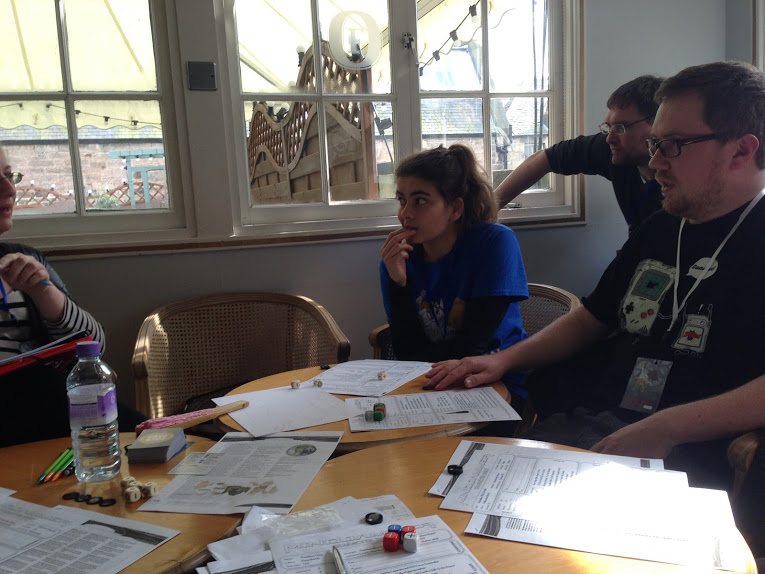
At this point I want to express a huge thank-you to Doctor Mike Reddy, of the University of South Wales fame (and MANY other places) – I’d met Doctor Mike at cons previously, and it was great to see him again, but this time he wonderfully offered to man the Mindjammer table in the trade hall while I was gadding about. Such an awesomely kind thing to do, and a huge help over the weekend for me and for anyone wanting to grab a copy of Mindjammer throughout the day. Thanks, Doctor Mike!
Doctor Mike and I joined Cat Tobin and David Elliot-Mumford (Ornithocracy) that evening in the bar, hosted by Conpulsion Coordinator Euan Reid, for the “great debate” – is the GM dead? A huge crashing clash of opinions – are the “new” brand of GM-less games going to destroy the role of game master in roleplaying games, or will the game master win out? Of course, the real answer to that is a lot more nuanced, but Doctor Mike and I joined forces to doggedly argue that the GM was *doomed* DOOMED!, and that GM-less games were the way ahead. Despite not actually believing that, I think we made a good case – especially for games where all the players are actually GMs in their own rights, too – and I used a lot of my Fate smarts to argue for a more decentralised approach to narration which hit the right spot more than once. It was fun to be basically arguing devil’s advocate all evening, but ultimately I think our true allegiance may have shown… The GM lives! 😉
Sunday morning began with a mild panic. I had my second session of Mindjammer at 10am, and I knew it was free parking in Edinburgh centre, and I might have stock to take home, so I decided to have a leisurely breakfast then drive in about 9.15 – it was only 5 minutes to Teviot Row House – and set up for my game in a relaxed manner. However, apparently Edinburgh had chosen that morning to close off the entire city centre around the convention for some little thing called a “Great City Run” or some such ;-), and I found myself potentially being diverted off to some endless hebridean bypass where I’d drive around and around in a traffic jam for all eternity. After some choice expletives hurled at the universe in general, I abandoned my car and walked (well, kind of ran, really) into the university – and my game – with minutes to spare – to find that my fully booked game had 2 additional players wanting to join, 7 folk in total!
The previous day when that had happened, my game had 3 spectators, for 9 of us in total. However, for the Sunday game I knew we had a room to ourselves, nice and quiet, and that all the players were pretty experienced, so I offered the 2 newcomers the chance to generate characters on the fly during play – something Fate Core (and therefore Mindjammer) does very well. They jumped at the chance, and so Thaddeus Clay’s SCI Force team acquired two additional members – “K” the Cyber-Street Brat, 15 years old and filled with lecherous hormones and lethal augmentations, and Churchill the Tank Ninja, with a wicked assortment of hypertech gadgets and stealth gear, some of which I’ll write up on the Mindjammer site shortly.
I had a great session – I hope the players did, too. I’d decided to run the session immediately following on from the day before – same characters, different players – so we ended up playing an intrusion mission into the Alpha Node mindscape satellite in geostationary orbit above Olkennedy’s Crater. Some excellent roleplaying and problem-solving, once again highlighting Fate’s great ability to generate drama and cool gaming out of pretty much any situation, and to create satisfying role-playing challenges involving not just physical but emotional, social, and even cultural conflict. As Martin Page, august novelist and player of Churchill the Tank Engine said, “We ended the session on a group hug! Oh my god, we’ve just played an episode of Star Trek – The Next Generation!” Proof you can save the world and still have a totally geeky laugh in under 3 hours. 🙂
After that, the pile of Mindjammers on our table in the trade hall were dwindling in a very satisfying way – apologies to Phil Harris, who interviewed me for Bleeding Cool actually at the table, in a very staccato interview constantly broken by pauses to chat, sell, and sign. Lord knows what the interview recording sounded like, Phil – but next time we’ll get a room! 😉 Thanks to everyone who came along and bought copies of the game – that was so cool.
My final bit of scheduling was next, a talk from 2.30 to 3.30 about Mindjammer. I’d intended to give a 20-minute setting spiel and then open for Q&A, but basically everyone who turned up either knew the setting or had just appeared in one of the two demo sessions and pretty much knew the spiel already, so we threw the session open to a discussion about Mindjammer and transhuman RPGing in general. Andrew Girdwood of Geek Native and Andrew Jones turned up again, and we got into some great detail and feedback on issues about the ideology of the Commonality, player agency and affecting the setting, directed evolution, and the nature of sentience, consciousness, and identity. So much great food for thought – and another reinforcement that SF gaming is a great arena for playing through and dealing with these great science-fiction themes. Thanks everyone for coming!

The rest of the afternoon was in the trade hall, chatting with gamers, and also getting to meet Liam O’Connor of Black Lion Games and his team, who run a great RPG shop in Edinburgh just round the corner from the university and had a big stand at the con. Lovely folk all – I had a grand browse of their shelves, seeing some great rarities, including a deluxe boxed set of Traveller – The New Era which I never even knew existed, plus the chance to get hands-on with the new “wood box” reprint of the original D&D white box books and supplements, which unfortunately I found a little underwhelming (I’ll be keeping my originals…). Why on earth didn’t they keep the original artwork and covers?
And then it was pack-up, and time to attend the closing ceremony before heading home. The closing ceremony was the total icing on the cake after a brilliant weekend, as Mindjammer won the Griffie Award for Best RPG at the con! Up against some very stiff competition – Numenera, 13th Age, Hillfolk, Rocket Age, and Blood and Smoke – the convention-goers voted for Mindjammer, and a quick hop on stage to wave, blush, and say thank-you had me with the biggest grin of the weekend. Thank you everyone for voting and awarding Mindjammer Best RPG. A great honour, and a lovely end to my first Conpulsion.
Then that was it. I’d had the chance to make tons of new friends, and meet up with some old ones – Ian Lowson, Steve Ironside, Gregor Hutton, Jon Hodgson, Adrian Tchaikovsky, David Donachie, and more. There was more fun still to come at the con, with pub quizzes and other RPG events, but I had a 4 hour drive into the Edinburgh nighttime rain, so I bade my farewells with many hugs, and vanished into the night, filled with good thoughts.
Thanks to everyone on the Conpulsion committee for inviting me, and for laying on such a great and friendly convention. If you’re ever wondering whether to go, then definitely do so – it’s great fun. Thanks too to all the blue shirts for beavering away right through the weekend, keeping everything moving like a well-oiled machine. Conventions are an opportunity when I get to spend time with My Tribe, and Conpulsion was no exception. I hope to do it again soon!
Cheers,
Sarah
Normandy, May 2014
All photos are by Doctor Mike Reddy via Twitter – many thanks Doctor Mike! Note to self: take photos next time!
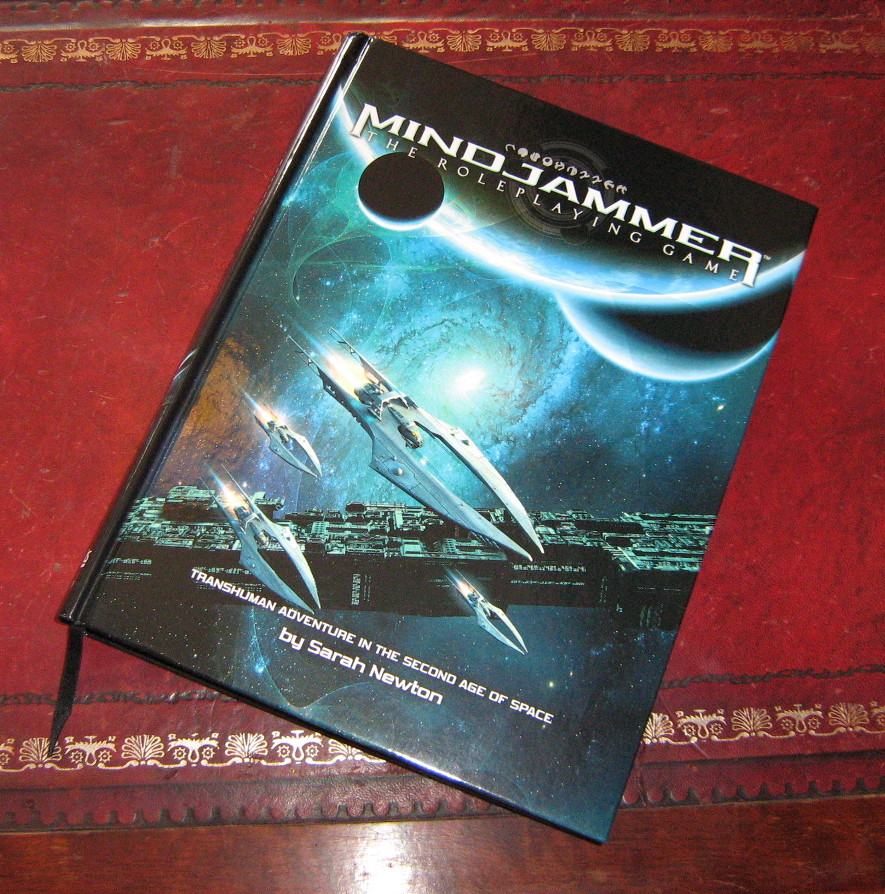 Well, folks, it’s been a heckuva few days! On Wednesday we launched the PDF-only version of Mindjammer – The Roleplaying Game, which you can now download from either the Modiphius webstore or DriveThruRPG, in addition to the print+PDF bundle available from Modiphius. Then, just yesterday morning, we took delivery of the shipment of Mindjammer hardbacks into our UK warehouse. Today, all that remained was for me to finally sign off on the hardback version of Mindjammer – The Roleplaying Game. I’m absolutely chuffed to bits to say that I’ve now been through the physical hardback with a fine toothcomb, and signed off on it earlier this afternoon. We’re now all set for shipping to customers to begin next Monday, 14th April!
 In the meantime, I thought I’d post some pictures of the Mindjammer physical version. As you can see it’s a 496-page hardback, full size (ie US letter size) and a complete roleplaying game using the Fate Core system from Evil Hat Productions. It contains everything you need to play, divided into 24 chapters, comprising:
- Chapter 1: Introduction introduces the Mindjammer game and explains what’s in the book.
- Chapter 2: The Basics gives you a quick overview of the Mindjammer rules.
- Chapter 3: Creating Characters shows you how to build a game and its characters.
- Chapter 4: Cultures, Genotypes, and Occupations provides examples of home cultures, genotypes, and occupations for your characters.
- Chapter 5: Aspects and Fate Points describes these two components of the Fate Core rules in detail.
- Chapter 6: Skills and Stunts describes the kinds of activities and specialisations your character may be competent in.
- Chapter 7: Extras introduces these extensions to your character’s abilities and provides a core list of special abilities he may have access to.
- Chapter 8: Technology provides essays on the hyper-advanced technologies of Mindjammer, and details the enhancements and equipment your character may possess.
- Chapter 9: Playing the Game provides rules for resolving actions, challenges, contests and conflicts.
- Chapter 10: Gamemastering Mindjammer gives guidelines for running Mindjammer games, including rules for handling non-player characters.
- Chapter 11: The Mindscape describes this crucial part of life in the New Commonality and provides detailed guidelines for including it in play.
- Chapter 12: Constructs provides rules for creating and using starships, vehicles, and other constructs in your game.
- Chapter 13: Starships and Space Travel explains how to use starships to travel between the worlds of the Commonality, and provides stat blocks for major vessels.
- Chapter 14: Vehicles and Installations describes the planetbound counterparts of starships and space stations, including descriptions of major vehicles.
- Chapter 15: Organisations provides rules for running corporacies, instrumentalities, and other organisations.
- Chapter 16: The New Commonality Era describes the history and politics of the New Commonality of Humankind, including example organisation sheets for polities, corporacies, and other organisations.
- Chapter 17: Cultures provides rules for describing cultures and culture conflicts, including guidelines for running cultural operations, as well as descriptions of the key cultures of the New Commonality Era.
- Chapter 18: Worlds and Civilisations provides rules for creating and describing planets and civilisations.
- Chapter 19: Stellar Bodies and Star Systems provides rules for creating star systems and other stellar bodies, and also for star system resources.
- Chapter 20: Commonality Space provides an overview of the universe of Mindjammer, including a detailed look at Manhome, the solar system of Old Earth.
- Chapter 21: Alien Life provides rules for alien biospheres and life forms, including example exofauna.
- Chapter 22: Scenarios and Campaigns discusses how to create and run scenarios, and provides tools and guidelines for running multi-scenario campaigns.
- Chapter 23: Themes, Genres, and Styles of Play discusses how to run transhuman science-fiction games, providing guidelines for different subgenres, themes, tones, and styles of play, and specific rules sub-systems to help support them.
- Chapter 24: The Darradine Rim describes an entire octant of Commonality Space, providing planetary statisics, maps, and descriptions of more than twenty worlds.

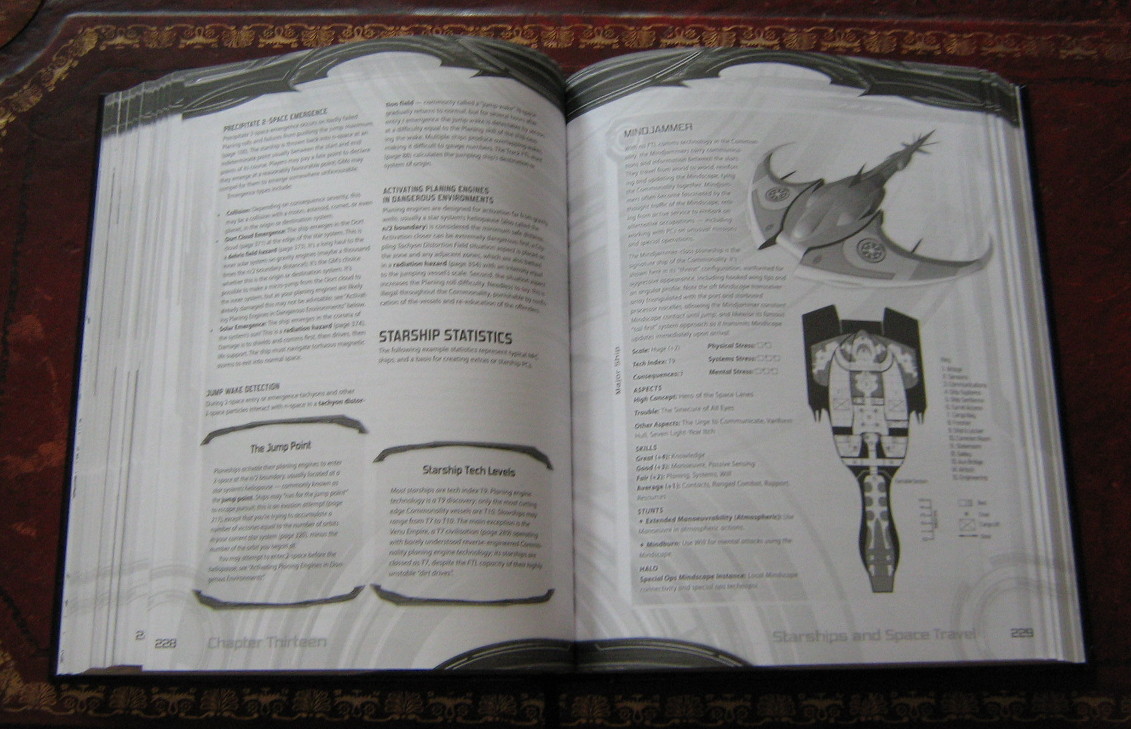

We’ll be talking a lot more about Mindjammer in the weeks and months to come, as it ships to customers, arrives in your FLGS, and the first of our series of scheduled supplements hits the shelves. If you’d like to know more about Mindjammer right now, please check out www.mindjammer.com. You can download a 40+ page free preview of the game from DriveThruRPG, and also order the print+PDF bundle directly from the Modiphius webstore, or the PDF-only version from DriveThru or the Modiphius store.
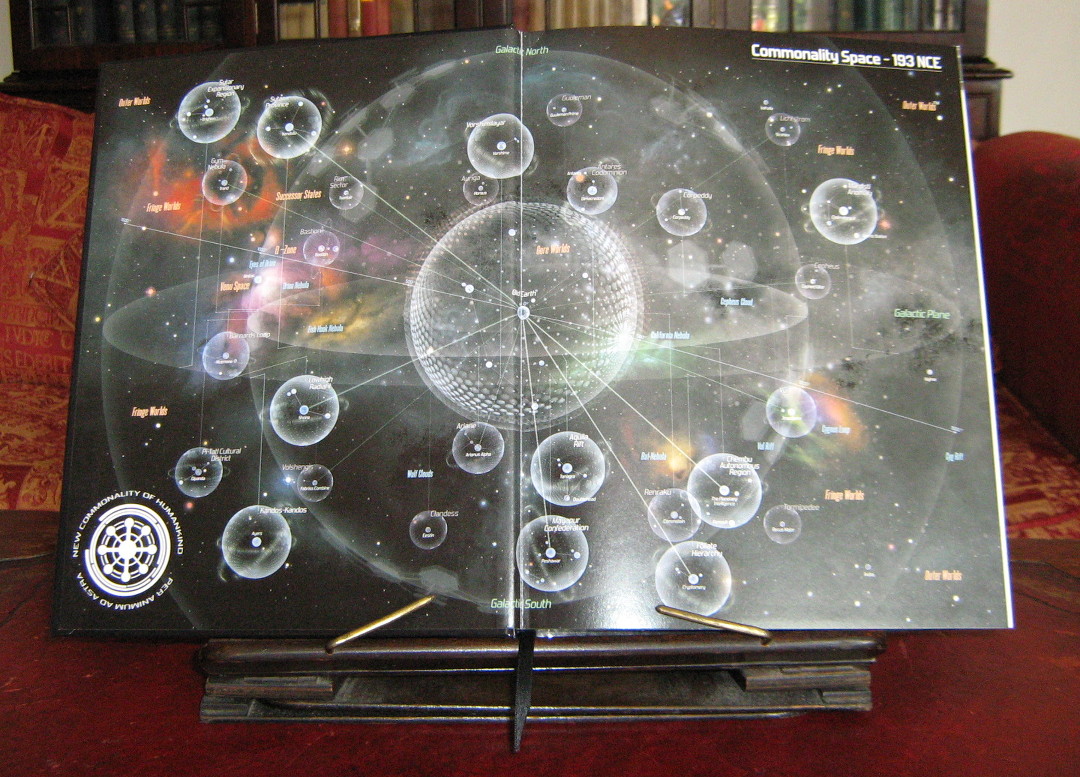
Thanks to all the Mindjammer supporters and fans for your constant encouragement and support as we’ve worked on Mindjammer – The Roleplaying Game. It’s an absolute thrill to see it head out into the wider cosmos at last, and I hope you enjoy the read! Happy gaming – and the Commonality salutes you!
Best,
Sarah
Normandy, April 2014
An Interview with Mindjammer Artist Ian Stead

This week the Meme Machine catches up with sci-fi artist, ship designer, and mapmaker extraordinaire Ian Stead, and asks him about his work and the awesome ship images, deckplans, and gear which he designed and illustrated for Mindjammer – The Roleplaying Game.
Meme Machine: Hi Ian! Thanks for agreeing to appear on the Meme Machine. Could you tell us a little about yourself – what work you do with RPGs, what you regularly play, and what games you’ve worked on?
Ian Stead: Well, I live in the lovely city of Lancaster, with my lovely wife and insane arthritic rabbit Mr Boo (although we’re not sure he is a rabbit…). I’ve drawn stuff all my life, but it’s only in the last few years that I’ve started doing it for clients. So far I’ve done a lot of deckplans, technical art (eg play sheets), and gear illustrations like vehicles and guns. On top of that I’ve done some non-deckplan maps, and some “space art” like planets and space scenes. I also do layout work, and some writing; I’ve self-published as Moon Toad Publishing and Gorgon Press.
Currently I play once a week – after a really long hiatus – with Peter Cakebread (of Cakebread & Walton). I’ve worked for clients such as Spica Publishing, Gypsy Knights Games, VBAM, Mongoose, FFE, Mindjammer Press, Zozer, Moon Toad, Gorgon Press, and John Brazer Enterprises; I’ve worked on games such as Mongoose Traveller, VBAM Campaign, Mercenary Air Squadron and War Dogs.
Meme Machine: So what’s your process for your design and art work? What software do you use? Do you work freehand?
Ian Stead: My process is pretty much the standard: sketch, design, then submit and tweak like hell to the client’s wishes. I’ve found I even do “rough flat images” in Sketchup too [a design application – ed.], submitting a page of designs and letting the client pick from there.
I mainly work with computers, though more and more my work is looking like it was hand-drawn. I can work freehand, but I love the freedom of computer art, where I can do so much more with one particular ship or vehicle design, for example; and also the fact that I can pull the ship models from the actual deck plans.
I really should look at doing more freehand. I can draw, and I miss it and feel out of practice – though I do sketch out my rough ideas in pencil first.
For software I use Sketchup, Illustrator, Photoshop, and InDesign. I also have a Bamboo graphic table, which is so underused.
Meme Machine: Who are your influences when it comes to art and design?
Ian Stead: The late Peter Elson is my biggest influence. When I was about 9, I received a TTA [Terran Trade Authority – ed.] book as a Sunday School prize – that, and a diet of Space 1999, Doctor Who, Blakes Seven, etc, really started my addiction to all things science-fiction. Other artist influences include Jim Burns, Chris Foss, HR Giger, Munch, Bryan Gibson, Rob Caswell, Tom Peters, Rodney Mathews, Bob Layzell, Chris Achilleos, Fred Gambino, Chris Moore, John Martin, and a few others.
Meme Machine: How did you approach the Mindjammer project? Did you do much research? What kind?
Ian Stead: First of all, I read the novel [the “Mindjammer” novel – ed.] – quite quickly, as at the time I was commuting 45 miles a day, so it was a welcome aid on the journey home. Then I started with the Mindjammer vessel, to hopefully get the look and feel of the Mindjammer universe. Sarah gave me a few images as pointers, too, and lots of background info, such as the 1st edition Mindjammer rules and setting. Fortunately I love the universe, and Sarah has created a wonderful piece of work.
Meme Machine: What do you think is unique and unusual about the Mindjammer project from a design and art perspective?
Ian Stead: For me, I think I stretched myself. A lot of my older work is very technical and straight lines; Mindjammer is a bit more organic, without being biotech as such. I think at first I was a bit daunted, but in the end it has worked out really well; I still have to pinch myself and say “I did that!”
Everything in the Mindjammer universe has a more flowing look, except the Venu (“Boo! Hiss!”). I’ve found more organic stuff tricky, but this has proved I can do it.

Meme Machine: Where did you get your inspiration for the ship shapes? And the vehicles?
Ian Stead: Nature, and what is floating about in my head. They say not to create from your mind, but I do to a certain degree – but influenced by things like sharks, fish, birds, and other things. In fact the Manowar was inspired by a nautilus. The vehicles are inspired by lots of real life and fictional examples, and directions from Sarah.
Meme Machine: What’s your goal when you create deckplans? What is it that you want to enable GMs to do with them?
Ian Stead: I want my deckplans to be clear, almost precise, and easy to read. I find the over-detailed cluttered ones a bugger to read! I hope GMs will find them a great tool to help players understand the layout of a given ship, and also to use them for things like combat.
Meme Machine: Where would you like to take your Mindjammer design work next? Is there anything specific you’d like to work on?
Ian Stead: I’d like to build something like Gentility Base, and do a more detailed map of the Botany Bay, and perhaps a world, too.
Meme Machine: What other projects are you working on at the moment? Anything you can tell us about?
Ian Stead: I’m currently working on my own work, a project for FFE, and one for Spica Publishing.
Meme Machine: Thanks very much for appearing on the Meme Machine Blog!
Ian Stead: Thank you!
You can find out lots more about Ian and his work at his website, Biomass Art, and contact him by email at biomassart-at-gmail-dot-com. Look out for Ian’s ship designs, gear and vehicle designs, and deckplans in Mindjammer – The Roleplaying Game, and in future supplements in the Mindjammer line, and in many other fine RPG products.
Arduin, Bloody Arduin – Thinking About How It Could Be Done

That Erol Otus Tunch cover…
As some of you may know, I’m a big fan of The Arduin Grimoire – the original gonzo fantasy fest RPG which followed hot on the heels of White Box D&D back in the 70s. I was actually an Arduin player before I was a D&D player; back in 1980/81, I got the very first Arduin Grimoire Volume 1 (the one with the Erol Otus Tunch on the front – you remember!), and for the best part of a year I played the game just with that book, before getting hold of White Box and the other 2 Arduin volumes. Yes, Virginia, you can play an entire game with just the first volume of The Arduin Grimoire. You have to wing it a fair bit in places (mostly in how many experience points to award), but it can be done.
I’ve followed Arduin over the years, and have pretty much everything apart from the recent Arduin Eternal releases, but again and again I’ve found myself going back to those original 3 volumes (and their spiritual comrades-at-arms, the All The World’s Monsters vols 1-3). I’ve played happy sessions of Arduin using my Monsters & Magic RPG as the underlying mechanic, with Arduin in all its bloody glory ravaging chaotically over the top.
Imagine my excitement, then, to hear that the guys at Emperor’s Choice, the current publishers of all things Arduin, are planning to publish a new game, “Arduin, Bloody Arduin”, based principally on those original three volumes. At last: the circle is almost complete, and mayhem will be the master!
So naturally I spent the last night thinking about how I’d do Arduin, if I had the chance. This is what I came up with. Remember – this is all just my own opinion, after a night of winter storms here in Normandy, and isn’t approved or official or anything; I’m not associated with the Arduin folks. But I’m a big fan of Arduin, always have been, and maybe this is a cool way to talk about and get excited about what’s to come. 🙂
Well, one of the big hurdles the original Arduin Grimoire faced was that it wasn’t allowed to be a complete RPG using the D&D system. There was all kinds of litiginous stuff flying around in the day, and Dave Hargrave tippexed out all mentions of the game in subsequent printings. That left Arduin in the weird situation of not being quite a game, not being quite a supplement, which was always a bit of a shame.

The Compleat Arduin – Still Awesome
That’s no longer the case. With the open gaming license, the d20SRD, and the whole Old School Renaissance movement, the d20 game system which underpinned Arduin is now available for use — and still wildly popular! So that’s where I’d start.
1. IT’S A D20 GAME
I’d go right back to basics on this one. Scrap all the percentile-based rulesy stuff from The Arduin Adventure and The Compleat Arduin. Emphasise Arduin’s genetic relationship to D&D – it’s D&D’s massively mutated, all-in-wrestling, steroid overdrive, rock-n-roll mega-Elric, demon-infested brother. It’s D&D with the safeties off; let’s rejoice in that.
On top of that, take advantage of the streamlining and advancements in the d20 mechanic of the past 30-40 years. So here’s the core mechanic:
- use the traditional Arduin attributes, but slightly streamlined: Strength, Dexterity, Constitution, Intelligence, Wisdom, Charisma, Ego.
- use the D20SRD attribute bonuses
- use the D20SRD core mechanic: roll 1d20+mods vs a difficulty class.
Reasons? Well, as much as possible keep the system familiar and easy to use. Arduin’s distinctiveness lies not in its atts and bonus and dice rolls, but elsewhere. Keeping consistency also makes the system easy to learn for new folk, and allows other products to be used with Arduin, and Arduin products to be used with other products. Good all round.
2. USE THE ARDUIN CLASSES
Take all the character classes from The Arduin Grimoire vols 1-3: Trader, Psychic, Barbarian, Rune Weaver, Techno, Medicine Man, Witch Hunter, Star-Powered Mage, Rune Singer, Bard, Saint, Martial Artist, Outlaw, Slaver, Courtesan, Alchemist, Assassin, Druid, Forester (Woods Ranger), Paladin, Sage.
Add to the above any classes from White Box + Greyhawk, Blackmoor, and Eldritch Wizardry which are missing. Off the top of my head, that’s: Fighter, Thief, Cleric, Magic User, Illusionist.
Stop there. Don’t be tempted to go any further with new-fangled classes: what we’re doing here is a new edition of Arduin, and we must keep the atmosphere and flavour. People can add other classes if they want, but we want to create Arduin, not a.n.other d20 fantasy RPG.
Speaking of which…

Not an OSR Game…
3. IT’S NOT AN OSR GAME
It won’t be obvious to everyone; Arduin isn’t old school renaissance. It’s always been old school, in its vibe and approach. What we’re doing here is a new edition of the game. Which edition? Well, here’s my calculation:
- 1st edition: The Arduin Grimoire
- 2nd edition: The Arduin Adventure
- 3rd edition: The Compleat Arduin
- 4th edition: Arduin Eternal.
And that makes us 5th edition! There’s something nicely symmetrical about that, and something axe-wielding about that big letter “V” you can use. Ladees and gentle-barbarians, I give yew: The Arduin Grimoire V, 5th edition!
Not being an OSR game gives you freedom to do some other cool stuff, too. More on that below. Meanwhile, where was I? Oh yes…
4. USE THE ARDUIN RACES
Now, I’m being specific here: only the races from the Arduin Grimoire trilogy. NO PANDAS. NO WEIRDO CAT-FOLK. We’re keeping atmosphere here. Nevertheless, we have a huge pile of the trad fantasy races, including monstrous races, and the old Arduin favourites such as: kobbits, saurigs, phraints, gnorcs, haggorym, amazons, and more.
5. DON’T USE THE D20SRD SKILL SYSTEM
This is important, too; this is where we start getting into Arduin flavour. Instead of a bunch of skills, we distinguish 2 types of competence: abilities, and skills.
Abilities are things everyone can do. Things like running, swimming, jumping, climbing, etc. These are all attribute rolls; you roll 1d20, add your attribute MOD, and measure against a DC. All attributes have attribute rolls; nice and simple. Note that level has no relevance here.
Skills are things classes can do. In Arduin, these are mostly linked to your level; a fighter gets some core skills at 1st level, and these go up by level (probably by +1 per level); other skills come in at different, higher levels. This preserves the old school flavour of Arduin; skills are a function of class and level.
Races can give you modifiers to abilities and maybe skills. Some racial abilities are unique, or restricted in availability (infravision, etc).
6. CRITICALS AND FUMBLES
This is pure Arduin flavour: gonzo, big wild successes and failures, pretty lethal. It doesn’t just apply to combat; this applies to attribute and skill rolls, and magic too.
- Rolling a Natural 20: If your roll was going to be a success anyway, you CRITICAL. Roll on the critical tables. If your roll was going to be a failure, you achieve an automatic success.
- Rolling a Natural 1: If your roll was going to be a failure anyway, you FUMBLE. Roll on the fumble tables. If your roll was going to be a success, you commit an automatic failure.
This keeps things larger than life, and reduces rolling; no “critical threshold” multiple dice rolls here; Arduin has a reputation for danger and wildness, and this keeps that reputation intact.
7. “MODERN” STUFF
I’d like to see some scope for non-physical combat in Arduin, too. That means things like mental combat, intimidation, coercion, enchantment, fear attacks, undead turning, all that good stuff. That might involve a kind of “contest” mechanic being built into the core d20 mechanic, and the use of attribute and some skill rolls as saving throws. Nothing too heavy or onerous, and very flexible, too.
8. MAGIC
Use the Arduin mana system. In fact, pretty much import the whole spell corpus from Mark Schynert’s very excellent The Compleat Arduin. It’ll need a bit of conversion, but not much. Note that there’ll be a fair bit of tinkering needing to be done around the various mage classes; and, again, The Compleat Arduin does a lot of that for you. Use it.
9. HIT POINTS
Use the system in Arduin Grimoire III: The Runes of Doom. More hit points to start with, fewer hit points at mega levels. And, speaking of which…
10. LEVELS
Use the Arduin Grimoire standards. Yes, that does mean characters can go mega-gonzo high in level. That’s good. It also means a lot of thought needs to go into making those high level classes playable, which feeds into the class skill system and dice roll mechanic. The Compleat Arduin is a help, but if anything that’s where the new Arduin edition has its work to do.
11. MONSTERS
Monsters!
Again, use The Compleat Arduin as a guide for which monsters to include, and derive stats from a mix of the d20SRD, the Arduin Trilogy, and Compleat Arduin. Wherever there’s a clash, the Arduin Trilogy takes precedence.
12. SETTING
Include the core setting! A map of Khaora, with a brief gazetteer of the lands, with more detail the closer you approach Arduin; then a good map of Arduin, and a detailed gazetteer and encounter section. Show why Arduin is Arduin; some potted history here, too. This doesn’t need to be an encylopedia, but it should be a good solid chapter of evocative and very usable stuff. Bring in bits from the World Book of Khaas where appropriate.
And, a humble request from me: can we redraw the Khaora and world maps? Continents aren’t square. The detail is awesome, but these two maps really don’t do the setting any favours; for me, they really break credibility. By all means preserve the relative positions and even maps of individual nations as much as possible, but redraw the continent outline to be more realistic, and get a really cool world map done.
Similar for the Arduin map; it’s pretty good, but get a cartographer to tweak it so there’s a bit more realism in the geography. Gorgeous maps sell games, and the Arduin setting is so good it’s a shame to be let down by maps.
Cool Maps are Cool…
13. ART AND LAYOUT
Don’t underestimate this. Get a really good layout person and a cool stable of artists who can do this stuff. Apart from a god-awesome cover, it doesn’t have to be colour art — that depends on your budget — but it should look right. Get a good line developer on board, and good editor and proofers to make sure the final product is sharp, hot, and desirable. Hell, kickstart it if you need the boost. 🙂
So! I think that’s my two-penn’orth; a quick imagineering of my ideal “Arduin, Bloody Arduin” design brief. It’s only a start — there are a lot of wrinkles to iron out — but I think it’s a “mission statement” for the kind of book I think would be cool, would do Arduin justice, and would sell.
And then I’d follow it up with plenty of supplements. Adventures, country guides, what have you. Keep the game firmly in the d20 orbit, but with a clear “Arduin” identity – gonzo, awesome, the heavy metal demon-haunted magic-blasted 21 planes of hell-infested awesome that we know and love.
And maybe keep the title and subtitle:
“ARDUIN, BLOODY ARDUIN.
The Arduin Grimoire, 5th edition.”
Of course, all the above is just in my dreams, a fervid night’s brainstorming thinking about what Arduin, Bloody Arduin might be.
But I’d buy it. Anyone else? 🙂
Cheers,
Sarah
*****
You can buy Arduin products from the Emperor’s Choice, and also in PDF from DriveThru.
You can get my Monsters & Magic RPG, which you can use with the Arduin Trilogy, from DriveThru here.
Oh, and don’t forget my new transhuman space opera RPG “Mindjammer”, on sale right now with an immediate PDF download and hardcopy in March. Nothing to do with Arduin, but it’s pretty cool. 🙂
Writing Mindjammer – Far Future Transhuman Science-Fiction Roleplaying With Fate Core
Just a week ago we launched the pre-order of Mindjammer – The Roleplaying Game, my new far future transhuman science-fiction RPG for the awesome Fate Core system. Those of you who know me, have been following this blog or progress on the Mindjammer project, will know this has been a while coming…
First up – thank you everyone for your encouragement and support, both in the year or two of work on Mindjammer 2nd edition, and in the past week with pre-ordering the game and helping spread the word about this brand-new offering in the science-fiction roleplaying game space. All pre-order customers of Mindjammer receive an immediate download of the PDF Thoughtcast Edition of the game, and we’ve been getting some great feedback. The Thoughtcast Edition is a 99.x% complete version of the game, and we’re now finalising the text ready for going to print and issuing an updated PDF at the end of February. Preorders are still open and the Thoughtcast Edition available for immediate download if you want to grab a copy!
Mindjammer has undergone quite a transformation since winning a Judges Spotlight Award at the ENnies in 2010. I was first asked to produce a new edition just as we were about to go to print with Mindjammer Adventures; the delays which followed meant that by the time I started the rewrite again, it was with Mindjammer Press, and using the new Fate Core system from Evil Hat Productions.
That’s actually worked out very well; Fate Core is an amazing evolution of the Fate system, and absolutely perfect for Mindjammer. Why’s that? For me, it’s down to Fate Core‘s concept of extras. In some ways they remind me of the “sprites” which revolutionised computer games in the 1980s; small pseudo-genetic “pods” of roleplaying power, amazingly flexible and very easy to customise.
An extra is a discrete yet viable roleplaying “container”. It’s a bit like an NPC stat block, except it can contain just one element – maybe a skill, or an aspect. It can be much bigger than that, though; it can expand almost all the way up to a character in size, with skills, stunts, aspects, and even equipment and aspects of its own.
In play, an extra can represent all kinds of things. It can be a piece of equipment; it can be a special ability. More than that, it can be a sidekick, or a vehicle or starship you use. It can be a community you belong to, or an organisation, or a culture.
But here’s the key: an extra has no independent game existence. It isn’t an NPC. An extra only becomes functional when its appended to a character sheet, usually of a player character, but also potentially of an NPC. But when it is appended to a character sheet, it immediately provides all its own abilities (those skills, stunts, aspects, etc, it might have) to that character. In simple terms, if a laser rifle is statted as an extra, when you attach it to your character sheet, you get all kinds of “laser rifle” abilities.

This can be an extra…
Now, in many games, you might go “huh, so what?” A laser rifle just fires laser beams, right? Just does damage, has a range, maybe a penetration value and a number of shots you can fire? But in Mindjammer, one of the tropes of the setting is that intelligence is everywhere; artificial intelligence is so ancient and so ubiquitous that anything that needs to be intelligent, is intelligent. In Mindjammer, that laser rifle can have a mind.
Extras are perfect for this. Sure, you can have a laser rifle which just gives you a damage bonus and doesn’t recoil (well, perceptibly) if used in zero-G. But you can also have a sentient laser rifle with its own memories, skills, aspects, and stunts; and when you have such a rifle as an extra, it gives you all of its abilities to use.
Now let’s take it further. As I said above, organisations and cultures can be extras. Also, using the famed Fate Fractal, they can be statted as “characters” in their own right – enormous, abstract characters with thousands of members and maybe covering many worlds, but they have a character sheet all the same. Now, in many other games, it’d be damned difficult to imagine how a mere human being would be able to interact, say, with a culture – even if they both have character sheets. But, using extras, you can do this.
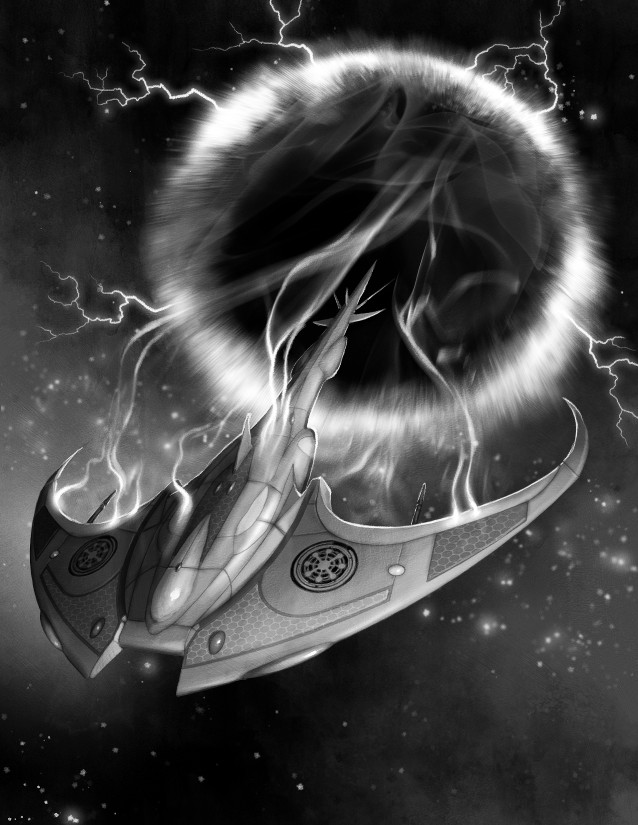
…and so can this.
In Mindjammer, a character can take a culture as an extra. Maybe they just take an aspect – all characters do that by default, and it influences their behaviour. But if you’re a character who deals with cultures a lot – perhaps a psy-ops specialist, a culture agent, or a “memetic engineer” (yup, that’s a profession in Mindjammer), you can take a culture’s skills, stunts, and aspects as an extra, and then use them to affect other cultures.
Isn’t that cool? That’s a feature of the Fate Core rules; extras are powerful juju. Suddenly, using extras, it becomes possible to have a character who is a general of an army, a political leader, a culture agent, or starship captain, and for that character to have real, in-game ability to directly affect other armies, polities, cultures, or starships using his own abilities (including those gifted to him by his extra).
This was always something which was a little hard to simulate in 3rd edition Fate. The Fate Fractal was there, so you could have stat blocks for starships, organisations, and cultures, as we did in Starblazer Adventures, Legends of Anglerre, and Mindjammer 1st edition. But the crucial link which tied characters to these larger entities was not explicit. In Fate Core, the extras rules provide that link in a single, elegant, and quite revolutionary way.
And everything remains centred on your character. Even in a huge war between nations, it’s still your character who is at the heart of the action; he uses one of those nations as an extra, and it’s his action through that extra which affects the enemy nation.

There are so many places we can take this. Future scenarios in Mindjammer will explore some of them. But Mindjammer is very intentionally also a completely Fate Core game; it dials some of the rules settings for far future transhuman sci-fi, but it’s in no way a variant. All the way through development, we wanted to make sure that Mindjammer was a Fate Core game; this means that, even though Mindjammer itself is standalone, you can easily use other Fate Core products with it. Go out and grab the Fate System Toolkit, Fate Worlds, even Fate Accelerated, and know that they all work together. Equally, take what you like from Mindjammer and plug it directly into your Fate Core game, whatever the genre. The extras, constructs, organisations, and cultures rules will work seamlessly, out of the box.
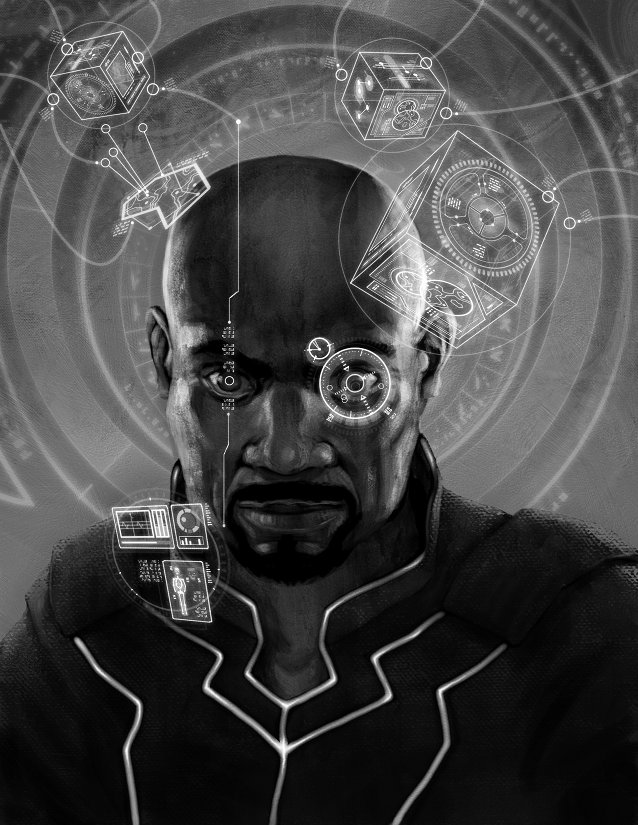
The transhuman adventure is just beginning…
I’ve had an absolute blast writing Mindjammer, and I’ve been helped, encouraged, and supported by some awesome people; playtesting, proofreading, editing, layout, publicity, promotion, and distribution. Now the game is yours, and its rules and ideas are out there in the Fate Core community. I can’t wait to see what everyone does with it.
Cheers,
Sarah
Normandy, February 2014
*****
You can preorder Mindjammer – The Roleplaying Game from Modiphius Entertainment now, and receive the PDF “Thoughtcast Edition” for immediate download. The 496-page hardback ships to preorder customers at the end of March.
For more information about Mindjammer, check out the Mindjammer website, the Mindjammer forums, or the Mindjammer Google+ community. For info about the game, contact info@mindjammer.com; for publicity, promotion, and distribution information, contact pr@modiphius.com.


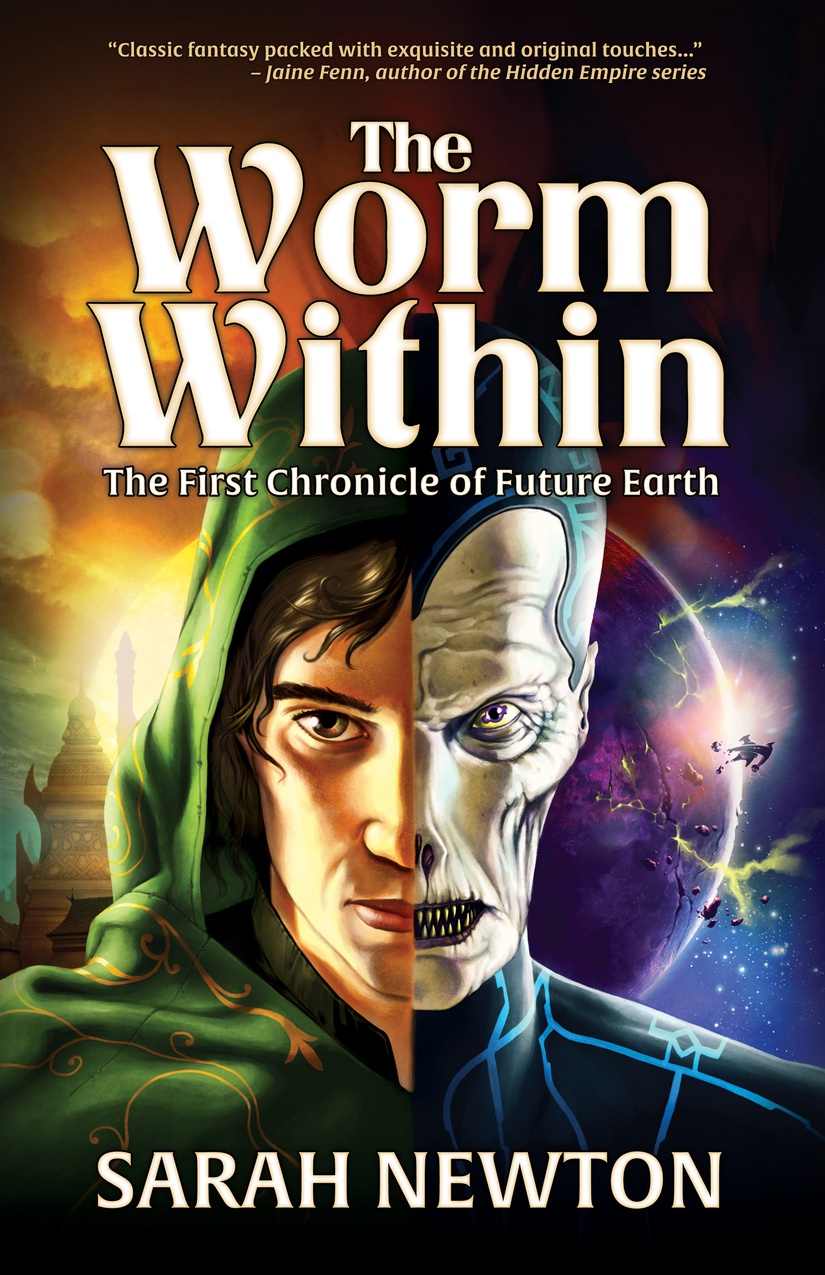


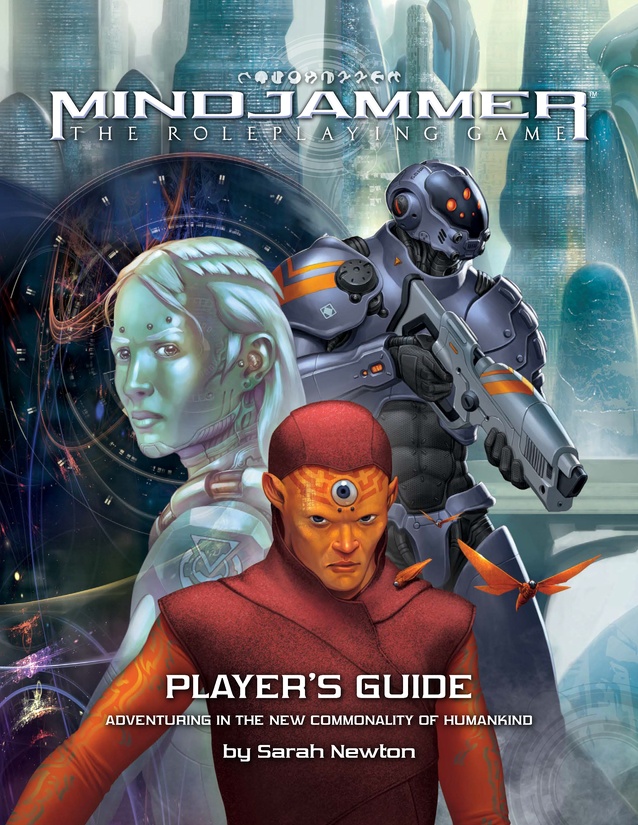









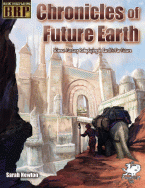


 Sarah Newton