Roleplaying Character Arcs: The Blade Runner Challenge (Part Two)
 Last time, I laid down the challenge of trying to describe in roleplaying game terms what’s actually going on in the rooftop scene between Deckard and Batty at the end of Blade Runner. Most RPGs are capable of describing the physical externalities of that scene in mechanical terms, but few (there are some) can reasonably attempt to describe what’s actually happening in ways which make for an exciting and satisfying game experience.
So, what are we really talking about with Deckard and Batty?
Essentially, we’re talking about internalized narratives. The whole point is not so much the externalities of the plot (the jumping around on that rooftop, ramming nails through wrists, breaking fingers), but what’s going on inside the characters – their “character development”, in literary terms. I was watching Seth Bullock in the “Deadwood” series last week, and how his thwarted relationship with Alma Garrett is both superficially unsatisfying for the viewer, and yet has a profound significance for Bullock’s internal character development – how he chooses to adopt a moral stance, even if it runs counter to his instincts. I wondered how this could work in an RPG.
In order to emulate this in a roleplaying game, we first have to have some sense of a character arc – that a character will change and develop as part of his experiences. Most RPGs do this in “external” ways – by measuring skills, levels, hit points, etc – and then letting the character improve in those. Because, ultimately, character development is what we want to see in a roleplaying game, even if it’s as simple as someone getting better at killing things.
In the old Advanced Dungeons and Dragons days, DMs often kept “alignment graphs” for characters. This was an attempt to chart how much a character’s actual behaviour matched his or her nominal alignment – and it was something which was tracked over time. If the alignment graph swayed too much to one side – from Lawful Good, say, to Neutral Good, then the DM could actually change the character’s alignment – with possibly wide-reaching effects.
Now, alignment graphs were good for tracking a character’s moral worldview, but character development is about so much more than that. In Batty’s case in Blade Runner, his initial greed for “I want more life, fucker” transforms from a purely selfish wish not to die, into an overarching love for life – not just his own life, but all life. There’s an alignment graph-type phenomenon happening there, but how could you track it in roleplaying terms?
Let’s start with a simple descriptor: “I want more life, fucker”. That could be an aspect, in FATE terms; an ability, in HeroQuest terms; a distinction in Marvel Heroic Roleplaying / Cortex+ terms. But, in “real world” terms, “I want more life, fucker” could morph in a number of ways – it could turn inwards, turn into psychopathy, an “if I can’t have more life, no one can”; it could turn into despair – “I can’t have more life, so I give up”; it could overcome itself, and transcend into something almost religious, like “I love all life – even yours”.
In other words, such descriptors are not simply linear – you can’t simply have a single score for “I want more life, fucker”, and expect it to cover all the possible parameters for character development. Instead, descriptors have multiple axes – stronger, weaker, better, worse, sideways, inwards, outwards. And a single person may have a descriptor moving along multiple axes simultaneously – that’s the stuff great character conflict is made from.
So – maybe there’s a paradigm here. Characters have multiple descriptors – let’s call them Traits, as it’s a nice neutral word. We can improve on that later if necessary. Maybe we can group Traits by category – Moral Traits, Belief Traits, Relationship Traits, and so on. Maybe they have a strength – that’s where an RPG “score” might come in. Let’s use a score from 1-10 for now. So, let’s say a character has the Trait “I want more life, fucker: 10”.
Now, a character can have an experience which directly challenges that Trait. Somehow, in that rooftop scene with Deckard, Batty is so impressed with Deckard’s struggle for life – and his own – that his “I want more life, fucker” Trait is irrevocably changed. That could be something which happens gradually – one “point” of “damage” at a time – or something which happens suddenly, in an instant. Let’s call each moment when such “damage” is done an Inflexion Point. It’s a crap term, but it will do for now. Deckard isn’t consciously attempting to do damage to Batty’s “I want more life, fucker” Trait at each of these Inflexion Points, but from a character development perspective, that’s what’s happening.
This means each Trait can conceivably have a number of Inflexions, each of which pulls the Trait in different directions. So, you could have the annotation “I want more life, fucker: 10 (Kill everyone 2, Love of Life 5)”. Now you’ve got a mechanic where you can track the meaning of a trait in character development terms, along different axes. There are questions to be answered: how many traits can you have, how many inflexions can a trait have, and so on. But there’s the nub of a mechanic there.
Lastly, we need to bring in the character development bit. That’s a bit genre dependent; in a more literary genre, you might phrase the Trait in a way which incorporates an assumed future development – “I’ll do anything I can to get more life”, etc. In other genres, it might be more punchy: “The whole world will bow before me!” In some ways, this is the continuum from pure aspects in Legends of Anglerre through to the “future aspects” we brought in for those rules.
So, there’s a suggestion. Next up, I want to look at the types of traits you can have (combat traits, belief traits, moral traits, etc), and the ways in which you can generate Inflexion Points and Inflexions for Traits – and how they change.
What does everyone think?
Thinking RPGs: The Blade Runner Challenge (Part One)
 I’ve been thinking recently about the experiences characters go through in movies and novels, and how they differ from those of roleplaying game characters. Sure, fictional characters come up against obstacles, experiences they have to “get through” in order to move on, but it’s rare that these obstacles present themselves as so many physical opponents which line up like a coconut shy to be knocked over one at a time. As often as not, obstacles for fictional characters represent something they have to overcome inside themselves – that’s what makes them difficult, not the objective degree of “difficulty” they might pose in themselves.
When Raskolnikov callously murders the old woman pawnbroker in Crime and Punishment, he doesn’t make a to hit roll with his axe against her imaginary (and non-existent) dodge skill, endurance, or armour class; he is wrestling with a compulsion, an obsession within himself “that he has to know”. Is his murder a victory over that obsession, or a defeat at its hands? Well, that’s what the novel’s about… When Luke fights Darth Vader and the Emperor in Return of the Jedi, it’s hardly about his skill at all – he’s completely outclassed, doomed to fail. Instead, it’s about his relationship with his father – whether he can reach out and touch a perhaps still glowing ember of humanity in Vader’s carbonised soul. And, perhaps most importantly for this discussion, when Deckard “fights” Batty at the climax of Blade Runner, it’s nothing to do with combat prowess – but rather a process of gradual satori for both sides, as they confront their love of life, vitality, will to survive, and it overcomes the resentment and spite engendered by their thwarted lives; a self-sacrifice at the altar of life.
How on earth do we represent those themes in roleplaying games? Most RPGs busy themselves almost exclusively with the externalities of a character – a mechanistic fixation on his equipment, skills, quantifiable and measurable strength, IQ, etc. In other words, pretty much everything which great fiction deals with is handled by none of what roleplaying games do. It’s all left in a vague, consensual. improvisational zone – as people say, “that’s the roleplaying bit”.
But, of course, the flipside is, if you have a game which doesn’t deal with the physical activities handled by most RPG rules – ie, all of the examples above – then you don’t actually have a game at all. Imagine trying to run the Deckard-Batty building / rooftop scene in most RPGs. Could you do it? Roll 1d100 to keep clinging to the outside of the building? Make an Willpower roll to jam a six inch nail through your fist? It wouldn’t make sense.
So, that’s my starting point. Over the next few weeks, I’m going to attempt to brainstorm just what a RPG would look like that could successfully and satisfyingly model that Blade Runner climax, in a way that was exciting, fulfilling, and also a damn good crunchy game. Identifying this goal is what this post has been about – what do you think? Can you think of any classic, iconic scenes in movies, novels, or comic books, which you would *love* to be able to game through in a roleplaying game, but which RPGs in their current incarnation just won’t let you play?
The Virtual Self
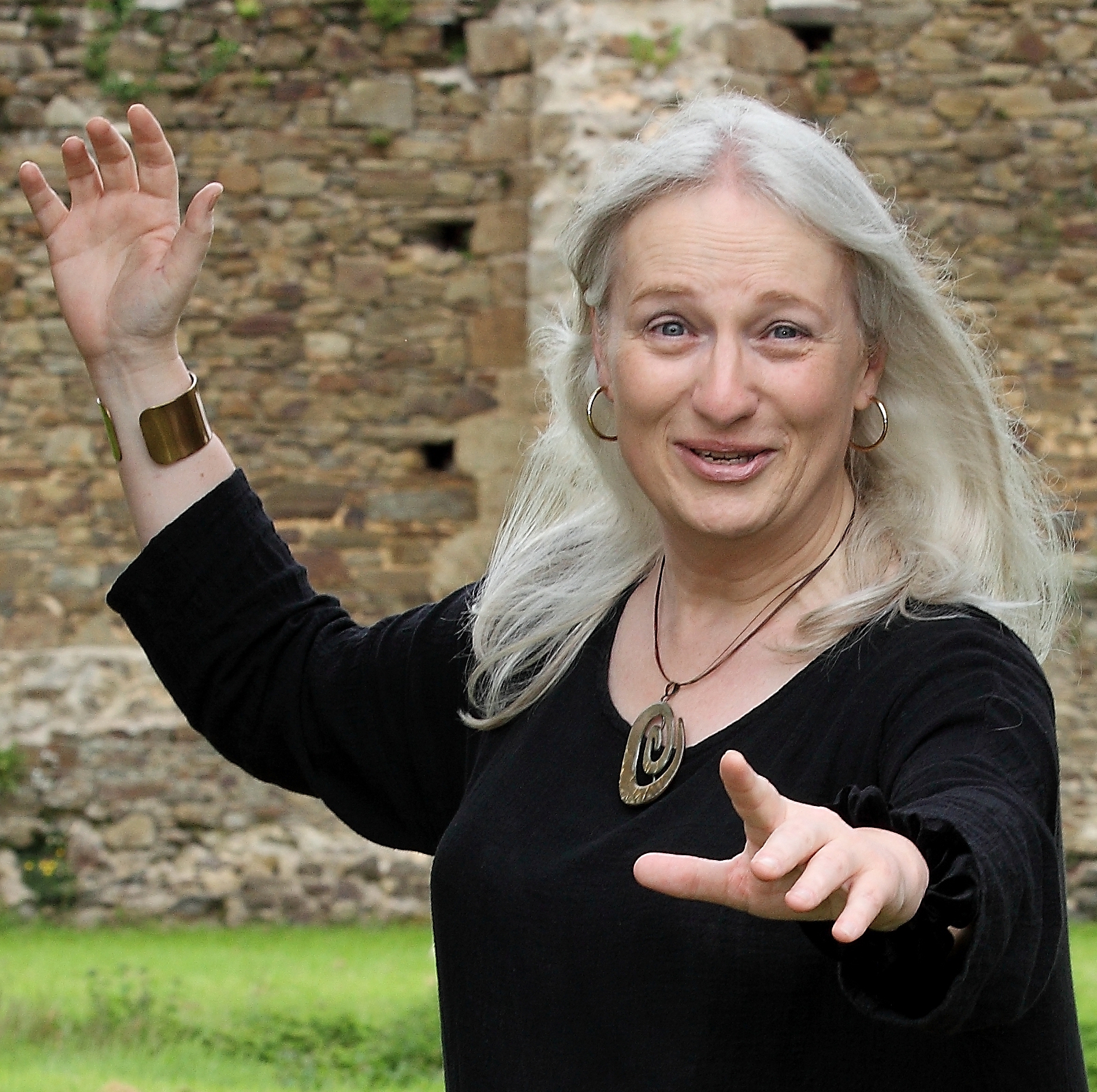
That's me on the right...
In Mindjammer, it’s possible to remember not just your own memories, but those of other people – gestalts of memory engrams uploaded to the interstellar mindlinked internet known as the Mindscape. The more advanced artificial intelligences have their very personalities based on the compound stored memories – known as exomemories – of dead individuals. Imagine you can remember pretty much every memory that Napoleon, or Lincoln, or Hitler, ever had, but that you’re none of those people, but someone else, someone new – what kind of person does that make you? That theme is one of the most crucial of the Mindjammer setting, and one I never seem to get tired of exploring.
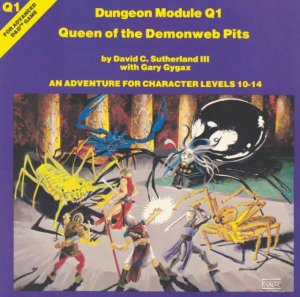
There’s a great article in today’s Guardian discussing this very topic – the instability and indeed variability of memory as a foundation of our own identities. Reading it today, my mind began to wander over a territory I still have to explore one day in much more detail: the memories and identities of roleplaying gamers. I’ve been a gamer for over 30 years, and some of my fondest “memories” are of events which never ever happened. I remember when I embarked upon an expedition to the Demonweb Pits and slew the evil goddess Lolth when I was about 12 years old; I remember when Tryfan Ironsword returned from the Hero Plane with God-Cleaver, the Unbreakable Sword, and thereby became the new son of Humakt, God of War, incarnate. And I remember the first time we encountered the insidious alien device known as the Uranawaltzer on the war-torn world of Amida, occupied by the nefarious Venu.
None of these things happened, of course. Or, rather, they happened as part of role-playing games, where I played the role of a fictional hero in a mutually created story. But, in some way, they are my memories, they’re part of what I remember of my life and they go some way to explaining who I am. I’m sure any role-player out there will understand what I mean.
It strikes me therefore that roleplaying games are very powerful tools. They can actually affect our memories, who we are. Maybe, almost 40 years after their invention, we’re only now beginning to realise their importance in the construction of our virtual selves. Especially as video roleplaying games become ever more realistic, and they too begin to create memories of things which never happened in the “real” world. Let me tell you of some of my adventures in Skyrim…
What do you think, folks? Has your sense of self been affected by being a gamer? Do you have memories from roleplaying games you treasure as if they’d happened to you yourself?
System Fatigue: Thoughts on D&D 5th Edition

This game needs more rules...
Now, admittedly, I’m not a “heavy user” of Dungeons and Dragons. I prefer more storytelling-oriented rules systems, like Fate, HeroQuest, etc; and for my more crunchy kick I tend to go with variants on the d100 system made famous by games like RuneQuest and Call of Cthulhu. But I used to play a heck of a lot of D&D – right from when I first started RPGs back in 1980, right through till about 10 years ago. So what’s changed?
One of the key plus points for an RPG rules set for me is its stability. That is, once I’ve learned the rules, I can reasonably rely on them remaining the same for an extended period of time, so that I can just pick up a game and play with relatively little prep. Now that I’m no longer fifteen years old, I don’t have weeks on end to spend meticulously prepping for gaming sessions: I like to pick up a game, quickly read the scenario, and play.
Obviously, in addition to being stable, this also means the rules set of a good RPG for me also has to be relatively simple. There are some great games out there whose setting I love and whose game play I like, but which I don’t play because I have to spend a month re-reading the rules before I can play a game again.
Finally, for me, a game system has to be reasonably elegant. This is a tricky one. For me, that means it doesn’t just focus on smashing up monsters or spaceships or whatever; it has to be able to model social interactions, heroic exploits, godlike or superhuman powers, whatever. In other words: to do a whole lot more than a simple tabletop skirmish game could. Don’t get me wrong: I *like* tabletop skirmish games, but I don’t use their rules for roleplaying.
Many people say 4th Edition Dungeons & Dragons fell down on the “elegant” score: it was basically a very combat-heavy ruleset focussed almost entirely on skirmishing, with not much scope for roleplaying per se. In my humble opinion there’s some truth in that, but personally I was impressed with the “Skill Challenges” rules in D&D 4e – an attempt to codify “playing against the story” into the rules, and which kind of worked. I’ve been able to use a lot of the theory of Skill Challenges when writing and playing the Hazards and Challenges rules in Legends of Anglerre and the upcoming Starblazer 2nd edition, and the “story obstacle” structure of scenario writing in HeroQuest 2. 4th ed D&D may have been combat heavy, but it was innovative in non-combat areas, too.
For me, the first 4th ed D&D books lost out on the simplicity score: I found myself studying the 4th ed Players Handbook trying to fathom the rules, and to be honest rapidly gave up and went back to my usual games – I couldn’t see any good reason to persevere – there was nothing in the 4th ed PHB that made me sit up and say “Wow – I really want to play this game!”.
However, D&D Essentials – that worked for me. I played the Red Box thoroughly, and bought the Essentials books, and found them well-written, well-targeted, and accessible. The rules there were presented much more simply, and were memorable.
But – and here, for me, is the crux of the entire Dungeons and Dragons problem, these days – I always had this niggling feeling that my time investment in learning the 4th edition rules was going to be a ultimately a waste, as sooner or later Wizards were going to release a new edition, and render all my attempts to learn the 4th edition rules a bit of a joke. I love roleplaying games, and I’m passionately loyal to systems I like and which I think play well. But, most of all, I play for the long term: if I learn a rules set, I want to know that it’s going to be either a.) pretty quick and easy to learn, or b.) something I’m going to be able to play for a decade or more, in the case of a relatively complex RPG.
Now, if I was *only* playing 4th edition D&D, then there probably wouldn’t have been a problem. But I don’t: I play several other games regularly, including Starblazer Adventures, Legends of Anglerre, HeroQuest 2, Unknown Armies, Call of Cthulhu, and even Exalted (I say “even” as in my book that’s a complex game requiring quite a time investment). D&D 4th ed shares my brainspace, and has to stack up against those other games.
So, 4th ed came out in – when? 2008? I bought the 3 core books, and did nothing with them for a year or two – too complex, too much time required. Then I got into Essentials with the Red Box in 2010, and I’ve played it maybe ten times. I bought the new Gamma World, which I thought was a great match with the 4th edition rules, and played it loads. I’ve recently been toying with getting the Neverwinter campaign books and giving them a whirl.
But today put my 4th edition purchase plans on hold, probably indefinitely. Today – 5th edition D&D is announced. In prospect: another couple of years getting used to a whole new rules set, again with the nagging feeling that once I’ve learned the rules, the carpet will be pulled out from under my feet and we’ll be onto the 6th edition (then the 7th, then the 8th, every few years or so). And the same niggling suspicion that the only reason we’re being given yet another edition is to force fans to re-purchase everything they’ve already got, only in new format. And the D&D core don’t come cheap…
I bought almost everything published for D&D and AD&D back in the day. I bought less for 2nd edition, less still for 3rd edition, and maybe 10 titles total for 4th edition. I’ll probably buy the core books for 5th edition, mostly out of interest – just because I’d like to read the latest rules for the grand-daddy of all RPGs. But the publication pattern D&D is falling into is less and less the way I want to “consume” my RPGs. I have so many DMGs and PHBs the mind boggles, and although they’re quaint artefacts, they’re all out of date and useless as games. Why would I want to continue doing that?
I must of course say a word about Pathfinder. Although I’ve found the Pathfinder core book to be a complex read, and as a result haven’t played it yet (although I played tons of D&D 3e), I’ve found the Golarion setting and scenarios to be superb quality, and easy to grasp. As a result, I’ll shortly be buying the Pathfinder beginners’ box set to finally play my updated “Halls of Tizun Thane” scenario as an old school D&D monster bash fest. Why? Because Pathfinder is showing commitment to the stability of its rules set; it may be incrementally tweaking and improving those rules, but with Paizo I have the faith that, even if they do one day produce a Pathfinder 2nd edition, it’ll be essentially the same game as Pathfinder 1st ed, and I won’t have an entirely new learning curve to climb. I’m happy to give Paizo my money, as I trust them as a long-term investment for my D&D-style adventuring. They’re using a ruleset that’s now 13 years old, and still plays well. Hell, I still play d100 – and that’s 35 years old, so Pathfinder’s got a way to go yet before I’ll consider it “old”!
So, those are my thoughts on yet another edition of D&D. Naturally I’ll be watching with interest, but doubtless reserving judgment for now. I wonder how many other people will be doing the same?
Inklings at Christmas
 As yet another Christmas comes around, I find myself once again keenly aware of my Northern European identity. While many of the trappings of our modern Christmas may have been invented and commercialised in the 19th century, the roots of Yuletide are of course far older and, here in Northern Europe at least, closely tied to that period of cold and lethal darkness through which we all hunker down by the fire and wait for the sun to return.
There’s little daylight now. Even then most of it is grey, lifeless, the trees like blasted remnants of their summer selves. Even the air smells dead, sterilised by frost and cold. Yet here, by the fire, a little spark of life lives on – embers in the hearth, preserved fruits and baking in the stove, a great evergreen tree brought still living into the house and decorated and praised as a symbol of life’s power to survive the midwinter.
I love the accoutrements of this season – the signs of continuing life, survival, and the hope of returning life to come. The birth of Jesus is a perfect addition to the medley of other religious symbols swarming together into this midwinter hotchpotch – the gift-giving, slaughtered meats, and cheerful feasts of Saturnalia, the mulled wines and beers of our Germanian and Scandinavian forebears raised by the hearth over the “hallowed nights” of the Solstice, the Yule log brought out again to kindle the fire.
One of the great strengths of Western civilisation is its eclecticism. Shameless, effortless, and somehow startlingly innocent. Despite the best efforts of propagandists and ideologues, we happily rip off, plagiarise, assimilate and regurgitate any bits of our constituent cultures – and those we come into contact with – and add them to our huge incongruous jumble. Christmas makes no logical sense. Christ was probably born in spring, when the lambs are in the field, not winter; we sit and sing songs of Zoroastrian priests, desert villages, and a Roman census two thousand years old, then bung it together with Scandinavian myths, Celtic legends, and twee Victorian commercialism.
But on an emotional level, it makes all the sense in the world, and after thousands of years is still the dominant event in our cultural calendar.
So raise a tankard of steaming ale by the fir tree by the hearth, and join me in chants to pagan kings, Zarathustra, and the birth of the King of the Jews – for Santa and the Wild Hunt ride tonight!
Merry Christmas, and Good Yule!
Asymmetric Gaming: Musings on HeroQuest 2nd edition (part 2)
 Over the past few months I’ve been reading, playing, and thinking a lot about the 2nd edition of the HeroQuest roleplaying game, published by Moon Design. Several weeks ago I posted about my first impressions of the game; today I wanted to talk a bit further about the radically asymmetrical nature of the HeroQuest 2nd edition rules.
In most roleplaying games, you play your character using the same rules as the “opposition” – the bad guys and monsters you encounter in play. Perhaps you have a few advantages – more flexibility, greater power – but fundamentally there’s a symmetrical relationship between the rules which define what you can do, and what the bad guys can do. It’s an assumption from roleplaying’s early days in the world of miniatures gaming, and one which is so widely held it’s rarely even acknowledged.
HeroQuest 2 is a storytelling roleplaying game. The thing you’re opposing (or at least interacting with) in a HeroQuest 2 game isn’t so much an array of opponents, but rather the story itself. When your character fights the dragon, rescues the prince or princess from the evil sorcerer, or destroys the space station in your tiny starfighter, in HeroQuest none of those opponents are defined using the “stat blocks” you’d find in other games. Rather, the difficulty of achieving those individual goals (fight the dragon, rescue the prince, destroy the space station) is defined. Moreover, that difficulty isn’t defined by how objectively hard each of those goals might be to achieve (starfighter against space station? no chance!), but instead by how difficult it should be in terms of the story. If the story, by its genre, dramatic structure, or structural necessity, suggests that a hero with a stray arrow should, right now, have a decent chance to kill the dragon which has terrorised the land for decades, then that’s what the difficulty of that task will be, regardless of how formidable the dragon might “objectively” be.
Now, like many RPG game masters, I’ve often enjoyed meticulously detailing the foes my players would face. Creating that dragon in gorgeous technicolor, with its strengths, weaknesses, and powers defined in pretty much the exact same terms as the player characters – in universal, objective, “game reality” terms, it has X hit points, does Y damage, and has a Z probability of turning the PCs into puree.
It’s initially a great shock not to be able to do that in HeroQuest 2. How the hell am I meant to differentiate between one bad guy and another without statistics? How can I even describe what the bad guy does, says, or thinks, without an exhaustive list of his skills, attributes, and powers, all carefully laid out in game mechanics terms, ready to be compared like-for-like with the PCs?
 The answer is quite subtle. You still describe your bad guy – certainly in as much detail as you need to be comfortable with. If it’s some mystical bad guy in a black environment suit with uncanny powers who once fell into a volcano, then you can probably improvise most of what he can do; but if it’s a Mistress Race priestess of Kyger Litor with a bevy of powers gained on Underworld heroquests, then you might want to note some pointers down – probably in some detail – to work from when riffing your descriptions.
HeroQuest 2 really helps you do this. Even for PCs, there are no fixed skill names, attributes, etc; you get to come up with those yourself when creating your character. You invent abilities like “Initiate of the Storm God”, “Lethal Magic Blade”, “Blood-curdling War Cry”, etc, to your heart’s content, and the rules provide numerical scores for these so you can utilise them in play.
You can probably see how the “bad guy” side of the equation comes together. On the one hand, the HeroQuest game system provides you with a numerical difficulty (or “resistance”) for a given thing you’re trying to do, a number which is based on the dramatic necessity of the scene you’re playing; on the other, you have a bunch of descriptive phrases defining your bad guy. It’s then simply a matter of judgement to pair them up: if the “resistance” at this point in the story is high, select one of the bad guy’s more powerful abilities; if the resistance is low, select an ability that’s not so powerful, or maybe even a weakness. Then, describe the PC’s interaction with that.
When I first got my head round that, I was floored. It’s so untraditional the whole concept takes some getting used to. Everything your PCs come up against is simply a “story resistance” in rules mechanical terms. This means all the finer points of the rules which are used to describe individuals – characters, etc – are basically used for PCs only.
Think about that for a moment. How much damage a weapon does, how you use “Hero Points”, how you take damage or heal from wounds, how you use magic to improve your abilities, etc: none of these rules apply to the opposition. In the most basic terms, it’s like describing the entire stat block of a D20 bad guy as “Demogorgon, DC45” – except that the DC45 might vary from DC10 to DC100, depending on the requirements of the story you’re playing.
This simple fact is probably one of the biggest hurdles for traditional RPGers learning how to play HeroQuest 2: it certainly was for me. Trad RPGs have a tendency to portray conflicts in rigid, binary terms: one individual versus another (or a group of ’em), where you have to come up against that individual and prevail. And that man-vs-man conflict gets the lion’s share of the game mechanics; other tasks – picking someone’s pocket, debating someone about the best tactic to use, trying to win the love of the Leopard Empress – are either simply talked through without any mechanics (the ur-traditional approach), or perhaps subjected to some simple mechanics, but which almost never approach that of the man-vs-man combat mechanics in sophistication.
In HeroQuest, you’re freed from that binary. Anything can be a contest, and that massively changes how your games play out. In a recent session, my PCs had to rescue an unconscious shaman about to be sacrificed by a bunch of werewolves on the night of the full moon. The traditional approach would be a military confrontation: go in there, battle, get the shaman, get out. Damage would be given and taken, and likely the foes would be slain.
 In our HeroQuest game, the “combat” part was just one of many facets of the encounter, rather than its main focus. There were magical distractions, attempts to lure away guardian wolves, war cries intimidating the lesser werewolves, and the occasional clash of arms, until one of the PCs raised a magical wind to fling himself across the battlefield to the unconscious shaman, grab hold of him, then use another wind to blast them both far away to safety.
In the end: mission accomplished. How many foes dead? Some, it didn’t really matter: the close detail of wounds and hit points was less important than the overall description of the scene and its outcome. With many games, that decree of narrative freedom is unimaginable; in fact, in most it would require a heckuva lot of arbitrary judgement calls and arm-waving. In HeroQuest 2, the outcomes of the contests you play through are strictly controlled in rules terms; you have leeway on how you describe the outcomes, but the objective level of victory you achieve is very precisely defined by the rules. Your character can die, but it won’t be at the GM’s whim: the rules will clearly indicate when and how that happens.
In my early experiments with HeroQuest – back in the days of HeroWars, over a decade ago – my biggest problem was trying to shoehorn this increasingly revolutionary ruleset into the traditional tropes and encounter structures mandated by more traditional RPGs. Where were the hit points? How much damage does my armour absorb? How much gold can I carry?
Twelve years on, the HeroQuest 2nd edition rules have pretty much freed themselves from their traditional legacy, to provide untrammelled access to a new way of running roleplaying games. The temptation to try and “fix” the HeroQuest 2 rules so they play more like traditional RPGs is immense: it’s only with great self-discipline I’ve been restricting myself to only playing the Rules-As-Written – and trying to learn the hidden lessons which lie therein.
So far – I think – I’m managing. At least till my next revelation…! 🙂
Fathoming “Nobilis”
 Somewhere, sometime, I fell to the Dark Side, and became interested in narrative storytelling roleplaying games. I still emerge into the light from time to time, for a good crunchy sesh filled with dice rolls, range estimates, searching for secret doors, and miniatures; but, equally, I’ve become fascinated with games with a much less traditional take on what an RPG is.
I think it’s the variability of storytelling games which draws me in. The more trad RPGs all have very much a single, monolithic take on how we “do” roleplaying games: you have a character, which represents “you” in the make-believe world, and that character has attributes like Strength and Intelligence and skills like Search or Hide or whatever, plus tons of equipment to allow him to do special stuff. Then you play the game by attempting to do stuff – “tasks”, loosely speaking – by rolling dice. Up until about 10 years ago (or a little more… how time flies), 99% of roleplaying games did just that.
I discovered Hero Wars in 1999, quite by accident – I’d been expecting it to be a kind of “super RuneQuest”, and had ordered it on that basis. It wasn’t, of course: it was one of the early games which have since been variously called “indie”, “narrative”, or “story telling” games. Games where the structuralism of traditional RPGs doesn’t apply – maybe no tasks, or no attributes, or no dice – and where the “reality” of the game experience is divided up and quantified differently.
Just for shorthand, I’ll call these games “modern”, rather than try and adhere to any other label – “modern”, as opposed to “traditional”. I think I get a similar buzz from reading and playing modern RPGs as I do from reading (or writing) speculative fiction – experiencing a different and unexpected way of viewing the world, discovering a completely alternative take on the assumptions and hidden truths which lie beneath the surface of (game) reality. Hero Wars, then HeroQuest, allowed for the resolution of “contests” – absolutely any contest, from a singing contest to a mass battle – with its resolution system, and allowed anything at all to be a character ability, and assumed there were tiers of ability – called “masteries” – in the world. FATE, my current go-to system, focussed on descriptive phrases to define a character – not numeric, but literary – and built a system around that which allowed for a vast array of scales to interact, where a hero really could single-handedly bring a kingdom to its knees, or a lucky shot by a farmboy flyer destroy a space station. Lots of other games have led me down similarly fascinating paths – so, like many modern gamers, I’m hooked.
Now – Nobilis. I’ve just discovered this game, after some creeping gradual interest and a definitive chat with Ken Hite at Dragonmeet a couple of weeks back. I bought the PDF of the 3rd edition rules last week, and will be opening the hardback on Christmas morning. But, for now, I’m puzzling my way through this fascinating, and – I must admit – damned hard to understand game!
First up, you play godlike characters, with miraculous powers, who can do pretty much everything. It’s a modern-day, magical reality setting, a la Sandman, or The Dark Is Rising, or Jacob’s Ladder. But it’s also the most (and I use this word with great caution) feminine RPG I’ve ever come across. OK, feminine’s the wrong word: I’m just being provocative. 😛 But, in the face of pretty much all RPGs being about rampaging around attacking things, hard statistics, and plenty of artwork showing unfeasibly pneumatic females, Nobilis comes across as the most New Agey, “soft-brain”, and frankly self-consciously literary and even psychological game I’ve ever seen. And I still don’t know if I can play it.
OK, I’ll probably work it out. For now, I’m in borg-mode, assimilating everything I read, trying to identify which bits are rules and which bits background and setting. It’s that kind of game. Happily, there’s a character sheet, which I expect will shortly be my big crutch for working out how to actually run a game. But a lot of what I’m seeing is completely unfamiliar: no dice, a resource management resolution system, earth-shaking powers in the PCs’ hands, and, it seems, the power to alter reality at will. Kind of like Exalted, if Exalted was played after smoking lots of weed, taking all the rules out, then dialling everything up to eleven.
So – can anyone give me pointers? How do you play Nobilis? How much power do your PCs have in your games, and how do you structure scenarios and plots when the characters can do almost anything? I think I’ve found me another modern RPG to bend my brain, and am looking forwards to getting started! 😀
Mindjamming at Dragonmeet 2011
Last Saturday, the 26th November, was the day of Dragonmeet, the annual roleplaying games convention at Kensington Town Hall, London. It was also Day Three of my “Dragonmeet Roadtrip”, my last UK trip of 2011, cunningly designed to cram in piles of meetings, chats, discussions, and awesome retail opportunities (both buying and selling!) with a minimum of… what’s the word?… oh, yes – sleep. 😉
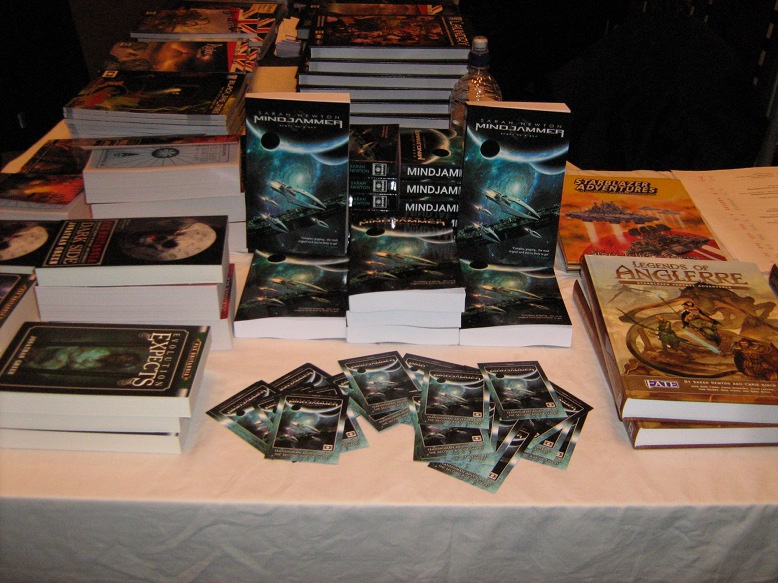
"Mindjammer" at Dragonmeet
I love Dragonmeet. Although it’s only a single day convention, and I never get the chance to run or play in games (there simply isn’t the time), it’s become something of an institution. It’s always the last weekend in November, just when things are starting to get seriously Christmassy, and for me it marks the dividing line between the frenetic activity of the rest of the year, and the slow, graceful decline into the Christmas break. Once Dragonmeet is past, Tinsel Time is not far away.
This year, for me, Dragonmeet was a little special. Mindjammer was there.
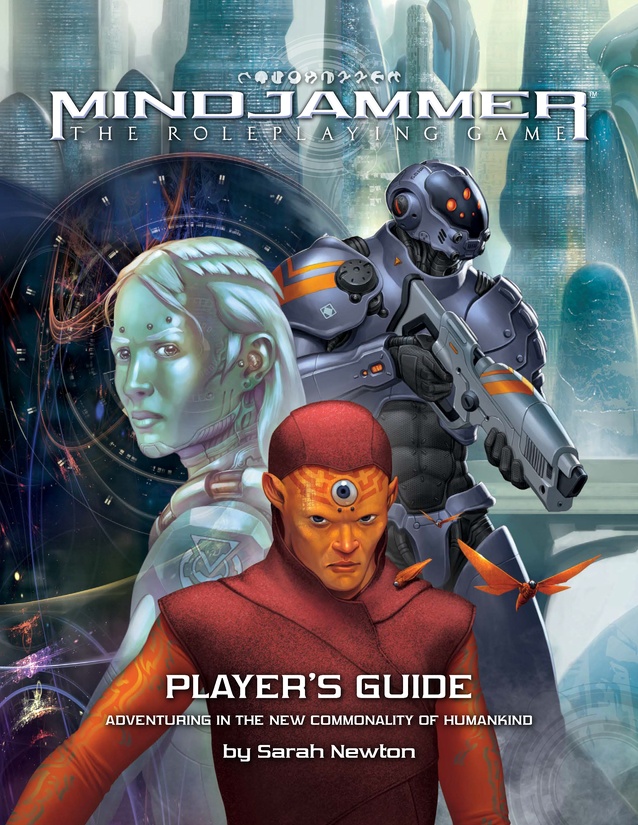
That’s right. My first novel, which I’ve been working on for the past 18 months, and which was launched in ebook format on the 26th October, appeared for the very first time in actual, dead-tree, trade paperback version at Dragonmeet this last weekend. And it was a thing of beauty! Dom at Cubicle 7 had expedited the printing during November so we could make the convention, and on Saturday morning I set up a wee corner of the Cubicle 7 stand dedicated to our new Cubicle 7 Fiction imprint, of which Mindjammer was the first title, hopefully of many more to come. (If you want to buy a physical paperback of Mindjammer, you can do so here!)
Happily, Mindjammer wasn’t the only fiction on display. This year we also had the privilege of displaying several of the novels of m’colleague Jonathan Green, author of (amongst *many* other things) the Pax Britannica series, which Cubicle 7 is hoping to produce as a roleplaying game book in the next year or two. Genre fiction and roleplaying games are such natural comrades – ideas bounce off each other and cross-fertilise between fiction and gaming, and having a fiction line running alongside an RPG one in the same setting adds so much more depth and pleasure to the gaming experience. It’s a natural marriage, and we’re all very excited to see how it works.

Sarah Newton and Jonathan Green at Dragonmeet with their novels
Dragonmeet this year to me seemed as busy and as vital as ever, though I found out later attendance was about 10% down on last year. Personally I’m not rushing to blame that on the state of the economy – London transport was utterly shot to pieces this last weekend, with it almost impossible to get through from the Cambridge rail line, and whole swathes of the Underground simply closed. Faced with a 3-hour commute from my in-laws in Essex, where I usually stay on Dragonmeet weekend, I found myself in a hotel near Olympia this year – without which I would not have been able to attend. I think that factor, as much as anything, probably counted for the slightly lower numbers.
Having said that, in true Dragonmeet fashion, we gamers made up for the lack of numbers with an absolutely infectious enthusiasm and a dedication to buying as much swag as possible in the convention’s 8 fun-packed hours. Over on the Cubicle 7 stand with Dom, Victoriana author Andy Peregrine, and Starblazer and Anglerre author Chris Birch, things were as busy as any other year, with excellent sales of The One Ring, Airship Pirates (and the new supplement Ruined Empires), the now plentiful Victoriana line, Cthulhu Britannica (and Shadows Over Scotland in particular, authored by Stuart Boon and one of my main development and editing projects of 2011), the Laundry RPG, Legends of Anglerre, and Starblazer Adventures. We actually sold out completely of Starblazer Adventures this time – meaning the second edition printing is now vital, the Player’s Guide of which will hopefully materialise in February or so next year, followed rapidly by the Storyteller’s Guide (you can still buy the PDF versions of the game here, of course). Amazingly, we didn’t have the Mindjammer RPG supplement at all – all our UK stocks have sold out, meaning the second edition of that is now well overdue. 2012 is looking busy!
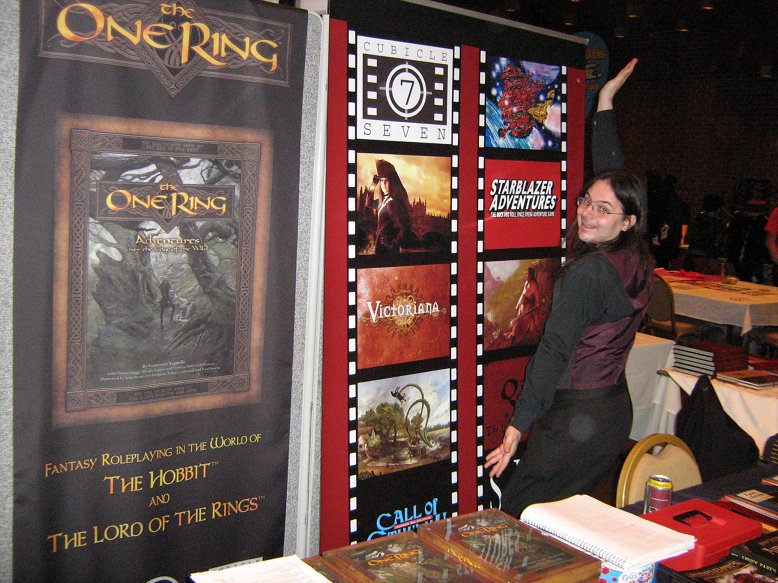
Victoriana author Andy Peregrine modelling the latest Cubicle 7 display 🙂
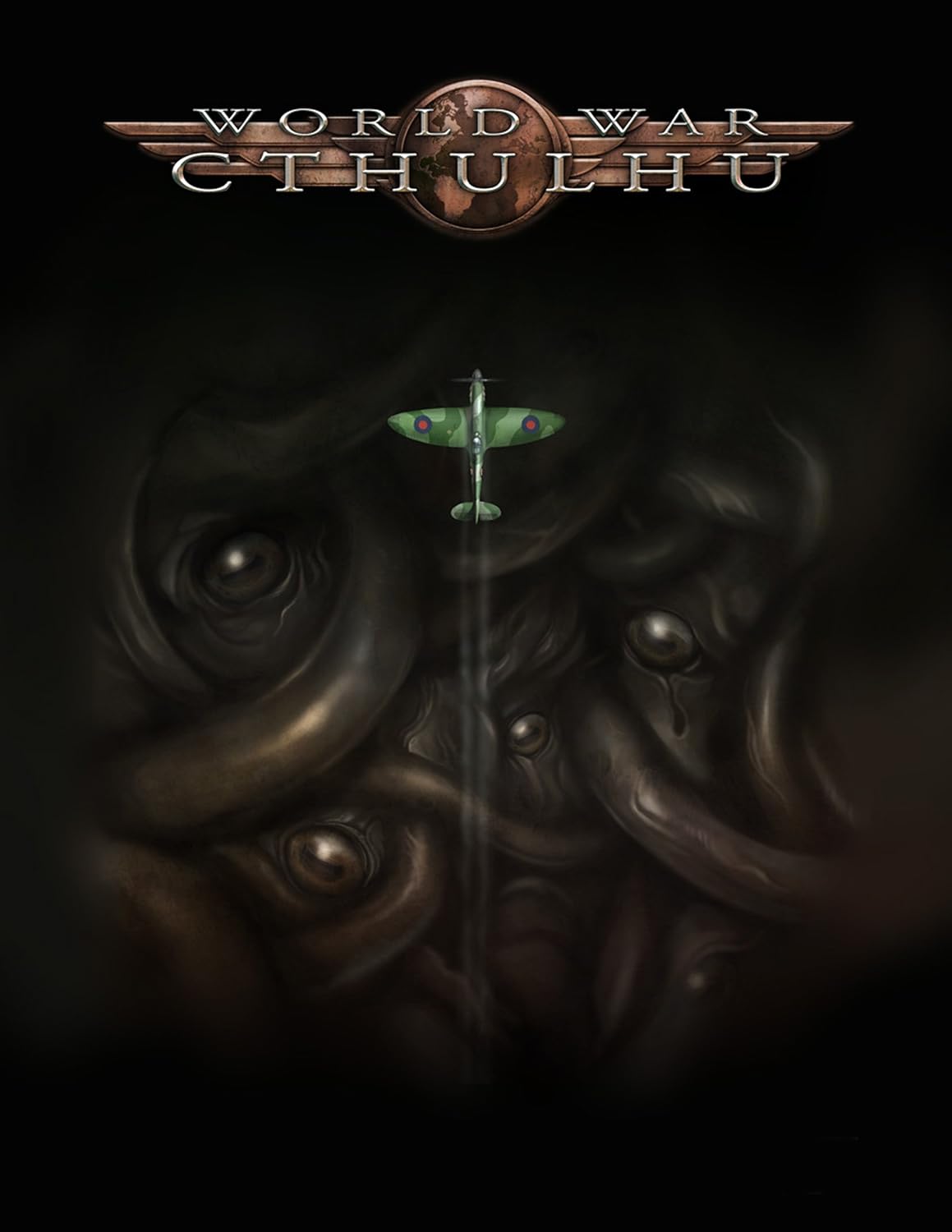
As I mentioned above, the Mindjammer novel was my personal baby this Dragonmeet, and it was flying off the stand, easily our best-selling product at the convention. As well as making me extremely bouncy and excited, it was also a great encouragement for our new Cubicle 7 Fiction imprint, as there definitely seems to be an appetite for fiction relating to our lines. Our next fiction book, a cool anthology called “World War Cthulhu”, is due to hit the shelves in July 2012, hot on the heels of the “World War Cthulhu” RPG supplement, my personal Cthulhoid baby of the past 4 years which will finally burst forth on the world in all its tentacled glory next year, featuring a host of awesome writers – stay tuned for more!
As well as hanging out on the Cubicle 7 stand meeting tons of keen fellow gamers (shout-outs to Steve and Paula Dempsey, Nathan Baron, Nick Brook, Stuart Boon, Julian Hayley, Peter Curzon, Stuart Mousir-Harrison, Dave Scott, and gazillions more), I also had the chance to take part in two seminar panels this year – the “Fiction and RPGs” one at 1.30pm, and the “Cubicle 7 – The Future!” one at 4.30pm.
Both panels were great fun, and the fiction one was especially well-attended – thanks to everyone who came! The panel comprised yours truly, plus august Fighting Fantasy, Warhammer 40K, and Pax Britannica luminary (amongst many other works!) Jonathan Green, and Star Wars and the Dark Harvest – Legacy of Frankenstein RPG writer Iain Lowson. We had a very cool hour or so chewing the cud about how our RPG and writing experiences bounce off one another, with some very perspicacious questions from the audience, including one which keenly identified the three of us as control-freak dyed-in-the-wool game masters! It was also my first opportunity trying to chair a seminar – we had no dedicated MC – so thanks to everyone who sat through my stumbling attempts to keep everything on track! 🙂
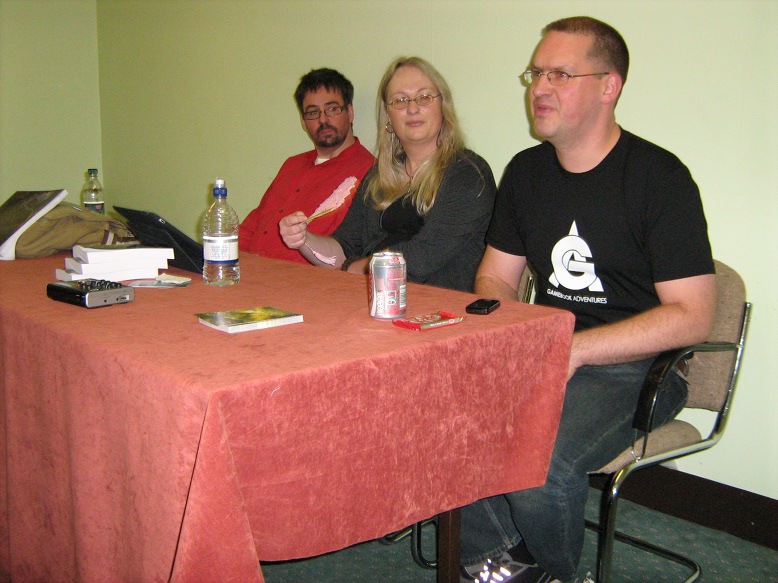
Iain Lowson, Sarah Newton, and Jonathan Green at the RPGs and Fiction panel
The Cubicle 7 seminar comprised me, plus m’colleagues Dominic McDowall-Thomas (CEO of C7), art director Jon Hodgson, and line developer (and all round RPG Writing God) Gareth Ryder-Hanrahan. The seminar was a whistle-stop tour of Cubicle 7’s plans for 2012, and in particular our dedication to getting our release schedule properly on track after the tumultuous events of the past few months. Dom and Gareth discussed plans for The One Ring, including Tales From Wilderland; Doctor Who, including the new boxed core rules, the Time Traveller’s Handbook, the Unit sourcebook, and individual Doctor boxed sets, appearing in 2012 and also into the golden year of 2013, Doctor Who’s 50th anniversary. Jon waxed lyrical about the art direction of The One Ring and the sterling work Paul Bourne has been doing on the new look-n-feel for second edition Mindjammer, releasing next year; and I took the opportunity to run through the Legends of Anglerre and Starblazer schedule for 2012, plus the plans we have for Cthulhu Britannica and World War Cthulhu. The audience fired heaps of great questions, keeping us on our toes!
I must make a special mention of Paco Jaen, a great and dear friend who I’ve known for many years, and who I met again after an almost 10 year hiatus this Dragonmeet. Paco runs the G*M*S Magazine and podcast, and sat through pretty much the whole day of podcasts at Dragonmeet this year (and still remained his lovely and charming self at the end of it all!), and I believe he’ll be posting audio podcasts of all the seminars on the G*M*S website at http://www.gmsmagazine.com/. Stop by and check it out!
Once the Cubicle 7 panel discussion was done, it was already 5.30 and the waning hour of Dragonmeet was upon us! I managed to get in some great meetings and chats, particularly with fellow Cthulhu Britannica conspirator and Shadows Over Scotland author Stuart Boon, with whom I spent some very quality time up in the gods overlooking the trade hall conspiring to inflict even more Cthulhoid Britannica madness on an unsuspecting gaming public – more on that to come! Despite corresponding with Stuart, often in great detail, for over 18 months, this was my first chance to meet him in person – and it was a great pleasure to meet such a cool and laid-back, tentacle-driven guy. Cheers Stuart!
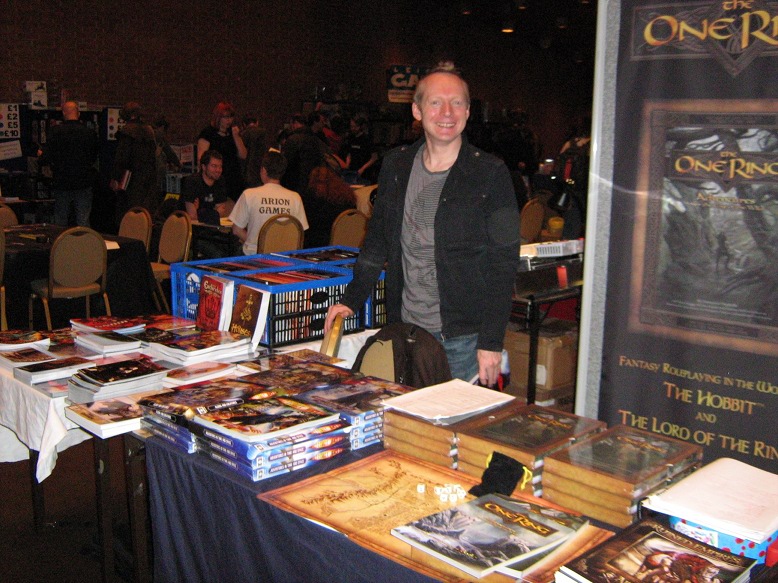
Starblazer and Anglerre author Chris Birch at the Cubicle 7 stand
It wouldn’t be Dragonmeet if I didn’t mention my swag haul. Sadly this year was one of omission: the Pavis supplement for HeroQuest 2 didn’t *quite* make it, despite me creating a special place for it under my Christmas tree and repeatedly praying to my insane gods well in advance. Jeff Richards and Dave Scott assured me it was in the final throes of layout and imminent indeed, and I was mollified by a handout detailing the Seven Mothers Cult, which I’m sifting through today. After the awesomely brilliant quality of Sartar: Kingdom of Heroes and the Sartar Companion by Moon Design, I’m really looking forwards to Pavis – and to opening up the New and Old Cities in the Praxian wastes for business again! More on that when I get my hot little hands on a copy.
So, swag. I got a copy of [BOARDGAME NAME REDACTED], a Christmas prezzie for the Brown Dirt Cowboy, which I’ll discuss post-Christmas, plus (at long last!) a copy of Fiasco, both from Mike, Sean, and the Good People at Leisure Games, who were also running a cool Dragonmeet sale. Leisure Games also took several copies of Mindjammer for the Leisure Games shop, so please support them and Cubicle 7 Fiction if you stop by!
Then, I managed to bag some Unspeakable Oaths, a copy of Ruined Empires for Airship Pirates, Gareth Hanrahan’s Black Bag Jobs for the Laundry, and some copies of the Mindjammer novel (two of which I subsequently sold down the pub! Dom – more please!). I also ordered the Savage Worlds edition of The Day After Ragnarok by the transdimensionally luminous Kenneth Hite, and also a PDF of the 3rd edition of Nobilis – the latter on a whim, and possibly to be followed by a dead-tree version! All in all a good haul, and I managed to dispense some of the hard-earned pennies I hadn’t spent on Pavis 🙂
One thing I must mention which I didn’t buy was Night’s Black Agents, another splendiferous disgorging from the feverish and conspiracy-filled multidimensionally haunted matrix of Kenneth Hite’s brain. This was at Dragonmeet in a special Dragonmeet edition, and looks absolutely excellent. It uses Robin D. Laws’ splendid Gumshoe system, and so far I’ve bought and enjoyed pretty much all the Gumshoe games; I’m looking forwards to getting my hands on the “Redacted” version of Night’s Black Agents shortly. I also had chance to chat with Ralf on the Profantasy stand, and admire Fractal Terrains 3. I held off buying for now, as I’ve recently changed over to Mac from PC, and need to puzzle my way through the WINE emulator before I start playing with Profantasy’s excellent mapmaking software again. Incidentally, the maps in the Mindjammer RPG book are all done with Profantasy’s stuff, and there’s even a Mindjammer style in Cosmographer 3 – cool beans!
I think that’s it! Shout-outs to everyone I met, and apologies to anyone I’ve not mentioned. Thanks to Angus Abranson and his awesome support team for organizing yet another excellent convention, and see you all again at Dragonmeet 2012!
Far Too Close to Reality to Resemble Credible Fiction?
A good friend of mine once received a rejection letter for a screenplay he’d written with the immortal line “This work is far too close to reality to resemble credible fiction”. I wish to hell I’d received that letter – what an awesome accolade! – but ever since it’s resonated with me as a terrible possibility whenever I read or write. Because it’s true: when you write fiction, you have to wrestle with the expectations of your reader – what that reader is prepared to accept as “realistic”, which often may have little to do with reality. Especially your own.
 A thousand years ago, no one would have believed a story about someone sailing round the world. Five hundred years ago, no one could have imagined you could travel around the world in a single day. A hundred years ago, no one could have conceived of a quantum world where cause and effect seem suddenly to have a far more casual relationship.
In short, the future is likely to be full of incredible things.
Arthur C. Clarke famously said that sufficiently advanced technology is indistinguishable from magic. I don’t think it’s that simple: even “magic” is subject to rules – a wizard has to cast a spell for it to happen, a teleportation device has to pretty much transport one person intact from A to B, an FTL spaceship has to arrive in the same condition as it left, and into the same universe. These are “credibility rules” which we have all internalised as 21st century human beings, and if a writer breaks them too egregiously, their writing won’t be considered believable.
So, how do you write about an incredible future, and keep it believable?
How about this: in every era, there’s a “cap” on how far you can stretch the credibility level of a fictional work. The era of H.G.Wells had its credibility cap; as did the era of Star Wars;and as does our own. In the dead of night, at the mythical “4 am Eternal”, I can stretch my brain to imagine futures I can barely articulate in words. At times like that, this “credibility cap” seems almost to be a problem of language – if only we had the words, expressing the concept would be easy.
 While it’s true that our hominid brains are absolutely not up to fathoming the weightiest truths of the universe – we are very limited creatures, after all – there is a conceptual space, just out of reach of language, which our understanding may aspire to. And all the time our brains are feverishly working to create the right conceptual tools to bootstrap our understanding to that next level.
Of course, “science” (in its loosest definition) does this all the time. “Scientists” are constantly defining new concepts, creating new words, talking about new ideas which no human being has ever talked about before – or even been able to talk about. And, if we’re lucky, science-fiction and speculative fiction sometimes participate in that dialectic: we receive concepts from science, jiggle about with them, expose them to the warpings and distortions of our 4am imagination, then return them to science badly mangled, as if to say,”Sorry, I bent your concept completely out of shape. Can you do anything with it?” And then – if we’re luckier still – science looks at the concept in another way, wipes the detritus of feverish imagination off it, and perhaps sees it in a new light.
So let’s say science is a language for a moment: it creates concepts and utterances to describe the world, but cannot “proscribe” the world. The world always exceeds the capacity of language, and the language of science, to confine, define, and express it. But, blunt though they are, language and science are the only tools we have. And they have within them the wonderful ability to overcome their own limitations, to constantly re-invent themselves, and to constantly aim to express the inexpressable, utter the unutterable.
That’s what I hope we’re doing when we read and write speculative fiction. Somewhere, out there, we hope, there is a single utterance, an ultimate tetragrammaton, which will remake the universe. And, if we all just keep remaking and stretching language and trying to say everything that can possibly be said, one day, perhaps, we will utter it. And the world will be transformed utterly.
I’m up for trying. Who’s with me?

- – Just after midnight on 9/11/11 (or 11/9/11) – this Wednesday – asteroid YU55 will pass close to earth inside the moon’s orbit – the closest approach ever for a body of this size.
- – Shortly after on 11/9/11, the USA will conduct its first ever nationwide test of its “Emergency Alert System”, in which the US government will take control of all US television and radio media. It’s unknown how this will affect the internet.
- – At the same time on 11/9/11, the UK will conduct emergency test drills at major nuclear power stations up and down the country.
- – The same day, and into Thursday, the UN will conduct “Exercise Pacific Wave 11” – a pacific tsunami warning and communications exercise.
- – The same day, a major new UN report by the International Atomic Energy Authority is expected to report on new developments in Iran’s attempts to manufacture nukes. Moscow has requested the report be “delayed at this time of tension”.
- – Morgan Freeman is revealed to be the same person as Barack Obama.
The above are all actual news events from this coming week. OK, maybe not that last one, but you get the picture… 😉
As anyone who knows me will attest, I’m a great fan of geopolitics and conspiracy theories, so much so that I’m often accused of blurring the lines between the two. I happen to believe that reality actually is a blurred mishmash of geopolitics and conspiracy theory. Regardless, it’s a cool way of thinking if you’re looking to generate plots.
When I first read Pushkin’s verse novel “Eugene Onegin”, I was utterly bowled over by how Pushkin had succeeded in creating a linear assembly of overtly unrelated short poems, only to use stanza structure and metre to encourage the reader to see those separate poems as belonging together. From there, Pushkin’s job was done: the reader himself would then go to great lengths to perceive those individual stanzas as belonging to a common plot – the reader would “write the novel” himself, as he read the poems. Awesome!
I still find that approach everywhere in life today – the desire to create patterns out of seemingly unrelated material is perhaps a defining human quality. That’s why I love geopolitics and conspiracy theories so much: sometimes events in the world actually *are* related – they don’t just seem so. And trying to piece together all these events is where the great fun of creating a coherent narrative lies.
This week’s post is partly just a bit of fun for my fellow tinfoil hat-wearing comrades. I’ve been doing my usual surfing of the less respectable news sites on the internet this week, as they’re great arenas for amazing concatenations of seemingly unrelated events into what look like great, globe-spanning conspiracies. And I picked out the above discrete, apparently unrelated events. Maybe Pushkin would approve – if the Father of Russian Verse were a tinfoil hat-wearing conspiracy theorist with a penchant for melodrama. (Hey, two out of three ain’t bad…)
So… 11/9/11… I’ve written my blockbuster novel from this week’s events. Have you? 😛














 Sarah Newton